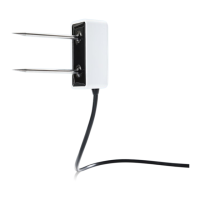
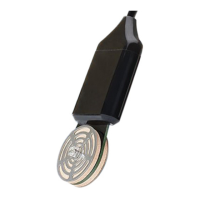
The TEROS 12 is a soil moisture, electrical conductivity (EC), and temperature sensor designed for installation in mineral soils, various growing media, and other porous materials. It measures volumetric water content (VWC), soil/substrate water balance, irrigation management, soil EC, soil/substrate temperature, and solute/fertilizer movement.
Function Description
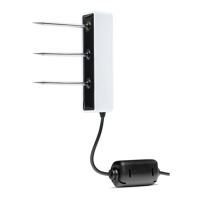
The TEROS 12 sensor utilizes an electromagnetic field to measure the dielectric permittivity of the surrounding medium. It supplies a 70-MHz oscillating wave to its stainless steel needles, which charge according to the dielectric of the material. The charge time is proportional to the substrate's dielectric and VWC. A microprocessor in the TEROS 12 measures this charge time and outputs a raw value based on the substrate dielectric permittivity. This raw value is then converted to VWC using a calibration equation specific to the substrate. The sensor measures soil moisture between Needle 1 and Needle 2.
Temperature readings are taken by a thermistor embedded in Needle 2. This feature is particularly important for measurements near the surface where temperature changes occur more rapidly. The sensor's output temperature is typically in degrees Celsius.
Electrical conductivity (EC) is measured by applying an alternating electrical current to two electrodes (Needle 2 and Needle 3) and measuring the resistance between them. Bulk EC is derived by multiplying the inverse of the resistance (conductance) by the cell constant. The TEROS 12 sensor's bulk EC measurements are normalized to EC at 25 °C. This measurement provides an indication of the amount of ions present in the solution. The sensor is capable of converting bulk EC to pore water EC, which is a good indicator of solute concentration in the soil pores. This conversion is achieved by leveraging the linear relationship between the soil bulk dielectric permittivity and bulk EC, as the TEROS 12 measures both nearly simultaneously in the same soil volume.
A ferrite core, positioned on the sensor cable 7.6 cm (3 in) away from the sensor head, isolates the sensor from system interferences, mitigating potential noise on the measured data.
Usage Features
The TEROS 12 is designed for continuous reading with a data logger or periodic reading with a handheld reader, making it ideal for permanent burial in soil due to its low power requirement.
For installation, users should first determine the best method, such as borehole or trench installation. The borehole method, which minimizes soil disturbance, often requires a specialized Borehole Installation Tool (BIT) for depths greater than 50 cm. The trench method is suitable for shallow installations (less than 40 cm) and does not require specialized equipment, though it results in greater soil disturbance. Regardless of the method, it is crucial to avoid placing any metal between the sensor and the ferrite core, as this can interfere with VWC measurements. Users should also avoid large objects like roots or rocks that could bend the needles. Minimizing air gaps around the sensor needles is critical for accurate soil moisture readings. When installing, the soil closest to the sensor has the strongest influence on readings, so installing the sensor in native soil is ideal. The sensor can be positioned with needles aligned horizontally or vertically; horizontal alignment provides the least restriction to water flow. After insertion, the hole should be backfilled, packing the soil back to its native bulk density, taking care not to hit the ferrite core.
The TEROS 12 works most efficiently with METER ZENTRA, EM60, or Em50 data loggers, connecting via a 3.5-mm stereo plug connector. METER data loggers automatically recognize TEROS sensors. ZENTRA Utility software (desktop and mobile application) or ZENTRA Cloud (web-based) can be used to configure measurement intervals and verify sensor identification and readings. For non-METER data loggers, the sensor can be connected using stripped and tinned (pigtail) wires, with specific connections for power, data, and ground. The acceptable excitation voltage range is 4 to 15 VDC. The sensor communicates using DDI serial string or SDI-12 communication protocol.
Cables should be secured and protected with PVC casing or flexible conduit to prevent damage. Excess cable should be gathered and secured to the mounting mast, and cable strain should be relieved by leaving a little slack between the logger and the closest secured point to allow for thermal expansion and contraction.
Maintenance Features
To ensure accurate EC readings, especially in salty soils with bulk EC greater than 10 dS/m, it is necessary to clean the sensor needles if they become contaminated with oils from skin contact or other sources. Cleaning involves using a mild detergent (like liquid dish soap, avoiding lotions or moisturizers) and a nonabrasive sponge or cloth on each needle, followed by thorough rinsing with tap or deionized (DI) water. It is important not to touch the needles with ungloved hands or bring them into contact with any source of oil or nonconducting residue after cleaning.
The TEROS 12 comes with generic calibration equations for mineral soils and soilless media. For higher accuracy, performing media-specific calibrations is recommended. If a stereo plug connector is damaged, it can be replaced with a replacement connector and splice kit. For damaged cables, guidelines for wire splicing and sealing techniques should be followed. Troubleshooting steps are provided for common issues such as the sensor not responding (checking power, cable integrity, and wiring) or reading too low/high (checking for air gaps, appropriate calibration equation, and inherently high dielectric permittivity of the substrate).


 To Next Page
 General