00,000
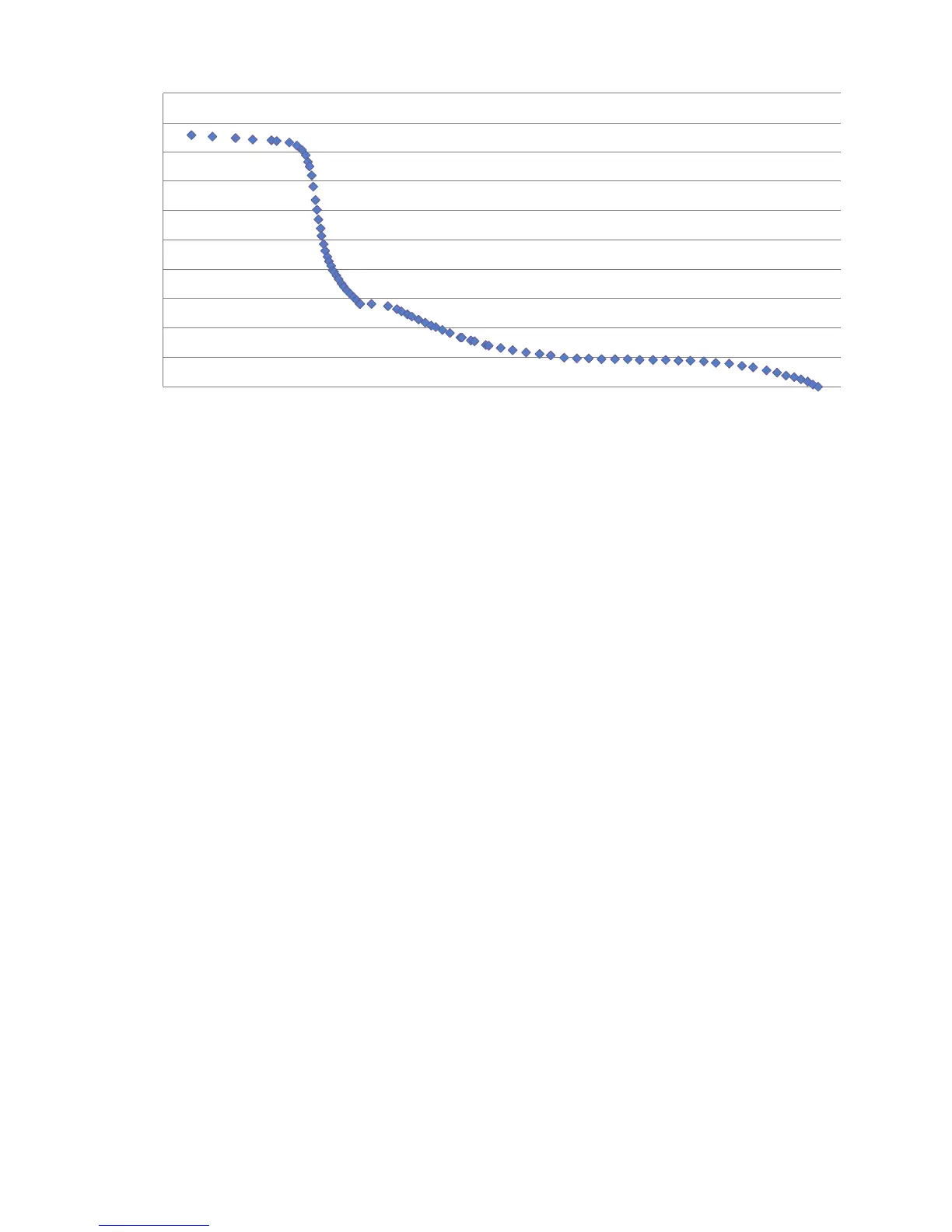
WATER POTENTIAL (-kPa)
GRAVIMETRIC WATER CONTENT
Moisture characteristic curve of TEROS 21 ceramic derived from mercury porosimeter data
As the sensor dries past the plant-available range, the total pore volume that drains at
a given water potential decreases. At these low water potentials, the measured water
potential can become somewhat noisy because small changes in measured water content
of the ceramic translate into large changes in water potential. This phenomenon is most
pronounced when the sensor is air dry. It is expected that the measured water potential of an
open air and dry sensor can jump around throughout the range of −50,000 to −100,000 kPa.
The noise level is much lower when the sensor is installed in the soil, even at air-dry
waterpotential.
The air entry potential of the largest pores in the ceramic is about −9 kPa. However, the
ceramic disc must have access to air for the large pores to begin draining and the response
of the sensor to change. If the soil around the sensor has an air entry potential lower (drier)
than −9 kPa, the ceramic will not begin to lose water until reaching the air entry potential
of the soil. In this scenario, the air entry potential of the soil limits the wet-end range,
rather than the ceramic discs themselves. The sensor may not begin to respond until lower
water potentials (−10 kPa). This is generally only an issue when using the sensor in poorly
structured soils with high clay content.


 To Next Page