12
SYSTEM
3.3.3 MEASUREMENT ACCURACY
TEROS 21 is calibrated at a saturated state (0 kPa), at an air-dry state (−100,000 kPa), and at
three calibration points between 0 and −100 kPa, resulting in accuracy of ±(10% of reading +
2 kPa) over the range of −9 to −100 kPa.
At water potentials drier than −100 kPa, TEROS 21 relies on the linear relationship between
the logarithm of water content and the logarithm of water potential. Laboratory evaluations
have shown good accuracy and low sensor-to-sensor variability to at least −1,500 kPa (plant
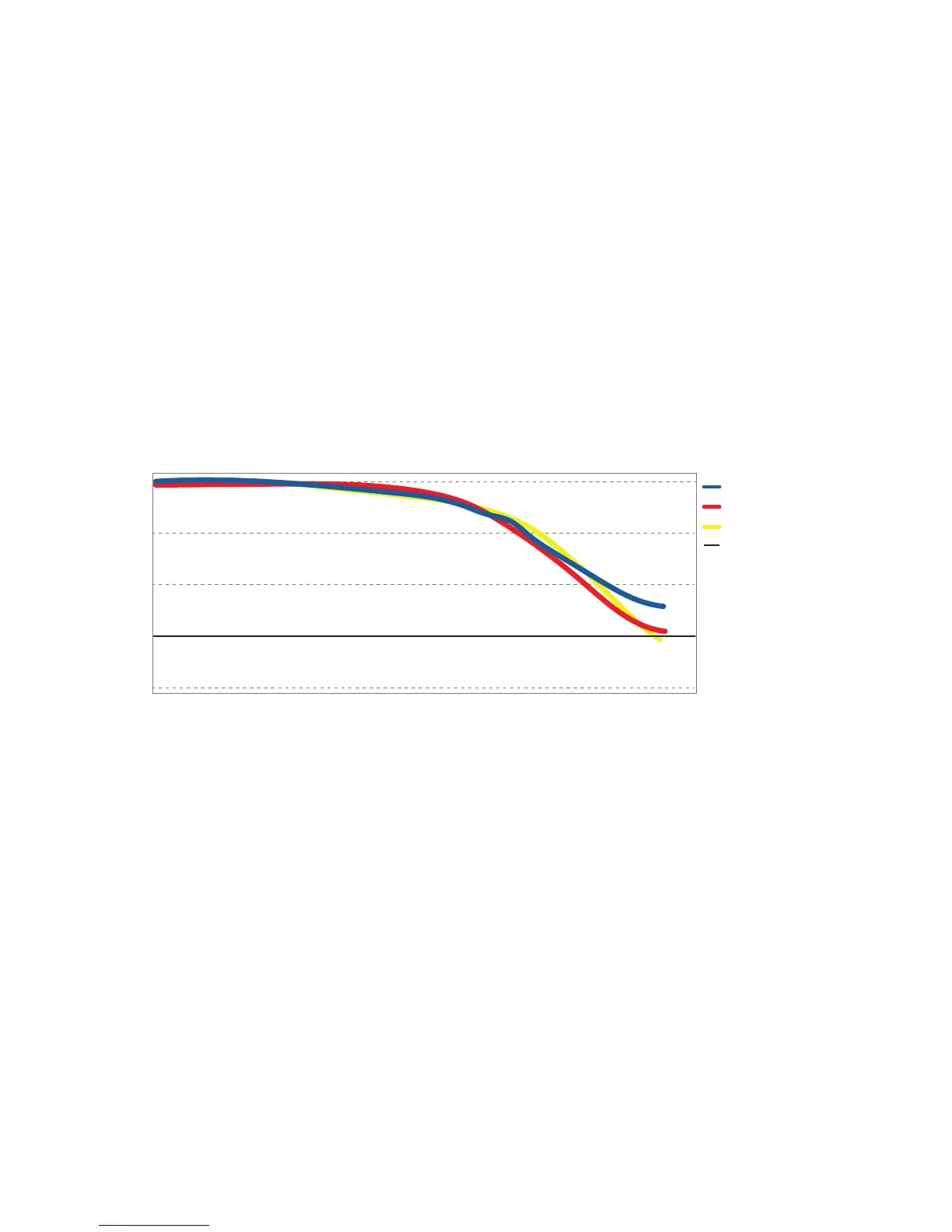
permanent wilting point). Field evaluations have shown low sensor-to-sensor variability to
−2,000 kPa (Figure5 and Figure6).
NOTE: METER strongly discourages dry-end calibrations in the pressure plate apparatus. Early attempts to improve
sensor dry-end performance in the pressure plate apparatus actually decreased accuracy, likely because of pressure
plate dry-end equilibrium issues pointed out in the literature (e.g., Campbell [1998], Gee et al. [2002], Bittelli and Flury
[2009], and Frydman and Baker [2009]).
−2,000.0
−1,500.0
−1,000.0
−500.0
0.0
Time series TEROS 21 water potential data collected at 80 cm depth
under a beech forest in Switzerland (Walthert, 2013). Note the good sensor


 To Next Page