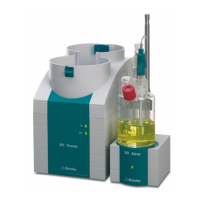
The Metrohm 719 S Titrino is a titrator designed for fast and precise endpoint titrations. It features an internal method memory pre-loaded with ready-to-start methods for common applications. Users can modify, overwrite, or create and store their own titration sequences. Data exchange with a PC is possible using Metrodata VESUV Software and Metrodata TiNet Software, enabling complete remote control, data acquisition, and evaluation via PC.
Function Description
The 719 S Titrino operates through various modes: SET (Endpoint Titration), CAL (pH Calibration), and MEAS (Measuring). The device allows for extensive remote control via an RS232 interface, enabling external controllers to send and receive data. Commands are structured hierarchically, allowing users to query and modify object values. Triggers initiate actions like starting processes or sending data. Status messages provide information on the Titrino's current activity, including global and detailed status conditions, as well as error messages.
Important Technical Specifications
Modes: SET (Set Endpoint Titration), MEAS (Measurement), CAL (pH calibration).
Measuring Inputs: Two high-impedance inputs for pH, redox, and ISE electrodes; one reference input for a separate reference electrode (can also be used as a differential amplifier); one input for polarized electrodes; one input for temperature sensor Pt100 or Pt1000.
Polarizer: Ipol (0...±127 µA, resolution 1 µA), Upol (0...±1270 mV, in steps of 10 mV).
Measuring Amplifier (at 25 °C and Titrino warmed-up): Input resistance >10^13 Ω, Offset current <3∗10^-13 A, Deviation of offset voltage 15 µV/K.
Dosification: Buret cylinder volumes of 1, (2), 5, 10, 20, or 50 mL; 10,000 steps per buret cylinder resolution; one internal titrating buret; two auxiliary burets (776 or 765 Dosimat).
Analog Output: -2000...2000 mV, 1 mV (12 Bit) resolution, signal depending on preselection (U, dU/dt, V, dV/dt, U(rel), T).
RS232 Interface: Data interface according to RS 232C standard, adjustable transfer parameters (baud rate 300-9600, data bit 7 or 8, stop bit 1 or 2, parity even/odd/none, handshake HWs/HWf/SWline/SWchar/none). Max. line length 512 characters, max. cable length approx. 15 m.
Remote Input/Output Lines: For Sample Changer, robot connection, etc.
Internal Memory: Method memory for up to 100 methods, data bank with 4 Metrohm methods, silo memory for sample data and results.
Display: LCD, 2 lines of 24 characters each, 5 mm character height, LED back-lit.
Ambient Temperature: Nominal operation range 5...40 °C, storage –20...60 °C, transport –40...60 °C.
Mains Connection: Voltage 100, 117, 220/230, 240 V (switchable); Frequency 50...60 Hz; Power consumption 15 W; Thermal fuse.
Dimensions (with Exchange Unit): Width 150 mm, Height 450 mm, Depth 275 mm.
Weight (incl. keypad): Approx. 3.6 kg.
Usage Features
Keypad Operation: The device features a keypad for data input, mode selection, parameter setting, and method management. Third functions on keys are used for formula entry.
Data Input: Data is entered through menus, with values stored by pressing . Special values can be selected using
Text Input: A text writing mode allows for entering method names or other text, with options to select characters and correct typing errors.
Method Management: Methods can be stored, loaded, and deleted from the internal memory.
pH Calibration: Supports 1-point or 2-point calibration, with automatic temperature compensation if a sensor is connected.
Statistics: Enables calculation of mean values and standard deviations for consecutive determinations, with options to view, print, and delete individual results.
Silo Memory: Stores sample data (method, identifications, sample size) using a FIFO (First In, First Out) principle, useful for automatic sample addition systems. Data cycling can be enabled to copy processed lines to the end of the silo memory.
Control Parameters: Parameters like endpoint, dynamics, maximum/minimum dosing rates, and stop criteria can be set for each endpoint to optimize titration speed and accuracy.
Data Output: Various reports (full, short, parameter, calculation, calibration, form feed) can be printed automatically at the end of a determination or on demand.
Remote Control: Full control via RS232 interface, allowing for querying and modifying object values, initiating processes, and receiving status and error messages.
Maintenance Features
Diagnosis Program: A built-in diagnostic program helps identify and troubleshoot malfunctions. It includes tests for display, keypad, cylinder code, date/time, analog output, analog input (highly insulated measuring inputs, Pt100/1000 connection, polarizer), external inputs/outputs, and RS232 interface.
RAM Initialization: In case of a system crash, the RAM area can be initialized, clearing stored user data but retaining basic instrument data.
Spindle Drive Release: Instructions are provided for releasing a locked spindle with an inserted Exchange Unit, involving disconnecting power, removing the control knob, and accessing internal components.
Error Messages: The device provides specific error messages (E20-E45, E120-E137) to guide troubleshooting, covering issues like exchange unit, electrode, T-sensor, calculation, stop conditions, silo memory, and RS232 communication.
GLP/Validation: The instrument is designed to meet GLP/ISO 9001 requirements, with documentation available for installation qualification (IQ) and operational qualification (OQ).
Warranty: A 12-month warranty covers material, design, or manufacturing faults, with specific conditions for day/night operation and exclusions for glass breakage. Proper packaging is required for returns to avoid transport damage liability.

 Need help?
 General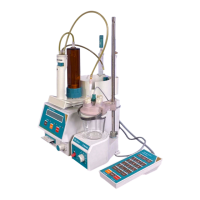




 To Next Page