
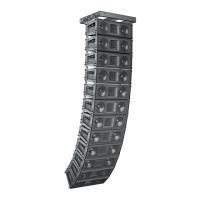
 Need help?
Do you have a question about the Meyer Sound UltraCompact High-Power Curvilinear Array Loudspeaker M'elodie and is the answer not in the manual?
 General
| Brand | Meyer Sound |
|---|---|
| Model | UltraCompact High-Power Curvilinear Array Loudspeaker M'elodie |
| Category | Speakers |
| Language | English |
Guidance on interpreting manual elements like notes, tips, and cautions.
Details on the drivers, horn, and REM manifold in the M'elodie design.
Explains the self-powered design, 3-channel amplifier, and control circuitry.
Focuses on the QuickFly rigging for ease of transport and setup.
How M'elodie integrates with other Meyer Sound products for complete systems.
Guidelines for connecting to AC power sources and grounding.
Instructions on how to connect multiple loudspeakers using PowerCon connectors.
Details on AC cable color coding and proper wiring.
Acceptable voltage ranges and how the power supply handles variations.
Information on current draw, looping capabilities, and breaker ratings.
Critical safety warnings related to power, grounding, and circuit breakers.
Details on input impedance, connectors, and wiring for audio signals.
Information on the amplifier modules, power output, and driver protection.
How drivers are powered and specifications for driver replacement.
Description of cables used for AC, signal, and RMS data.
Explanation of low- and high-frequency limiter functions and LEDs.
How the amplifier modules are cooled and thermal behavior indicators.
Overview of the RMS module components and their functions.
Description of the RMS software graphical interface and data display.
Principles of constructive and destructive interference in line arrays.
How M'elodie drivers and REM technology achieve coverage and directivity.
Key factors for designing line array systems: elements, splay, coverage.
Strategies for high-frequency coverage using splay angles and element count.
Achieving directionality at low frequencies through array length and coupling.
Techniques for EQ and zoning arrays for optimal performance.
Integration of M'elodie with MICA systems for specific array roles.
How Galileo and LD-3 processors aid in array optimization and integration.
Considerations for using external DSPs with M'elodie systems.
Guidelines for integrating M'elodie with 700-HP and 600-HP subwoofers.
Overview of MAPP Online Pro for acoustical prediction and system design.
Introduction to the SIM 3 analyzer for system measurement and alignment.
Explanation of the SIM 3's unique measurement methodology.
Various uses of the SIM 3 analyzer for system testing and alignment.
Description of the captive QuickFly rigging hardware and its features.
Specifics on the function and use of the front GuideALinks.
Details on the grid for flying and ground-stacking M'elodie arrays.
How to use the grid for secure ground-stacking configurations.
Use of the frame for integrating M'elodie with MICA or subwoofers.
Information on the caster frame for transporting M'elodie stacks.
Step-by-step instructions for attaching the rain hood.
Diagram and explanation of VEAM connector wiring for power.
Detailed acoustical performance data like frequency response and SPL.
Specifications for low/mid and high-frequency drivers.
Technical details on audio input type, impedance, and wiring.
Information on amplifier type, output power, and load capacity.
Details on AC power connector, voltage selection, and current draw.
Enclosure, finish, rigging, dimensions, and weight of the loudspeaker.


 To Next Page