EasyManua.ls Logo

MFJ MFJ-1886 - Site Selection; Telescoping Mast; Side of House Mounting; Tower

MFJ MFJ-1886
8 pages
Print Icon
To Next Page IconTo Next Page
To Previous Page IconTo Previous Page
Loading...
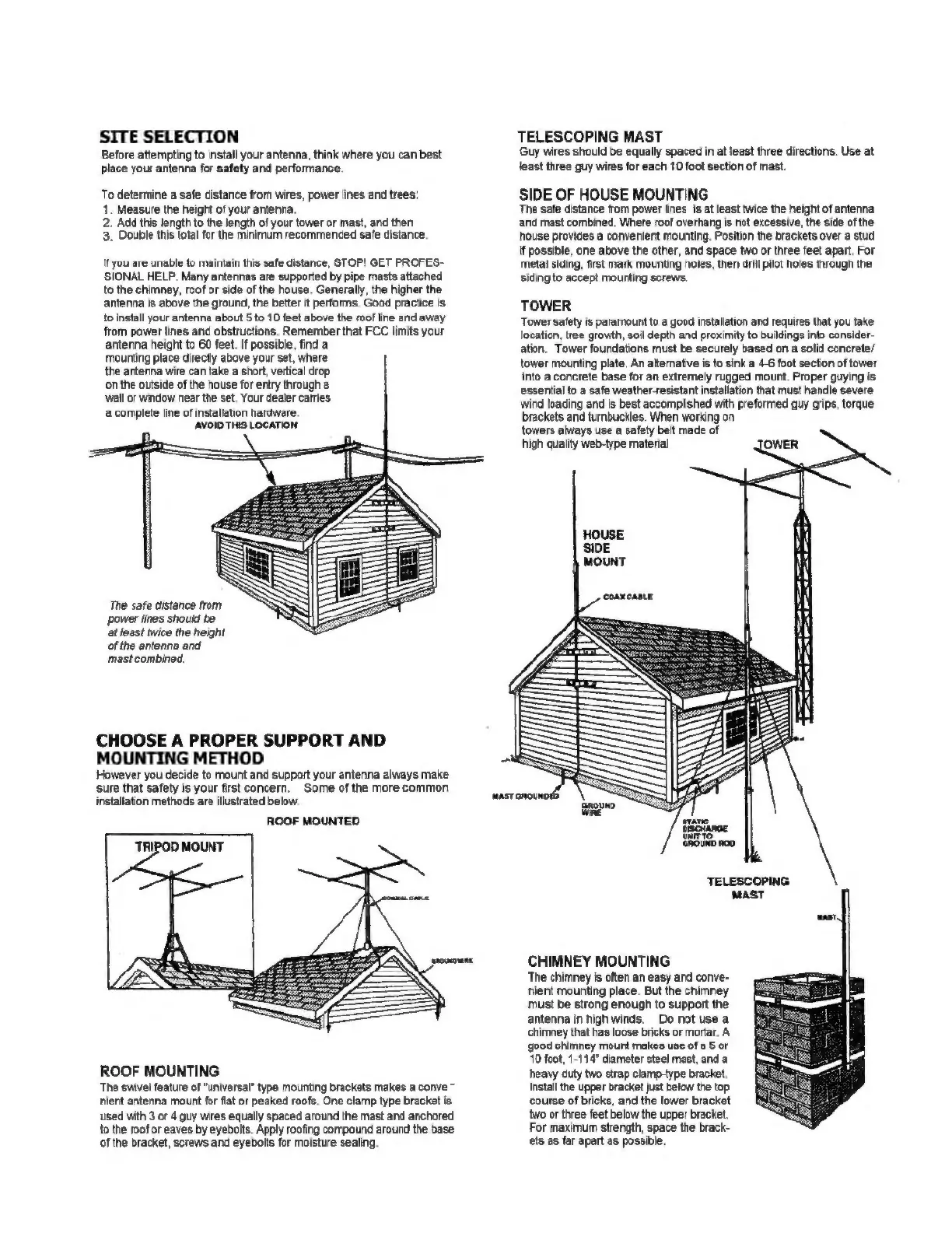
SITE
SELECTION
Before
attempting
to
install
your
antenna,
think
where
you
can
best
place
your
antenna
for
safety
and
performance.
To
determine
a
safe
distance
from
wires,
power
lines
and
trees:
1,
Measure
the
height
of
your
antenna.
2.
Add
this
length
to
the
length
of
your
tower
or
mast,
and
then
3.
Double
this
total
for
the
minimum
recommended
safe
distance.
f
you
are
unable
to
maintain
this
safe
distance,
STOP!
GET
PROFES-
SIONAL
HELP.
Many
antennas
are
supported
by
pipe
masts
attached
to
the
chimney,
roof
or
side
of
the
house.
Generally,
the
higher
the
antenna
is
above
the
ground,
the
better
it
performs.
Good
practice
is
to
install
your
antenna
about
5
to
10
feet
above
the
roof
line
and
away
from
power
lines
and
obstructions.
Remember
that
FCC
limits
your
antenna
height
to
60
feet.
If
possible,
find
a
mounting
place
directly
above
your
set,
where
the
antenna
wire
can
take
a
short,
vertical
drop
on
the
outside
of
the
house
for
entry
through
@
wall
or
window
near
the
set.
Your
dealer
carries
@
complete
line
of
installation
hardware.
AVOIDTHIS
LOCATION
power
lines
should
be
at
least
twice
the
height
of
the
antenna
and
mast
combined.
CHOOSE
A
PROPER
SUPPORT
AND
MOUNTING
METHOD
However
you
decide
to
mount
and
support
your
antenna
always
make
‘sure
that
safety
is
your
first
concern.
Some
of
the
more
common
installation
methods
are
illustrated
below.
ROOF
MOUNTED
ROOF
MOUNTING
The
swivel
feature
of
"universal"
type
mounting
brackets
makes
a
conve
~
nient
antenna
mount
for
flat
or
peaked
roofs.
One
clamp
type
brackat
is
used
with
3
or
4
guy
wires
equally
spaced
around
the
mast
and
anchored
to
the
roof
or
eaves
by
eyebolts.
Apply
roofing
compound
around
the
base
of
the
bracket,
screws
and
eyebolts
for
moisture
sealing.
TELESCOPING
MAST
Guy
wires
should
be
equally
spaced
in
at
least
three
directions.
Use
at
least
three
guy
wires
for
each
10
foot
section
of
mast.
SIDE
OF
HOUSE
MOUNTING
The
safe
distance
from
power
lines
is
at
least
twice
the
height
of
antenna
and
mast
combined.
Where
roof
overhang
is
not
excessive,
the
side
of
the
house
provides
a
convenient
mounting,
Position
the
brackets
over
a
stud
if
possible,
one
above
the
other,
and
space
two
or
three
feet
apart.
For
metal
siding,
first
mark
mounting
holes,
then
drill
pilot
holes
through
the
siding
to
accept
mounting
screws.
TOWER
Tower
safety
is
paramount
to
a
good
installation
and
requires
that
you
take
location,
tree
growth,
soil
depth
and
proximity
to
buildings
into
consider-
ation,
Tower
foundations
must
be
securely
based
on
a
solid
concrete/
tower
mounting
plate,
An
alternative
is
to
sink
a
4-6
foot
section
of
tower
into
a
concrete
base
for
an
extremely
rugged
mount.
Proper
guying
is
essential
to
a
safe
weather-resistant
installation
that
must
handle
severe
wind
loading
and
is
best
accomplished
with
preformed
uy
arips,
torque
brackets
and
tumbuckles.
When
working
on
towers
always
use
a
safety
belt
made
of
high
quality
web-type
material
CHIMNEY
MOUNTING
The
chimney
is
often
an
easy
and
conve-
nient
mounting
piace.
But
the
chimney
must
be
strong
enough
to
support
the
antenna
in
high
winds.
Do
not
use
a
chimney
that
has
loose
bricks
or
mortar.
A
good
chimney
mount
makes
use
of
a
5
or
10
foot,
1-114"
diameter
steel
mast,
and
a
heavy
duty
two
strap
clamp-type
bracket.
Install
the
upper
bracket
just
below
the
top
course
of
bricks,
and
the
lower
bracket
two
or
three
feet
below
the
upper
bracket.
For
maximum
strength,
space
the
brack-
ets
as
far
apart
as
possible,

Related product manuals