MFJ-962E Instruction Manual
3
reactance loads. T-network tuners always handle the least power when operated on 160 meters
into low impedance capacitive reactive loads.
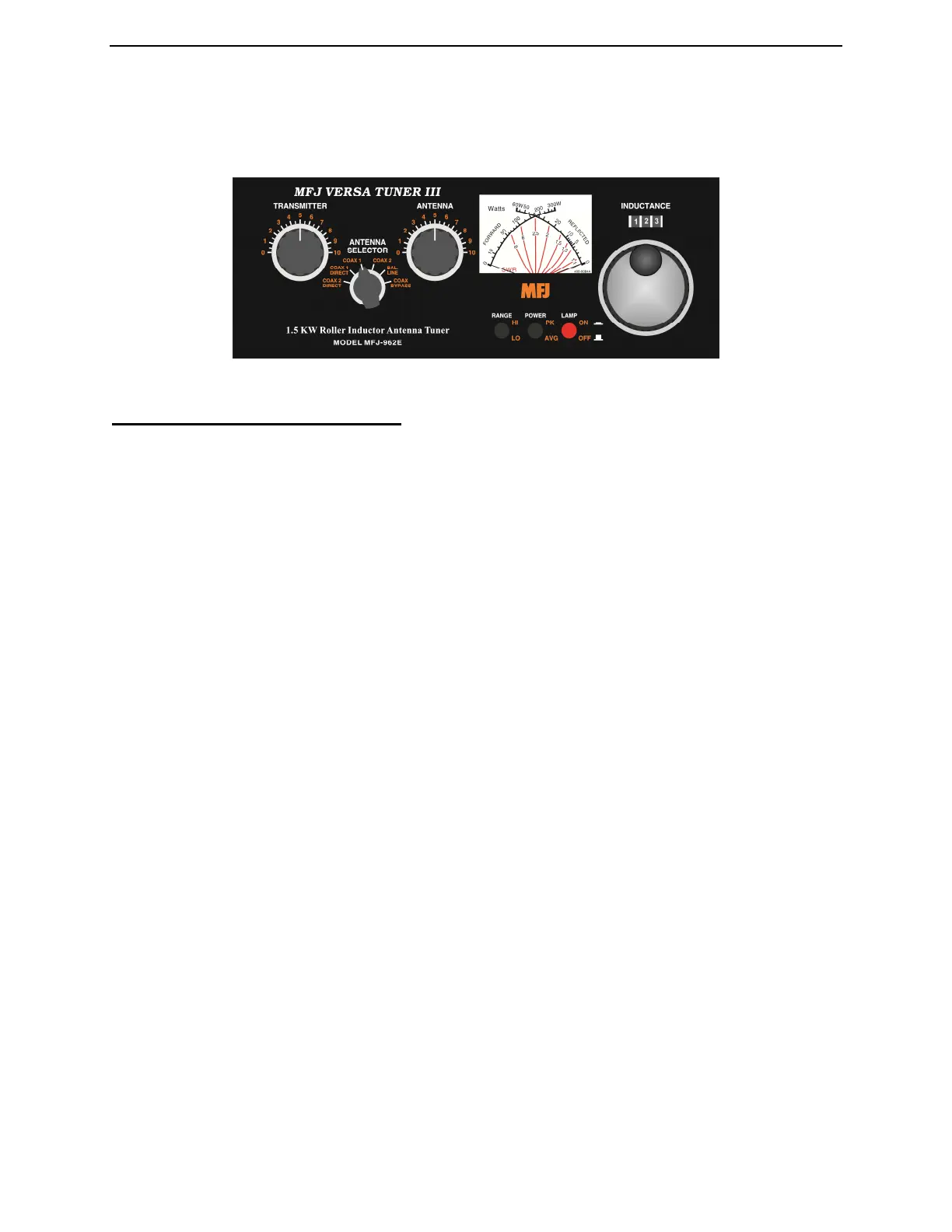
Front Layout
Figure 1
Peak Reading SWR/Wattmeter
The cross-needle meter measures the peak or average FORWARD power, REFLECTED
power, and SWR. The illuminated cross-needle meter operates with the antenna tuning circuit in
or out of line. The wattmeter can be used without the tuning network by setting the ANTENNA
SELECTOR to either of the two COAX DIRECT positions of the antenna selector or the
BYPASS position. The wattmeter is active in all positions of the ANTENNA SELECTOR.
The meter's full scale forward and reflected power range is controlled by the left POWER switch
that selects 3000W (HI) or 300W (LO). If your transmitter runs more than 300 watts of output
power, set this switch to the 3000W HI (in) position. If your transmitter has less than 300 watts
of output, set this switch to the 300W LO switch position (out).
Peak envelope power (PEP) is measured when the PEAK or AVG POWER push button (right-
hand side) in placed in the PEAK (in) position. Peak power and average power values are equal
with steady unmodulated carriers, FSK, or FM. The meter reading on these modes will be the
same whether the PEAK / AVG button is pressed or released. On SSB, the PEP meter reading
should be twice the average power with two tone test modulation.
On SSB, the ratio of PEP to average power varies with different voice characteristics. With most
voices, the PEP reading is three to five times higher than the average voice power reading. The
most accurate peak envelope power readings are obtained only with sustained carrier, voice or
two tone test modulation.
Forward power is displayed on the left-hand FORWARD meter scale. This scale is calibrated
from 0 to 300 watts and is read directly in the 300 watt position. Each picket (scale mark)
represents 5 watts below 10 watts, 10 watts between 10 and 100 watts, 25 watts above 100 to
200 watts, and 50 watts above 200 watts. In the 3000W (HI) position the forward power scale
must be multiplied by 10. Each picket represents 100 watts below 1000 watts and 250 watts
from 1000 to 2000 watts, and 500 watts above 2000 watts.



 To Next Page