Update Documentation P341/EN AD/F43
MiCOM P341
(AD) -45
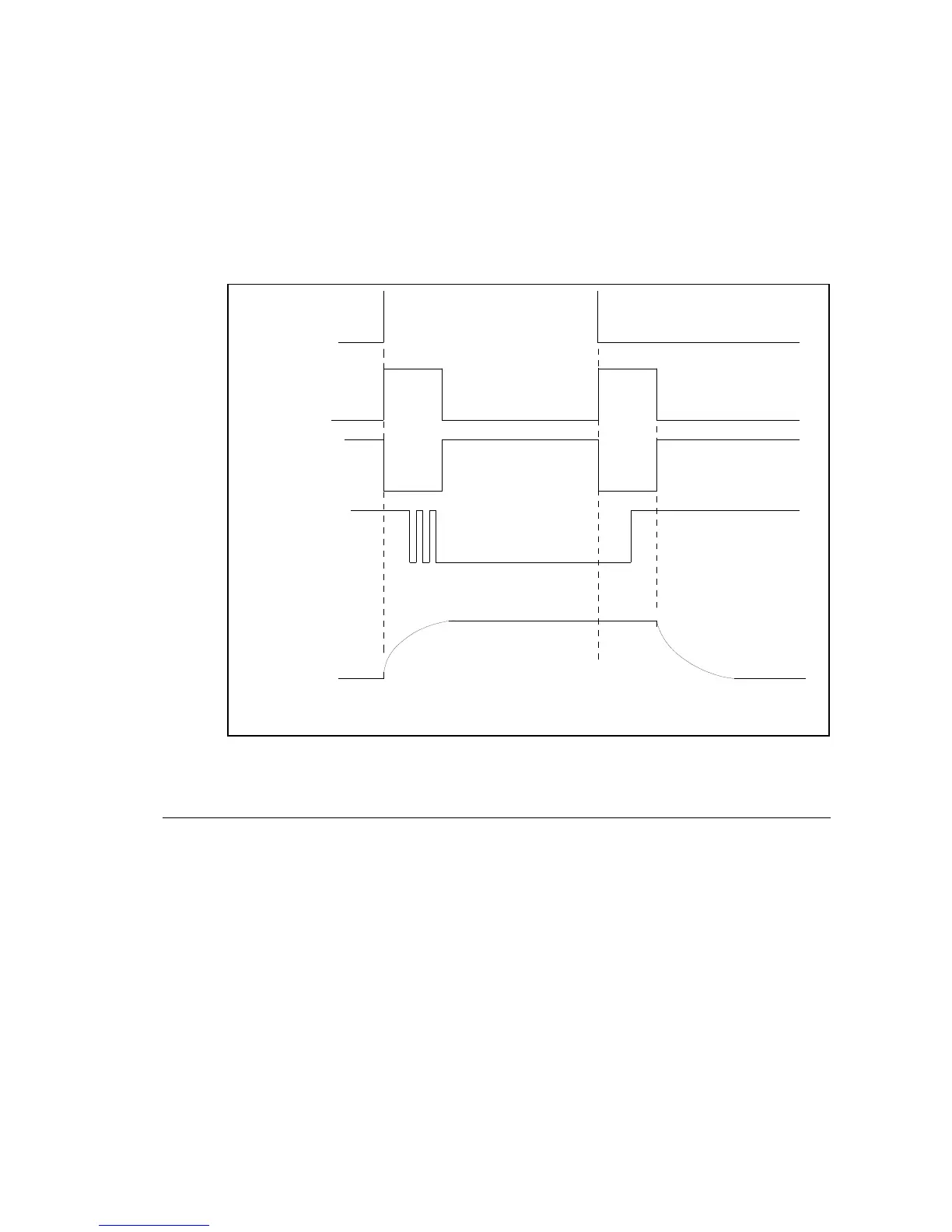
When there is a control input command to operate an output contact the miniature relay is
operated at the same time as the SSD. The miniature relay contact closes in nominally 3.5
mS and is used to carry the continuous load current; the SSD operates in <0.2ms and is
switched off after 7.5mS. When the control input resets to open the contacts, the SSD is
again turned on for 7.5mS. The miniature relay resets in nominally 3.5ms before the SSD
and so the SSD is used to break the load. The SSD absorbs the energy when breaking
inductive loads and so limits the resulting voltage surge. This contact arrangement is for
switching dc circuits only. As the SSD comes on very fast (<0.2ms) then these high break
output contacts have the added advantage of being very fast operating.
3.5ms + contact bounce
load current
relay contact
databus
control input
MOSFET reset
MOSFET operate
on
7ms
on
3.5ms
closed
on
7ms
off
P1981ENa
Figure 3: High break contact operation
2.4.3.1 High break contact ap
plications
1) Efficient scheme engineering
In traditional hardwired scheme designs, high break capability could only be achieved using
external electromechanical trip relays. External MVAJ tripping relays can be used or the
new high break contacts inside MiCOM relays can be used – reducing panel space.
2) Accessibility of CB auxiliary contacts
Common practice is to use circuit breaker 52a (CB Closed) auxiliary contacts to break the
trip coil current on breaker opening, thus easing the duty on the protection contacts. In
cases such as operation of disconnectors, or retrofitting, it may be that 52a contacts are
either unavailable or unreliable. High break contacts can be used to break the trip coil
current in these applications.



 To Next Page