Need help?
Do you have a question about the Microgate SyncLink and is the answer not in the manual?
Defines RS-232/V.28 voltage ranges, cable length, and data rate.
Details RS-422/RS-485/V.11 voltage ranges, cable length, and data rate.
Explains clock polarity for RS-232/V.28 signals.
Explains clock polarity for RS-422/RS-485/V.11 signals.
Details RS-232 signal mapping to HD-26 and DB-25 connectors.
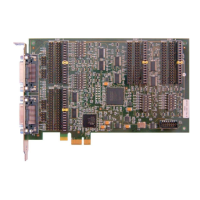
The SyncLink PCIe Serial Adapter is an add-in card designed to expand the serial communication capabilities of systems equipped with PCI Express expansion slots. This device provides two serial ports, enabling a wide range of serial protocols and interface standards to be utilized by the host system. It's a versatile solution for applications requiring robust and flexible serial connectivity.
The primary function of the SyncLink PCIe Serial Adapter is to facilitate synchronous and asynchronous serial communications. It acts as a bridge between the high-speed PCI Express bus of a computer and various serial devices, supporting a broad spectrum of communication protocols. The card incorporates a MicroGate FPGA serial controller, which is central to its operation, managing the two serial ports and handling data transfer.
The adapter is capable of high-speed data transfer, supporting a maximum speed of 10Mbps. It can handle a variety of protocols including SDLC, HDLC, BISYNC, MONOSYNC, ASYNC, raw bit-synchronous, and TDM/McASP. This extensive protocol support makes it suitable for diverse industrial, telecommunications, and data acquisition applications.
A key feature is its ability to perform DPLL Clock Recovery, with options for x8 and x16 sampling, ensuring reliable data synchronization even in challenging environments. The card also includes its own clock generation capabilities, providing precise timing for serial communications. For data integrity, it offers selectable hardware CRC (Cyclic Redundancy Check) with options for CRC-16, CRC-32, or no CRC, allowing users to balance error detection needs with performance.
The adapter supports configurable transmit preamble and idle patterns, which are crucial for establishing and maintaining synchronous communication links. It also offers various encoding schemes such as NRZ, NRZB, NRZ-L, NRZI, NRZ-M, NRZ-S, FM0, FM1, Manchester, and differential biphase level, providing flexibility to interface with different serial devices.
The serial interface type and input termination can be selected either through switch settings on the card or via software. This adaptability allows the card to support multiple electrical standards, including RS-232, V.35, RS-422/485, RS-530, RS-449, and X.21. For differential inputs, optional termination can be enabled, which is important for signal integrity over longer cable runs. The card provides a full set of control and status signals (DTR, DSR, RTS, CTS, DCD, RI, LL, RL), giving users comprehensive control and monitoring capabilities over their serial connections.
The SyncLink PCIe Serial Adapter is designed for ease of integration and flexible usage. It is compatible with any PCI Express slot size (x1, x4, x8, or x16), making it adaptable to various system configurations. The card is keyed to prevent incorrect insertion into incompatible PCI or PCI-X slots, ensuring proper installation.
For connectivity, the card features two high-density 26-pin D-SUB male connectors (HD-26). Adapter cables are included with the card to convert these HD-26 connectors into standard DB-25 male connectors, which are widely used in serial communications. This allows for immediate connection to many existing serial devices. For interface types that use connectors other than DB-25 (such as V.35, RS-449, or X.21), additional adapter cables are available, providing a comprehensive solution for various physical interfaces.
The serial interface type and input termination are configurable through an 8-position DIP switch on the card, with four positions dedicated to each port. Users can select between software control, RS-232, V.35, or RS-530/422/485. When "software select" is chosen, the interface remains disabled until configured via an API call, offering dynamic control. Other selections fix the interface type, preventing software modification and ensuring a stable configuration. The TERM switch on the card controls the 120-ohm termination for differential inputs. If the serial interface is software-selected, the TERM switch is ignored, and termination is managed through software. This dual control mechanism provides both hardware-level stability and software-level flexibility.
The card also includes a 14-pin header (J2) that provides 12 general-purpose input/output (GPIO) signals (GPIO[0] to GPIO[11]). These GPIO signals can be configured as either inputs or outputs and are controlled and monitored through the serial API. This feature allows for application-specific control and monitoring, enhancing the card's utility in custom systems. The GPIO signals are 3.3V TTL compatible and 5V tolerant for inputs, offering robustness in various interfacing scenarios.
A frequency synthesizer is integrated into the card, providing a base clock for the baud rate generator. This base clock is crucial for creating data clocks, which can be used for synchronous data, asynchronous sampling, or DPLL clock recovery. The card has both a fixed-frequency oscillator and a variable-frequency synthesizer. The oscillator serves as the reference clock input for the synthesizer. Serial controller GPIO signals are used to program the synthesizer via an SPI interface and to select between the oscillator and synthesizer outputs. This allows for precise control over the data rates and timing of the serial ports.
The SyncLink PCIe Serial Adapter is designed for reliable operation and straightforward maintenance. The card's robust construction and use of high-quality components contribute to its longevity. The inclusion of hardware CRC capabilities helps in maintaining data integrity, reducing the need for extensive troubleshooting related to data corruption.
The ability to select interface types and termination settings via either hardware switches or software provides flexibility for configuration and troubleshooting. If a specific interface type is fixed by hardware switches, it ensures that the configuration remains stable even across system reboots or software changes. Conversely, software control allows for dynamic adjustments, which can be useful during development or when adapting to different serial devices without physically accessing the card.
The GPIO signals offer a means for advanced diagnostics and control. By monitoring or controlling these signals, users can gain deeper insights into the card's operation or integrate it into custom diagnostic routines. The detailed pin assignments for various serial standards (RS-232, V.35, RS-422/RS-449/RS-485/RS-530, X.21) are clearly documented, simplifying the process of connecting to different devices and ensuring correct wiring. This clear documentation is invaluable for both initial setup and ongoing maintenance.
The frequency synthesizer, while offering advanced clocking capabilities, is also designed with maintenance in mind. The default oscillator frequency is set to a standard value, and other frequencies are available by special order, providing options for specific application requirements. The use of GPIO signals to program the synthesizer via an SPI interface means that the clocking mechanism can be reconfigured or diagnosed through software, without requiring specialized hardware tools. Sample code for programming the synthesizer is available, further aiding in its configuration and maintenance.
Overall, the SyncLink PCIe Serial Adapter is engineered to be a dependable and adaptable component for serial communication needs, offering a balance of performance, flexibility, and ease of use for both initial deployment and long-term operation.
 General
| Category | Adapter |
|---|---|
| Manufacturer | Microgate |
| Connectivity | Wired |
| Interface | USB |
| Ports | 1 |
| Data Rate | Up to 10 Mbps |
| Operating System | Windows, Linux |
| Compatibility | Various |


 To Next Page