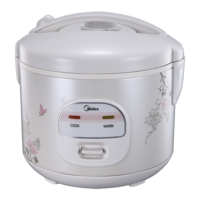
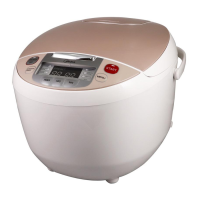
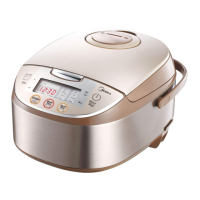
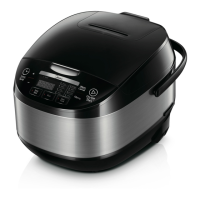
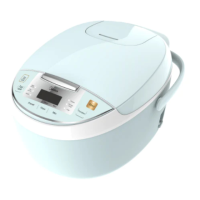
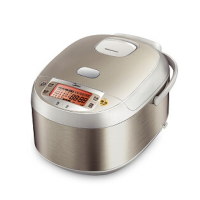
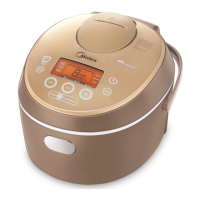
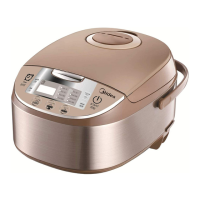
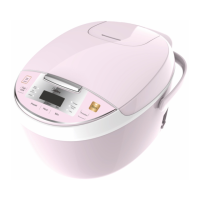
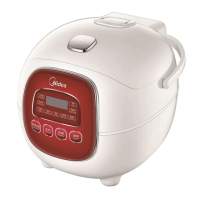
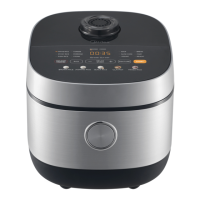
This document provides a comprehensive guide to the Midea Multi-functional Automatic Rice Cooker, models MB-YN161, MB-WYN161, and EB-YN161B. It covers safety instructions, product features, usage guidelines, maintenance procedures, and troubleshooting tips to ensure safe and efficient operation.
Function Description
The Midea Multi-functional Automatic Rice Cooker is designed to simplify the cooking process for various rice and soup dishes. Its primary function is to cook rice automatically, transitioning to a warming state once cooking is complete. Beyond basic rice cooking, it offers a dedicated "Porridge / Soup" function, allowing users to prepare these dishes with controlled heating. The cooker is equipped with a control panel that includes a "Cooking" button and a "Cooking lamp" to indicate operation status, as well as a "Warming lamp" to show when the insulation function is active.
Key components include:
- Cover plate: Removable for easy cleaning.
- Inner pot: The main cooking vessel, designed to be non-stick and durable.
- Heating plate: Located beneath the inner pot, it provides the heat for cooking.
- Steam port: Releases steam during cooking.
- Water holder: Collects condensed water, which should be regularly emptied.
- Accessories: Includes a scoop, measuring cup, food steamer, and power wire component, enhancing the cooker's versatility.
The cooker operates on a 220V~50Hz power supply and is designed for household use, as well as similar applications such as staff kitchen areas in shops and offices, farmhouses, hotels, motels, and bed and breakfast environments.
Usage Features
The Midea rice cooker is designed for straightforward operation, with specific steps for preparation and cooking.
Preparation:
- Measuring Rice: Always use the provided measuring cup for rice. Avoid washing rice directly in the inner pot to prevent scratching its surface.
- Adding Rice and Water: Place the washed rice into the inner pot. Refer to the water level marks inside the pot to add the appropriate amount of water based on the rice quantity. Users can adjust the water level slightly to suit personal taste. It is crucial not to exceed the maximum water mark for the selected function, as this can lead to overflow and short circuits.
- Minimum and Maximum Capacity: The product has a minimum capacity of 1 cup of rice and a maximum capacity of 3.5 cups of rice.
- Inner Pot Placement: Before placing the inner pot into the cooker, ensure its external surface and the coil panel are dry. Rotate the inner pot 2-3 times after placement to ensure a tight fit between the pot bottom and the heating plate.
- Lid Closure: Press down the cover until a "click" sound is heard, indicating it is securely closed.
- Container Substitution: Do not use any other container in place of the inner pot on the coil panel.
- Steaming Food: When steaming food over water, add a suitable amount of water to prevent boiling over.
Cooking Status:
- Rice Cooking:
- Set the "selection" switch to the "rice" file.
- Press the "Cook" button to start the cooking process. The "Cooking lamp" will illuminate.
- Once cooking is complete, the "Cook" button will automatically jump up, and the rice cooker will enter the "Warming" state, indicated by the "Warming lamp."
- Porridge / Soup Cooking:
- Set the "Function Select" switch to the "Porridge / Soup" file.
- Press the "Cook" button to begin the porridge or soup cooking.
- Unlike rice cooking, the "Porridge / Soup" function does not automatically end. Users must manually turn off the heating by lifting the "Cook" button, otherwise, it will continue to heat. The heating time should be controlled by the user based on their needs.
- Porridge / Soup Specifics:
- For porridge, use 0.4 cups of rice and add water up to the 3.5 scale mark.
- It is recommended not to use the "Porridge / Soup" function for more than two hours to avoid excessive soup spills and potential damage to components.
Maintenance Features
Regular cleaning and maintenance are essential to ensure the longevity and safe operation of the Midea rice cooker.
Cleaning Procedures:
- Insulation Seat Board: Wipe the insulation seat board position with a damp cloth. Never wash it directly with water.
- Water Storage Tank: The water in the water storage tank should be wiped dry with a semi-dry rag.
- Removable Parts: Remove the water holder, steam valve, and cover for thorough cleaning with water.
- Heating Plate: Any water on the heating plate should be wiped dry with a rag. If there are burnt rice grains, they can be removed using steel wool or sandpaper.
- Inner Pot Preparation: Before placing the inner pot back into the cooker, ensure that any water or rice grains around and on the bottom of the pot are wiped away.
Safety and Care:
- Power Cord: If the power cord is damaged, it must be replaced with a special flexible cord or a component purchased from the manufacturer or a service agency.
- Children: Do not allow children to operate the product unattended. Keep it out of reach of babies to prevent electric shock, scalds, and other accidents.
- Damaged Plug/Wet Socket: Do not use the appliance if the power cord plug is damaged or if the socket is wet, to avoid fire, electric shock, or short circuit.
- Dust in Plug: Any dust in the plug must be cleaned immediately to prevent fire.
- Professional Repair: For product repair or part replacement, always go to a designated professional repair shop. Incorrect repairs or parts can lead to safety hazards, overheating, or fire.
- Power Cord Handling: Avoid bending, approaching high temperatures, binding, or bearing heavy objects on the power cord to prevent damage, fire, or electric shock.
- Voltage: Do not use the appliance with voltages other than 220V AC to avoid fire or electric shock.
- Wet Hands: Never pull the plug with wet hands to prevent electric shock and injury.
- Socket Usage: Use an individual earthed socket with a rated current of 10A or more. Sharing a socket with other appliances can cause fire.
- Plug Insertion: Ensure the plug is fully inserted into the socket to prevent fire, electric shock, or short circuit.
- During Operation: Do not move or shake the rice cooker during operation. Do not immerse the appliance in water or any other liquid.
- Steam Port: Never cover the steam port with a cloth, as this can cause accidents or damage to the rice cooker.
- Food Restrictions: Do not cook foods that may block the steam vent, such as leafy vegetables (e.g., laver, Chinese cabbage), strip foods (e.g., kelp), or fragmentary foods (e.g., corn grit), as this can cause accidents or damage.
By following these guidelines, users can ensure a safe, efficient, and long-lasting experience with their Midea Multi-functional Automatic Rice Cooker.


 To Next Page
 General