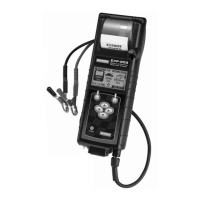
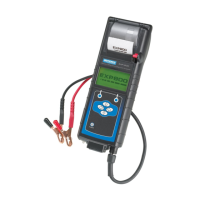
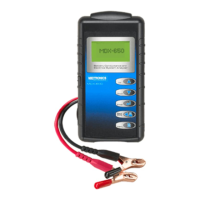
The Midtronics MDX-655P is a battery conductance and electrical system analyzer designed for testing 6 & 12-volt automotive starting batteries and 12 & 24-volt starting/charging systems. This device provides quick and accurate test results, often within seconds, and includes a built-in printer for immediate customer reports.
Function Description:
The MDX-655P serves as a comprehensive diagnostic tool for automotive electrical systems. Its primary function is to assess the health of batteries and the performance of starting and charging systems. When initially connected to a battery, the device acts as a voltmeter, displaying the battery's voltage until the ENTER button is pressed to initiate a test. The menu-driven interface guides the user through the testing process, allowing for selection of various parameters.
Key Capabilities:
- Battery Testing: It can test a wide range of battery types, including 6 & 12-volt regular flooded, AGM flat plate, AGM spiral, and GEL batteries.
- Rating Systems: The analyzer supports multiple battery rating systems, including CCA (Cold Cranking Amps) from 100 to 2000, JIS (Japanese Industrial Standard), EN (Europa-Norm), DIN (Deutsche Industrie-Norm), and IEC (International Electrotechnical Commission).
- System Testing: Beyond battery health, it tests the starting system (cranking voltage and time) and the charging system (alternator output).
- Advanced Diagnostics: The device can detect bad cells, protect against reverse polarity connections, and test discharged batteries.
- User Interface: It features a multi-lingual user interface for broader applicability.
Usage Features:
- Intuitive Navigation: The display and keypad consist of UP and DOWN arrows for scrolling, an ENTER button for selections, a BACK/PRINT button for navigating back or printing results, and a MENU button to access main options.
- Voltmeter Functionality: Upon connection, it defaults to a voltmeter display, which can be configured via the Options Menu.
- Test Procedure:
- Battery Location: Users select whether the battery is "IN VEHICLE" or "OUT OF VEHICLE." In-vehicle tests prompt for subsequent starting and charging system tests.
- Battery Age: Options include "new battery" (freshly produced, not yet installed) or "in service" (already used and cycled).
- Application: Users specify the application: AUTOMOTIVE, MOTORCYCLE, or TRUCK.
- Battery Type: Selection among REGULAR FLOODED, AGM FLAT PLATE, AGM SPIRAL, or GEL.
- Battery Standard & Rating: Users choose the battery's rating system (e.g., SAE, EN) and input the rated value.
- Starting System Test: After a battery test, if "IN VEHICLE" was selected, the device prompts for a starter test, guiding the user to start the engine.
- Charging System Test: Following the starter test, the device prompts for a charging system test, instructing the user to rev the engine, turn on loads (headlights, blower fan), and then idle.
- Test Results Interpretation: The device provides clear decisions such as "GOOD BATTERY," "GOOD-RECHARGE," "CHARGE & RETEST," "REPLACE BATTERY," "BAD CELL-REPLACE," "24 VOLT SYSTEM," "READY TO INSTALL," and "NEEDS CHARGE." For new batteries, "CYCLING REQUIRED" and "REST & RETEST" are additional results.
- Error Messages: The device displays various error messages to guide troubleshooting, such as "CHECK CONNECTION," "REVERSE CONNECTION," "ENGINE REV NOT DETECTED," "UNSTABLE BATTERY," and "WIGGLE CLAMPS."
- Options Menu: Accessible via the MENU button, this menu allows users to:
- View/Print previous test results.
- Perform a quick "QC Mode" test for battery inventory.
- Export data to an IR Reader program.
- Start a "Perform Test" procedure.
- Select language.
- Set address for printouts (up to 8 lines, 21 characters/line).
- Set time (24-hour or AM/PM) and date format.
- Clear or display battery/system test results counter.
- Adjust display contrast.
- Select temperature units (F or C).
- Toggle automatic voltmeter function on/off.
Maintenance Features:
- Cable Assembly Replacement: The cable assembly is user-replaceable by removing a single screw, pulling the old assembly, and inserting a new one.
- Printer Paper Replacement: The built-in thermal printer uses 2.25 in x 85 ft (57 mm x 25.9 m) thermal paper rolls. Replacement involves pressing a red lever to unlock the printer door, removing the spent roll, placing a new roll, and ensuring the paper extends past the serrated edge before closing the door.
- Internal Battery Replacement: The device uses internal AA batteries. When these are low, the device displays "LOW INTERNAL AA BATTERIES, REPLACE AA BATTERIES SOON!" Replacement involves turning the tester face down, removing a screw to access the battery compartment, lifting the door, replacing the discharged batteries with fresh AA batteries (alkaline recommended), and resecuring the cover. Setup information is retained during this process.
- Troubleshooting: The manual provides guidance for printer issues (e.g., "PRINTER OUT OF PAPER," "PRINTER DOOR OPEN," "BATTERY POWER TOO LOW TO USE PRINTER") and display issues (e.g., display not turning on, which may require checking connections, charging the vehicle battery, or replacing internal AA batteries).
Important Safety Guidelines:
- Always exercise extreme caution when working with batteries to prevent personal injury.
- Battery posts, terminals, and related accessories contain lead and lead compounds; wash hands after handling.
- When connecting the tester, ensure clean battery posts and use lead terminal adapters for side-post batteries, tightening them no more than 1/4 turn to avoid damage and inaccurate results.
- Avoid testing at steel bolts.
- When testing in a vehicle, ensure all accessory loads are off, the key is out of the ignition, and doors are closed to prevent system noise or parasitic drain from affecting results.
- Do not connect the tester to a voltage source greater than 30 Vdc, as this can damage the circuitry.
- For accurate starting and charging system tests, the battery must be in good condition and fully charged.
- The tester retains only the results of the last test; new tests overwrite previous data.

 Need help?
 General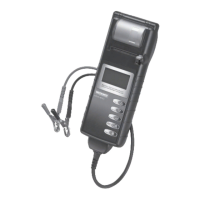



 To Next Page