Need help?
Do you have a question about the Milesight UG63-868M and is the answer not in the manual?
Datasheet for UG63 LoRaWAN® Gateway.
Guide for logging into the web GUI and configuring settings.
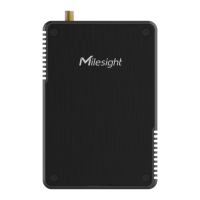
Overview of device interfaces and ports, checking them after removing the mounting plate.
Instructions for placing the device on a desktop after removing the mounting plate.
Steps for mounting the device on a wall or ceiling using the provided mounting plate and screws.
Connecting PC to UG63 ETH port and accessing the web GUI via default IP address and credentials.
Configuration of the UG63's Ethernet port settings, including connection type and IP address.
Steps to connect the gateway to network servers by adding a network server and filling in details.
Configuring radio channels and adding the gateway on the network server page for traffic viewing.
Ensuring internet access, pinging the domain, enabling the embedded network server, and configuring radio channels.
Enabling Milesight IoT Cloud mode in Network Server and adding the gateway via its serial number.
Enabling Remote Embedded NS, adding UG63 gateway ID to UG65/UG67, and checking data transfer.
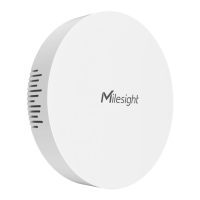
The Milesight UG63 Mini LoRaWAN® Gateway is a compact and versatile device designed for various IoT applications, offering robust connectivity and management features. This Quick Start Guide provides essential information for its installation, configuration, and maintenance.
The UG63 serves as a LoRaWAN® gateway, acting as a bridge between LoRaWAN® end devices and network servers. It is equipped with pre-installed multiple packet forwarders, including Semtech UDP Packet Forwarder, Chirpstack-Generic MQTT broker, and LoRa Basic Station, allowing for flexible integration with different network server platforms. The gateway facilitates the transmission of data from LoRaWAN® nodes to the cloud, enabling data collection, monitoring, and control for IoT solutions. It supports multi-gateway architecture, which enhances signal coverage and provides failover capabilities, ensuring continuous operation even if one gateway experiences issues. This multi-gateway setup also allows node devices to roam across multiple gateways, optimizing network performance and reliability. The UG63 can function as a packet forwarder, transmitting all data to a main gateway like the UG65/UG67, which can then act as the network server.
The UG63 offers a user-friendly web-based configuration interface (GUI) for easy management and setup. Users can access this interface by connecting a PC to the gateway's Ethernet port via a PoE injector or PoE switch. The default login credentials (username: admin, password: password) are provided for initial access, with a strong recommendation to change the password for security purposes after the first login. The GUI allows users to view system information, configure network settings, and manage packet forwarder configurations.
For network connectivity, the UG63 supports various modes including Static IP, DHCP, and PPPoE, providing flexibility to integrate into different network environments. Users can configure Ethernet port information and apply changes through the "Network" -> "Interface" -> "Port" page in the web GUI. It is crucial to ensure that the gateway's IP address and the modem/router's Ethernet port address are compatible when using static IP.
The gateway's packet forwarder configuration is a key feature, enabling connection to various network servers. Users can add and enable network servers, specifying server addresses, ports, and types (e.g., Semtech). The "Radio" page allows for the configuration of center frequency and channels, which must match those of the network server and end nodes for proper communication.
The UG63 can also be connected to the Milesight IoT Cloud, a platform for managing Milesight products and their data. To connect, users must ensure the gateway has internet access and can ping the cloud domain. The embedded network server can be enabled through the "Packet Forwarder" -> "General" page, and the gateway can be added to the Milesight IoT Cloud via its Serial Number (SN) through the "My Devices" page. Once connected, node devices can be added directly to the cloud.
In a multi-gateway setup with UG65/UG67, the UG63 can be configured as a remote embedded network server by enabling the "Remote Embedded NS" option in the "Packet Forwarder" -> "General" page and filling in the main gateway's IP address. The UG65/UG67's "Network Server" -> "Gateway Fleet" page is then used to add the UG63's gateway ID and define a name, establishing the connection. This allows the UG63 to transfer node data to the UG65/UG67, with data details viewable on the "Network Server" -> "Packets" page of the main gateway.
The device supports multiple installation methods, including desktop, wall mounting, and ceiling mounting, providing flexibility for deployment in various settings. The mounting plate on the back of the device can be easily removed for installation. For wall/ceiling mounting, the plate is aligned, holes are marked and drilled, wall plugs inserted, and the plate is fixed with screws. The device is then turned clockwise to lock it onto the mounting plate.
The UG63 incorporates several features to aid in monitoring and troubleshooting. LED indicators provide visual cues for system status (SYS), LoRa status (LoRa), and Ethernet port activity (Link Indicator and Rate Indicator).
A reset button is included for system recovery and factory default restoration.
The web GUI provides a "Status" page where users can monitor system information, including model, region, serial number, firmware version, hardware version, local time, uptime, CPU load, RAM usage, and eMMC capacity. This information is crucial for diagnosing issues and ensuring optimal performance. The "Traffic" page in the "Packet Forwarder" section allows users to view data communication, including RF channel, direction, time, ticks, frequency, datarate, coderate, RSSI, and SNR, which is vital for verifying data flow and signal quality.
Safety precautions are emphasized, including not modifying the device, keeping it away from naked flames, operating within the specified temperature range, avoiding powering on or connecting to other electrical devices during installation, checking lightning and water protection for outdoor use, and not using damaged cables. These guidelines contribute to the longevity and safe operation of the device.
The device is powered by 802.3af standard PoE or a Type-C port (5 VDC), with PoE being preferred if both are connected. This dual power option provides redundancy and flexibility in deployment.
Milesight offers technical support via email, phone, and fax, and provides related documents like the UG63 Datasheet and UG63 User Guide on their website, which offer comprehensive instructions for advanced settings and troubleshooting. These resources are invaluable for maintaining the device and resolving any issues that may arise.
 General
| Frequency | 868 MHz |
|---|---|
| Communication Protocol | LoRaWAN |
| Number of Channels | 8 |
| Max Output Power | 27dBm |
| Ethernet | 10/100 Mbps |
| IP Rating | IP30 |
| Weight | 300 g |
| LoRaWAN Protocol | 1.0.3 |
| Interface | Ethernet, RS485 |

 To Next Page