EasyManua.ls Logo

Millennium M815 ChessGenius Pro - User Manual

Millennium M815 ChessGenius Pro
15 pages
Print Icon
To Next Page IconTo Next Page
Loading...
Operation Manual for M815 ChessGenius Pro
Extended version V1.00
1. Inserting batteries & starting the computer the first time ..................................................................... 3
2. Choose the language for the screen text .......................................................................................................... 3
3. Play a game ...........................................................................................................................................................................4
Play your move .....................................................................................................................................................................4
Execute the computer’s move ...................................................................................................................................4
Retracting and replaying moves .............................................................................................................................. 5
Meaning of symbols in the bottom line ............................................................................................................... 5
Info and analysis windows during the chess game ..................................................................................... 5
4. Start a new game: Your choices ............................................................................................................................... 6
5. System help messages ................................................................................................................................................... 6
6. Switch OFF/ON .................................................................................................................................................................... 6
7. Functions of the control buttons ............................................................................................................................ 7
8. Special functions the main menu ....................................................................................................................... 9
Hint get a hint ................................................................................................................................................................... 9
Move now force the computer to move .......................................................................................................... 9
Back/Forward all jump to start or end of the game ................................................................................. 9
Next best get an alternative move ...................................................................................................................... 9
2 Players/Analys the computer as referee ...................................................................................................... 9
Play level choose your playing strengh ............................................................................................................ 9
Options further settings ............................................................................................................................................. 9
New game restart ........................................................................................................................................................... 9
Set up position customized chess positions ................................................................................................. 9
Save/Load save and replay your games ......................................................................................................... 10
9. The “Options” list................................................................................................................................................................ 11

Other manuals for Millennium M815 ChessGenius Pro

Question and Answer IconNeed help?

Do you have a question about the Millennium M815 ChessGenius Pro and is the answer not in the manual?

Summary

Battery Installation and Initial Startup

Screen Language Selection

Playing a Chess Game

Making Your Move

Instructions for moving pieces, castling, en passant, and pawn promotion.

Executing Computer Moves

How the computer's moves are signaled and displayed on the LCD.

Retracting and Replaying Moves

How to undo or re-execute moves and sequences within a game.

Understanding Bottom Line Symbols

Explains the meaning of icons and indicators shown at the bottom of the LCD screen.

Accessing Game Information Displays

Details on viewing clock times, move history, and the computer's analysis.

Starting a New Game

System Help Messages

Powering the Chess Computer On and Off

Control Button Functions

RED and GREEN Button Functions

Explains the dynamic functions of RED and GREEN buttons for navigation and confirmation.

Navigation and Game Control Buttons

Details the roles of NEW GAME (▷), HELP (?), and arrow buttons (←, ⇨, ↑, ↓).

POWER Button Operation

How the POWER button manages ON, OFF, and standby modes, preserving game state.

RESET and ON;OFF Switch Functions

Covers RESET functionality and the ON/OFF switch for power disconnection.

Special Functions and Main Menu

Hint, Move Commands, and Navigation

Functions for getting hints, forcing moves, alternatives, and game navigation.

Player Modes and Game Restart

Features like '2 Players/Analys' mode and 'New Game' restart.

Playing Strength and Options Access

How to adjust playing level and access the 'Options' menu for settings.

Custom Position Setup

Enables users to create and play from specific chess positions.

Game Saving and Loading

Functionality to save and retrieve up to 12 games.

The Options Menu List

Board Orientation and Brain Calculation

Options for 'Turn Board' and 'PermanentBrain' calculation behavior.

Game Assistance and Play Style

Settings for 'Tutor' warnings, 'Resign/Draw' offers, and 'Style' of play.

Sound, Display, and Book Settings

Controls for 'Book' usage, 'Sound' volume, and 'Brightness'.

Piece Design and Language Selection

Options to choose 'Pieces' design and set the preferred 'Language'.

Playing Strength Levels

Standard Level Categories

Descriptions of Normal, Blitz, Fun, and Easy levels and their characteristics.

Tournament Time Controls

Details on 'Fischer' time controls and 'sudden death' formats for tournament levels.

Custom User and Find Mate Levels

Explains customizable 'User' time controls and the 'Find Mate' search mode.

Setting Up Custom Chess Positions

Piece Manipulation and Setup Menu

How to manipulate pieces and navigate the 'Set up' menu.

Position Configuration Options

Adjusting side to move, castling rights, player modes, and confirming the position.

Saving and Loading Game Data

Game Saving, Loading, and Deletion

Procedures for saving, loading, and deleting games from memory slots.

Memory Slot Management

Navigating memory slots and understanding their contents.

Disclaimer and Copyright

Overview

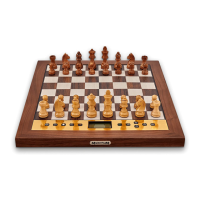
The ChessGenius Pro (M815) is a dedicated chess computer designed to offer a comprehensive chess playing and analysis experience. It features a physical chessboard with pressure-sensitive squares and an LCD display for showing game information, moves, and menu options.

Function Description

The primary function of the ChessGenius Pro is to allow users to play chess against a computer opponent or against another human player, with the computer acting as a referee and analyst. It offers a wide range of playing strengths and customizable settings to suit players of all skill levels, from beginners to advanced enthusiasts.

The device can be powered by four AA batteries or an optional mains adaptor. Upon initial startup, users are guided through a language selection process, with 14 languages available for the screen text.

Playing a Game:

To start a game, users place the physical chess pieces on the membrane board. Moves are input by pressing the "from" and "to" squares of a piece. The computer acknowledges moves with a "click" sound. Special moves like castling and en passant captures have specific input methods. Pawn promotion involves moving the pawn, selecting the desired piece type using arrow buttons, and confirming.

The LCD display shows the chessboard, current move, and game timers. Squares are highlighted in yellow to indicate a selected "from" square and in red to prompt for the computer's move or to complete a special move. Illegal moves are indicated by a low-pitched sound.

Computer's Move:

When it's the computer's turn, a sound signal announces its move, and the LCD shows the piece switching between squares, with the move appearing in notation. Users execute the computer's move by pressing the highlighted squares. A "ping" sound indicates a check.

Retracting and Replaying Moves:

The device allows users to retract moves using the "back" button and retrace the physical pieces. A sequence of moves can be retracted by repeatedly pressing the "back" button. Similarly, retracted moves can be replayed using the "forward" button. Users can resume play at any point after retracting or replaying moves.

Information and Analysis:

During a game, the LCD displays various "info" windows, cycling through clock times, last few moves, and computer analysis. The analysis includes a "score" (evaluation of the position), "depth" (how many "ply" ahead the computer looked), and the "main line" (the computer's strongest continuation). It can also show if the current position is in its "openings book."

Special Functions (Main Menu):

Accessed via the GREEN button, the main menu offers a suite of special functions:

  • Hint: The computer suggests a move.
  • Move now: Forces the computer to make its move immediately, even if it's still calculating, or to "swap sides" if it's the user's turn.
  • Back/Forward all: Jumps to the start or end of the game.
  • Next best: Retracts the computer's last move and plays an alternative, next-best move.
  • 2 Players/Analys: Allows two human players to play, with the computer providing analysis.
  • Play level: Users can choose from various playing strengths.
  • Options: Accesses further settings for customization.
  • New game: Restarts the game with choices for playing against the computer or in "2 players" or "Set up" mode.
  • Set up position: Allows users to create custom chess positions on the board.
  • Save/Load: Enables saving and loading up to 12 games to and from the computer's memory.

Playing Levels:

The ChessGenius Pro offers 7 categories of playing strength: "Normal," "Blitz," "Fun," "Easy," "Tourn" (Tournament), "User," and "Find mate." Each category has multiple numbered levels.

  • Normal levels: Computer takes an average amount of time per move (from instantaneous to 2 minutes).
  • Blitz levels: Each player has a total thinking time for the whole game.
  • Fun levels: Computer moves instantly and makes deliberate mistakes.
  • Easy levels: Computer plays quickly by cutting short calculations after examining a fixed number of positions.
  • Tournament levels: Uses "Fischer" time controls or "sudden death" finishes, with specific time limits and increments.
  • User level: Allows customization of time controls with up to 5 parameters.
  • Find mate level: Computer searches for the shortest way to force checkmate.

Setting Up a Position:

In "Set up" mode, users can construct custom positions by inserting or removing pieces. The bottom line of the LCD shows the piece type, which can be changed, and its color. The "Set up" menu provides options to clear the board, set up a new game position, or abandon the setup. It also allows specifying which side moves next, rotating the board, defining castling rights, and selecting "2 Players" mode. The device prevents confirming an "Illegal board" setup.

Usage Features

Control Buttons:

The device features several control buttons:

  • RED button: Reverts to the previous LCD display, cycles through "info" displays (clock times, last moves, analysis), confirms a "setting up" position, or cancels a "level" change.
  • GREEN button: Accesses the main menu, selects menu items, or confirms a "level" change.
  • "New Game" (▷) button: Starts a new game.
  • "Help" (?) button: Displays scrolling help text or shows possible moves for pieces.
  • "Backlight" (*) button: Adjusts LCD backlight brightness (5 settings).
  • "Retract" (←) button: Retracts a move, decreases a parameter number, alters a parameter setting, or cycles through piece types in "Set up" mode. Can be held for auto-repeat.
  • "Replay" (⇨) button: Replays a retracted move, increases a parameter number, alters a parameter setting, or cycles through piece types in "Set up" mode. Can be held for auto-repeat.
  • "Up" (⇧) button: Navigates upwards through lists, allows scrolling, or switches between white and black pieces in "Set up" mode.
  • "Down" (↓) button: Navigates downwards through lists, allows scrolling, switches between main continuation and opening name in "analysis" display, or switches between white and black pieces in "Set up" mode.
  • "Power" (⏻) button: Switches the computer on or places it in "standby" mode. In standby, the current game and parameters are retained.

Options List (Further Settings):

The "Options" menu allows users to customize various parameters:

  • Turn board: Play with Black ("up the board").
  • PermanentBrain: Computer continuously calculates during the user's thinking time (can be turned off to save battery).
  • Tutor: Provides warnings for dubious moves (automatically activated in "Fun" or "Easy" levels).
  • Resign/Draw: Computer may offer to resign or draw.
  • Style: Choose computer's playing style ("Normal," "Risky," or "Solid").
  • Book: Select from two opening books or turn off the book entirely.
  • Sound: Adjust volume (4 settings, including mute).
  • Brightness: Set LCD display brightness (5 settings).
  • Pieces: Choose from 4 designs for chess pieces on the LCD.
  • Language: Select preferred screen text language (14 choices).

Maintenance Features

Battery Replacement:

The device indicates low battery with a red "low battery" symbol on the LCD. Batteries should be replaced by opening the compartment on the underside, inserting four AA batteries with correct polarity, and closing the lid.

Automatic Standby and Power Off:

ChessGenius Pro automatically enters "standby" mode after 10 minutes of inactivity (5 minutes with fresh batteries, 1 minute with low batteries), retaining game progress and settings. The display is "dimmed" during inactivity and restored with any button press.

Complete Power Disconnection:

For lengthy periods of non-use or transport, the ON/OFF switch located on the underside (near the power adaptor input) can completely disconnect the power supply. It is recommended to place the computer in standby mode first to save settings and the last game.

Reset Function:

A "RESET" opening on the underside allows for a hard reset. Holding down the RED button while pressing the RESET button with a thin object restores the device to its factory settings. This is useful if the language list fails to appear or if an incorrect language was accidentally selected.

Power Adaptor:

The device can be powered by a mains adaptor (M811 Power Supply, sold separately) with a centre positive plug and maximum 5V output, connected to a socket on the underside.

Millennium M815 ChessGenius Pro Specifications

General IconGeneral
CategoryGame
BrandMillennium
ModelM815 ChessGenius Pro
Chess EngineChessGenius by Richard Lang
Elo RatingUp to 2200
ConnectivityUSB
DisplayLCD
Game ModesTournament
Power SupplyPower Adapter
Dimensions30 cm x 27.6 cm x 3 cm
FeaturesHint function, Take back moves, Save games

Related product manuals