Pellerin Milnor Corporation 7
WARNING:
Multiple Hazards — Proximity safeguarding provides only partial protec-
tion and only against injury resulting from entering the shuttle path. It is
not a substitute for proper lockout/tagout procedures and good safety practices.
� Always lockout/tagout any individual machine (or follow the published maintenance
procedures) when performing maintenance or clearing a fault on that machine.
� Ensure that all personnel understand the safeguards and do not attempt to defeat them.
� Inspect safeguards weekly to ensure that they are not mechanically or electrically
circumvented.
1.2.4 How Milnor
®
Accommodates Proximity Safeguarding
BNSUUI01.C05 0000230079 A.4 B.3 A.3 1/2/20 2:04 PM Released
Milnor
®
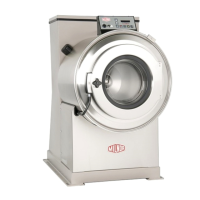
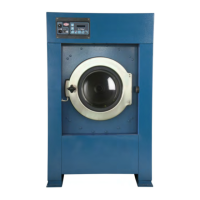
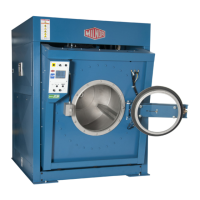
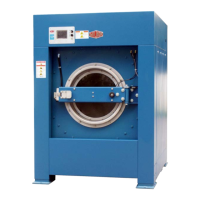
provides connection points on shuttles, presses and centrifugal extractors for interfacing
with devices such as gate interlock switches. These connection points are tagged for easy identifi-
cation. When Milnor
®
provides equipment layout drawings for an automated laundering system,
it indicates on the drawing, the perimeter of the shuttle movement area that must be guarded. The
following hazard statement is displayed on connection point tags as well as equipment layout
drawings prepared by Milnor
®
:
WARNING: Strike, Crush, Sever, and Entrapment Hazards — Serious bodily injury
or death can result to personnel in proximity to machinery/systems that tra-
verse, elevate, extend, pivot, and/or tilt. The following mandatory mini-
mum safety requirements must be installed with the machinery system
(local codes may require additional precautions):
� Safety fence enclosing machine movement areas,
� Lockable electrical interlocks on all gates, properly interfaced as shown on machine
schematics, to disable machine movement when any gate is opened,
� Signs to alert personnel to these hazards, placed prominently around the fenced area.
Although the objectives of proximity safeguarding are the same anywhere, design requirements
vary with local codes (which occasionally change) and with the plant layout. For this reason, Mil-
nor
®
does not provide detailed designs or materials for proximity safeguarding. If the necessary
expertise does not exist within the owner/user's organization, consult appropriate sources such as
local engineers or architects specializing in industrial facility design.
1.2.5 Examples of Safety Fencing With Interlocked Gates
BNSUUI01.C06 0000230078 A.4 B.3 A.3 1/2/20 2:04 PM Released
Fencing with interlocked gates like that depicted in Figure 1 and Figure 2 , may be used to meet
the proximity safeguarding requirement. Should the owner/user choose this method, the following
information may be useful. However, this information may not satisfy current or local code
requirements. The owner/user must determine its suitability for his particular facility.
For Owner/Management


 To Next Page
 Loading...