Need help?
Do you have a question about the Minebea Intec Combics 2 Series and is the answer not in the manual?
Guidance on carefully reading and keeping the manual accessible for proper product use.
Explanation of sequential steps and result descriptions in instructions.
Explains the symbol used to indicate items in a list.
Describes how menu items and softkeys are represented using brackets.
Explains signal words (DANGER, WARNING, CAUTION) and their severity.
Highlights compliance with standards and risks of improper use, emphasizing manual adherence.
Defines the Combics 2 as a robust scale for industrial applications; any deviation is improper.
Procedure for checking consignment for completeness and damage upon receipt.
Includes visual inspection for mechanical damage and adherence to safety requirements.
Specifies use with option Y2 in hazardous areas, referencing a specific manual.
Warns about RS-232 cable pin assignments from other manufacturers.
States that only trained technicians should open the device after disconnecting power.
Emphasizes that the protective ground conductor must never be disconnected.
Details the IP protection grades for different models and options.
Covers conformity assessment, Declaration of Conformity, and adhesive seals for verification.
Instructs to disconnect power if damaged and avoid extreme conditions affecting performance.
Highlights robustness, ease of use, and built-in application programs.
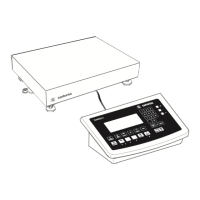
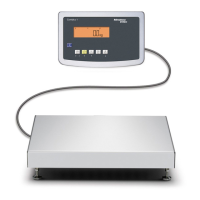
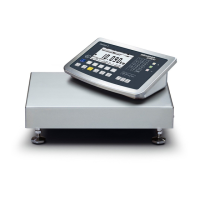
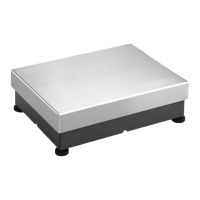
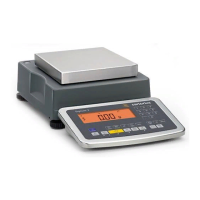
Provides dimensions and details about the indicator and weighing platform housing.
Details the device display, keys, and functions for operation and navigation.
Notes that special equipment is delivered pre-installed if ordered.
Outlines work steps including setup, leveling, connections, and calibration.
Warns about material damage from vibrations and extreme conditions.
Advises avoiding unsuitable influences like extreme temperatures and moisture.
Provides instructions for unpacking, including wearing protective clothing.
Lists items to check: indicator, weighing platform, operating instructions, and options.
Explains how to achieve reproducible results by ensuring the platform is precisely horizontal.
Instructs to disconnect from mains and acclimatize in a warm environment to prevent condensation.
Details connection procedures for cables, interfaces, and pin assignments.
Refers to Interface Pin Assignments and Pin Assignment Charts for connections.
Explains using Combics 2 for recording values, calculations, and assigning IDs.
Describes the self-test procedure upon switching on and the scale starting in measurement mode.
Advises warming up for at least 30 minutes after connection for exact results.
Explains how to switch to and navigate the menu for settings and applications.
Summarizes basic settings grouped into categories like Application, Function Key, and Setup.
Step-by-step guide to selecting the desired language for the display and printout.
Details the process for setting up a password to prevent unauthorized parameter adjustment.
Introduces scale configuration options, starting with Service Mode.
Explains service mode access for additional, normally hidden menu items.
Provides the procedure to activate service mode, requiring a service access code.
Details how to enter geographical data for external calibration at different sites.
Explains how to input weights for calibration and linearization, requiring service mode.
Describes how to assign functions like external linearization or preload to the ISO test key.
Step-by-step guide for external linearization, including legal metrology considerations.
Explains how to set a preload, noting restrictions in legal metrology.
Details the procedure for deleting the preload setting.
Describes calibration without weights by entering load cell characteristics, with legal metrology warnings.
Details setting and selection of applications like Basic Weighing, Counting, etc.
Explains how to define functions for the Fn key.
Allows adjustment of device settings to user requirements.
Provides access to device-specific information like serial number and software version.
Allows selection of the language for display and printout.
Covers ADC configuration settings for weighing platforms.
Details how to perform weighing, tare, printout, and use identifiers.
Explains automatic tare when goods fall below minimum load, with conditions for activation.
Describes setting the minimum load for automatic taring and printing.
Explains automatic printout based on exceeding minimum load or menu activation.
Allows selection of the primary weighing platform displayed upon startup.
Details how to enter tare weights using a barcode scanner when the TARE setting is active.
Explains entering wRef parameters using a barcode scanner when REFERNC. is active.
Describes how to enter ID codes (ID1-ID6) using a barcode scanner.
Explains how to display identifier content using the ID key.
Details direct scanning of barcodes for identifiers, tare, reference weight, and data activation.
Explains automatic recording of adjustment and weighing parameter changes.
Covers password protection, acoustic signal, keyboard lock, auto-off, and display illumination.
Describes COM1, UniCOM, and barcode reader connectivity options.
Details specifications for serial interface (COM1, UniCOM) including levels, transmission rate, and parity.
Provides detailed specifications for the serial interface like levels, data bits, and stop bits.
Details the levels, power supply, and factory settings for the optional Analog UniCOM interface.
Lists connection options for COM1, UniCOM, second weighing platforms, and printers.
Explains setting up the interface with Data protocols like SBI, SMA, XBPI, Ethernet, DeviceNet.
Details the shared frame format for control commands sent via data interface.
Describes print line formats with or without marking, including special and error messages.
Defines the output format for 16 characters, detailing positions and character types.
Details the 22-character output format including normal, special, and error message structures.
Maps PC keyboard functions to Combics 2 keys for alphanumeric input.
Explains connecting and configuring printers via COM1 and UniCOM interfaces.
Details how to configure single, component, or summary protocols and headers.
Adds GMP header/footer to print protocols, with options for result frequency.
Provides examples of printouts for Weighing, Counting, Neutral Measurement, and Checkweighing applications.
Highlights benefits of regular maintenance by Minebea Intec Customer Service for accuracy.
States that repairs must only be performed by authorized specialists using original spare parts.
Instructions for replacing a damaged protective cover.
Provides detailed instructions for cleaning the indicator, platform, and stainless steel parts.
Emphasizes avoiding moisture, aggressive agents, and spraying water directly.
Advises removing corrosive substances regularly.
Details cleaning the interior, cautioning against dirt near overload protection.
Provides safety warnings and cleaning advice for the indicator unit.
Recommends using specific cleaners and regular intervals for stainless steel parts.
Lists conditions under which safe operation is not guaranteed and actions to take.
Covers display, housing, temperature range, power supply, emissions, immunity, and electrical safety.
Details accuracy class, scale intervals, protective interface, and data interface for CAW* P/S models.
Provides detailed weighing ranges, readability, and capacities for various CAW models.
Lists resolutions for CAW*S models across different weighing ranges and types.
Lists Operating Instructions, interface manuals, and alibi memory documentation.
Details new installation services, verification requirements, and contact information for customer service.
Shows details of the identification plate, including model, serial number, IP protection, and certifications.
Lists EU Declaration of Conformity, EU-type examination, Test Certificate, Manufacturer's Certificate, and Safety Information.
Provides information on accessing menus and lists the service and general passwords.
 General
| Maximum Capacity | 0.6 kg to 300 kg |
|---|---|
| Protection Class | IP65 |
| Display | LCD |
| Housing Material | Stainless steel |
| Material | Stainless steel |
| Interface | RS-232, Ethernet |


 To Next Page