Coupling. Light-weight sample must be firmly coupled with a heavy base plate. Both coupled
surface must be flat and smooth, and there is no redundant coupling agent existing. The impact
direction must be vertical to the coupled surface. When the sample is a big plate, long rod or
bending piece, it can be deformed and become unstable, even though its weight and thickness is
big enough, and accordingly, the test value may not be accurate. So the sample should be
reinforced or supported at its back.
Magnetism of the sample itself should be avoided.
4 Testing Program
Note : Use a calibrated hardness tester, test the standard test block downward vertically for 5
times, the arithmetical average value compare with the value of standard test block. If this value
exceeds the standard value, could use the function of user calibration to adjust.
4.1 Start-Up
Insert the plug of the impact device into the socket of impact device on the instrument.
Press the key,now power is on. The instrument is in working mode.
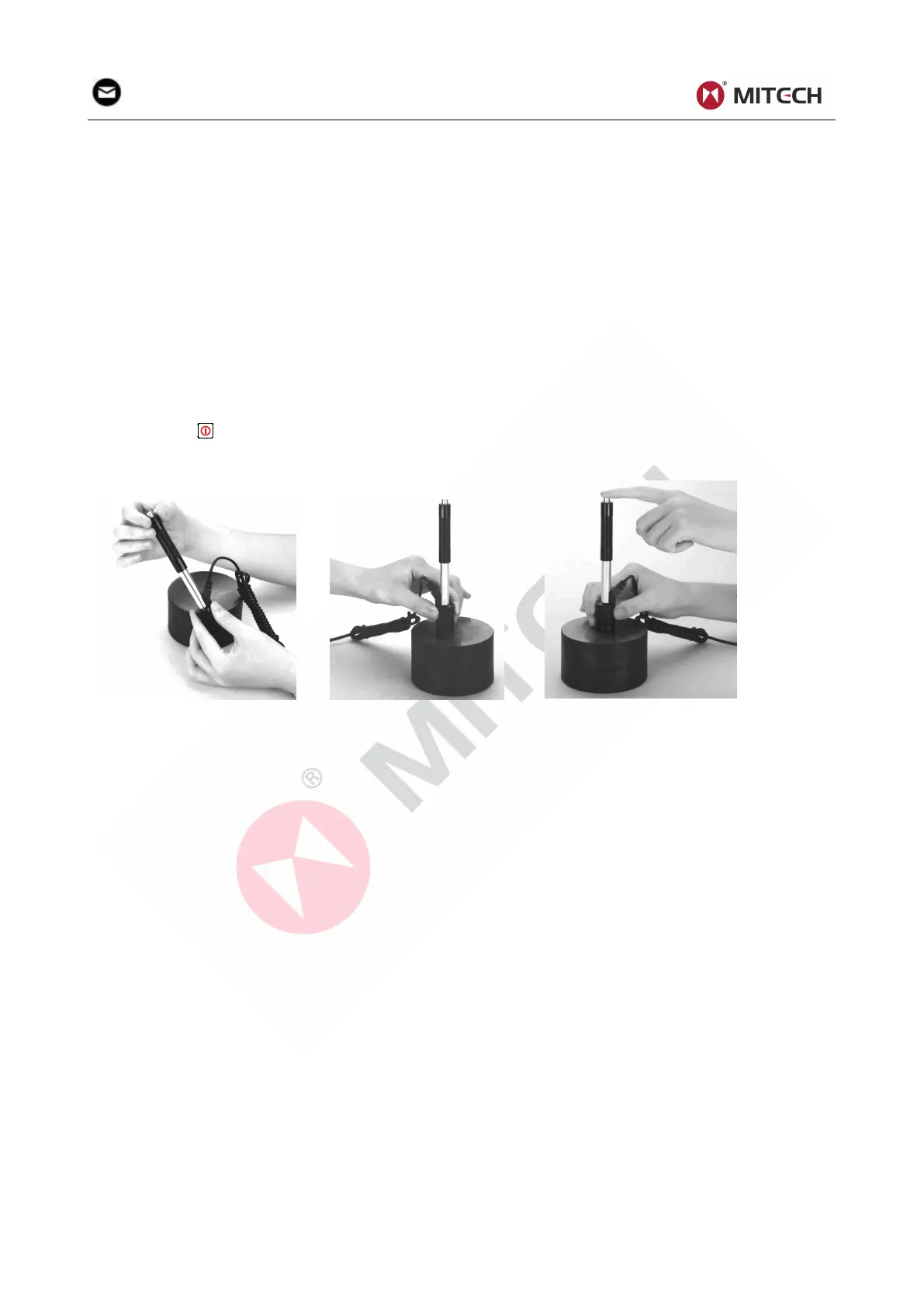
Pushing the loading-tube downwards until contact is felt. Then allow it to slowly return to the starting
position or using other method locking the impact body.
4.3 Localization
Press the impact device supporting ring firmly on the surface of the sample, the impact direction
should be vertical to the testing surface.
4.4 Testing
Press the release button on the upside of the impact device to test. The sample and the impact
device as well as the operator are all required to be stable now. The action direction should pass the
axis of the impact device.
Each measure area of the sample usually need 3 to 5 times of testing operation. The result data
dispersion should not more than mean value±15HL.
The distance between any two impact points or from the center of any impact point to the edge of
testing sample should conform to the regulation of Table 4-1.
If want accurate conversion from the Leeb hardness value to other hardness value, contrastive test
is needed to get conversion relations for the special material. Use inspection qualified Leeb
hardness tester and corresponding hardness tester to test at the same sample respectively. For
each hardness value, each measure homogeneously 5 points of Leeb hardness value in the
surrounding of more than three indentations which need conversion hardness, using Leeb hardness
arithmetic average value and corresponding hardness average value as correlative value
respectively, make individual hardness contrastive curve. Contrastive curve at least should include
three group of correlative data.


 To Next Page