exact location of small pits or flaws in the material being measured.
Geometry of the transducer. The physical constraints of the measuring environment
sometimes determine a transducer’s suitability for a given job. Some transducers may simply be
too large to be used in tightly confined areas. Also, the surface area available for contacting with
the transducer may be limited, requiring the use of a transducer with a small wearface. Measuring
on a curved surface, such as an engine cylinder wall, may require the use of a transducer with a
matching curved wearface.
Temperature of the material. When it is necessary to measure on surfaces that are
exceedingly hot, high temperature transducers must be used. These transducers are built using
special materials and techniques that allow them to withstand high temperatures without damage.
Additionally, care must be taken when performing a “Probe-Zero” or “Calibration to Known
Thickness” with a high temperature transducer.
Selection of the proper transducer is often a matter of tradeoffs between various
characteristics. It may be necessary to experiment with a variety of transducers in order to find one
that works well for a given job.
The transducer is the “business end” of the instrument. It transmits and receives ultrasonic
sound waves that the instrument uses to calculate the thickness of the material being measured.
The transducer connects to the instrument via the attached cable, and two coaxial connectors.
When using transducers, the orientation of the dual coaxial connectors is not critical: either plug
may be fitted to either socket in the instrument.
The transducer must be used correctly in order for the instrument to produce accurate,
reliable measurements. Below is a short description of the transducer, followed by instructions for
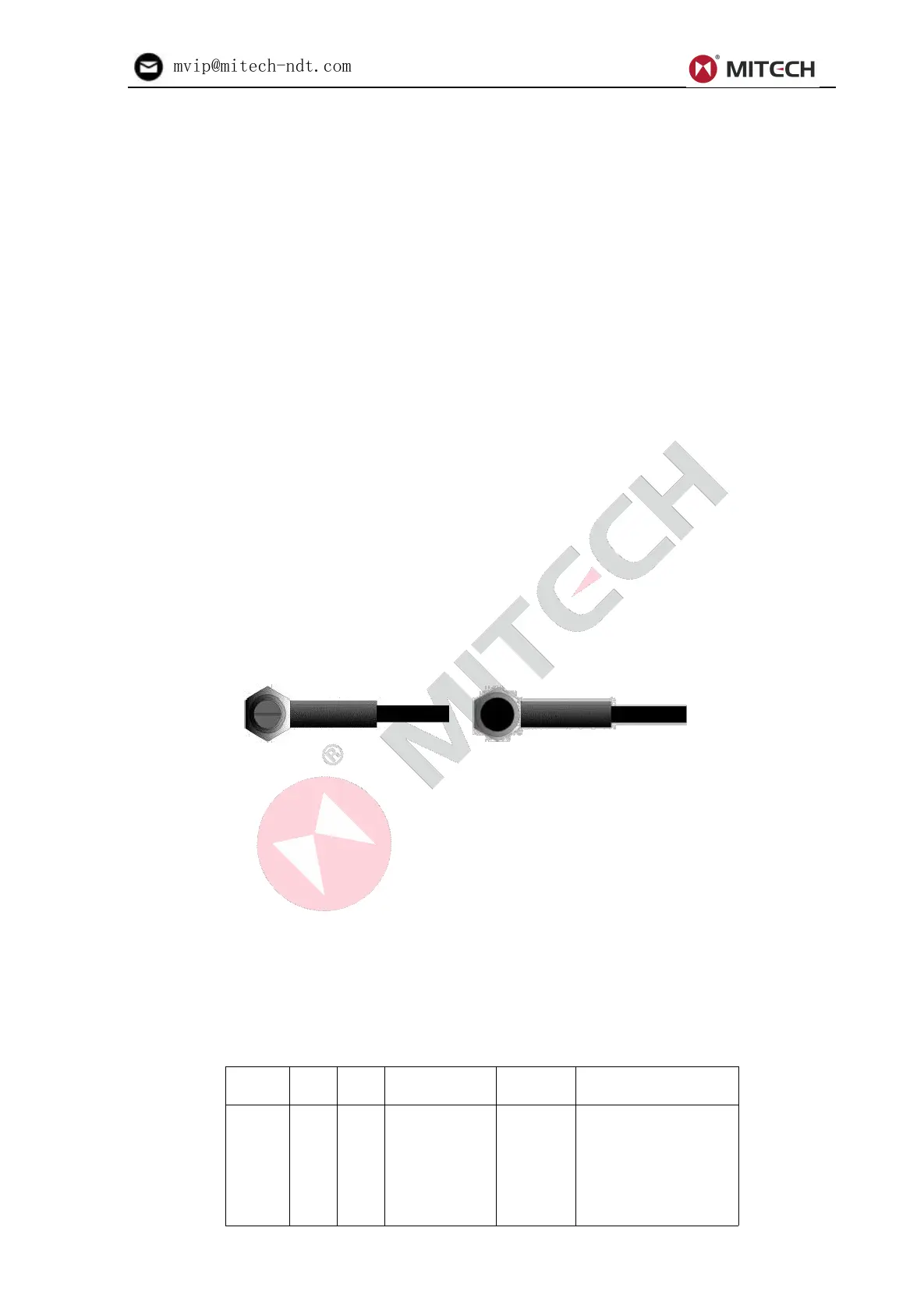
Left figure is a bottom view of a typical transducer. The two semicircles of the wearface are visible,
as is the barrier separating them. One of the semicircles is responsible for conducting ultrasonic
sound into the material being measured, and the other semicircle is responsible for conducting the
echoed sound back into the transducer. When the transducer is placed against the material being
measured, it is the area directly beneath the center of the wearface that is being measured.
Right figure is a top view of a typical transducer. Press against the top with the thumb or index
finger to hold the transducer in place. Moderate pressure is sufficient, as it is only necessary to
keep the transducer stationary, and the wearface seated flat against the surface of the material
being measured.
Table 3-1 Transducer Selection
3.0mm~
300.0mm(In
Steel)
40mm (in Gray
Cast Iron
HT200)
for thick, highly
attenuating, or highly
scattering materials



 To Next Page