21
4. Fore Course Yard Rigging
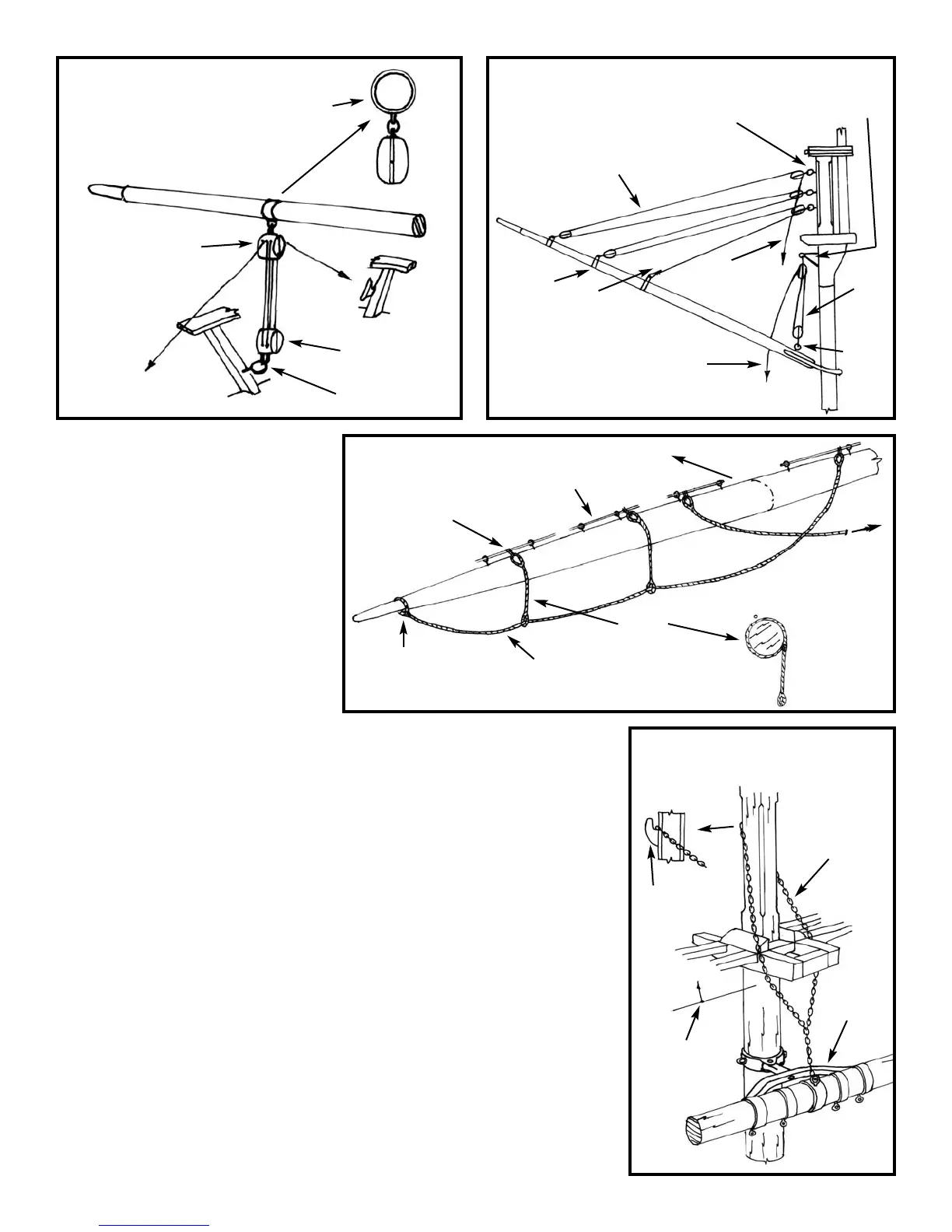
Footropes & Stirrups - Remember these are
black standing rigging lines. Beeswax the
footropes heavily so you can droop them into a
natural hanging curve and they will stay in
place (Figure H-5).
Sling & Truss - The course yard has no halliard
or parrel, but a fixed sling and truss since the
yard is not hoisted like other yards. The sling
fitting band and truss fittings should already be
on the yard and mast. When fixing the yard to
the mast, connect the truss and add the chain
sling (Figure H-6).
Lifts - The lifts are port and starboard. Seize the
line around the shoulder at the end of the yard,
pass thru a block at the mast cap and down to a
purchase just above the deck. The purchase is
belayed to the fife rail.
Buntlines & Leechlines - These por
t and star-
board lines pass thru bullseyes on the yard and
blocks on the fore top cross-trees, then proceed
down and are belayed to the bulwark pin rail.
Without sails the lines could be omitted. How-
ever, for added detail knot the lines under the
yar
d blocks, or connect the ends of the leechline
and buntline together (F
igur
e H-7).
R
eef
T
ackle
-
This por
t and starboar
d rig could
also be omitted on the model without sails, or
the rig installed and the block that would be
attached to the sail just pulled up under the
block on the yard. The more lines you add to
the model certainly enhances the detail.
Sheets, Tacks, & Clew Garnets - All lines port
and starboard. With sails off, hook the sheet,
tack, and clew garnet together. Locate the hook
point just below clew garnet block on the yard
(Figure H-8 ). Unlike the fore and aft head sails
where the sheets would clutter the deck, the
lines for the course sail hang nicely in place and
all belay at the rail.
B
races
- A
dd the por
t and starboar
d brace
blocks and their leader at the ends of the yar
d.
The brace standing end and the lead block ar
e
seized to the main shrouds (Figure H-9).
5. Fore Lower Topsail Yard Rigging
F
ootr
opes & S
tirrups
-
The footr
opes & stir
-
rups are rigged essentially the same as for the
course yard.
Truss - Like the course yard, the lower top-
sail yard is fixed by the truss fitting but there
is no sling.
Lifts -
The lifts ar
e fix
ed lines and should be
black.
The upper end can be set to an ey
ebolt
on the side of the trestletree port and starboard.
The lo
w
er end is seiz
ed to the yar
d but inboar
d
of the shoulder at the end of the yar
d.
Buntlines - Rig similar to the course yard,
knotted under the yar
d bullsey
e.
The block
above the yard is hanging at the end of a line
which is attached to the shroud above. The
buntline belays to the bulwar
k pin rail.
Clew lines and Sheets - Hook the clew lines and
sheets together just below the clew line block on
the yar
d.
The sheet passes thru a hole in the end
of the course yard, thru a block under the course
yard, then down to a purchase tackle on the
deck.
The clew line has no purchase and goes
directly to the bulwark pin rail (Figure H-10).
FIG. H-3 BOOM SHEET
FIG. H-5 FORE COURSE
YARD FOOTROPES
FIG. H-6 FORE YARD
SLING & TRUSS
FIG. H-4 GAFF HALLIARDS
MET
AL
BAND
EYEBOL
TS
BANDS
SEIZE
BELAY TO
STBD
PIN RAIL
BELAY
T
O PORT
FIFE RAIL
HALLIARD
CRANE
FITTING
THR
OAT
HALLIARD
EYEBOL
T
PEAK HALLIARD
TRIPLE
BLOCK
DOUBLE BLOCK
BELAY TO
CLEAT
ON B
ULWARK
STANCHION
P/S
TO
ST
ARBOARD
CLEAT
EYEBOL
T ON
STERN CENTERLINE
ST
ANCHION
SEIZE TO
JACKSTAY
J
ACKSTAY
FORWARD
EYESPLICE
FOOTROPE
CLEAT ON
AFT SIDE
OF MASTHEAD
TRUSS
NOTE: CHAIN IS
LEATHERED
FROM THIS
POINT ABO
VE
CHAIN
SLING
OPTIONAL STIRRUP
IF A ROPE JACKSTAY
IS USED
STIRRUP


 To Next Page
 Loading...