16
6-534.1
INSTALLATION - HIGH ALTITUDE ACCESSORY KIT
HIGH ALTITUDE ACCESSORY KIT
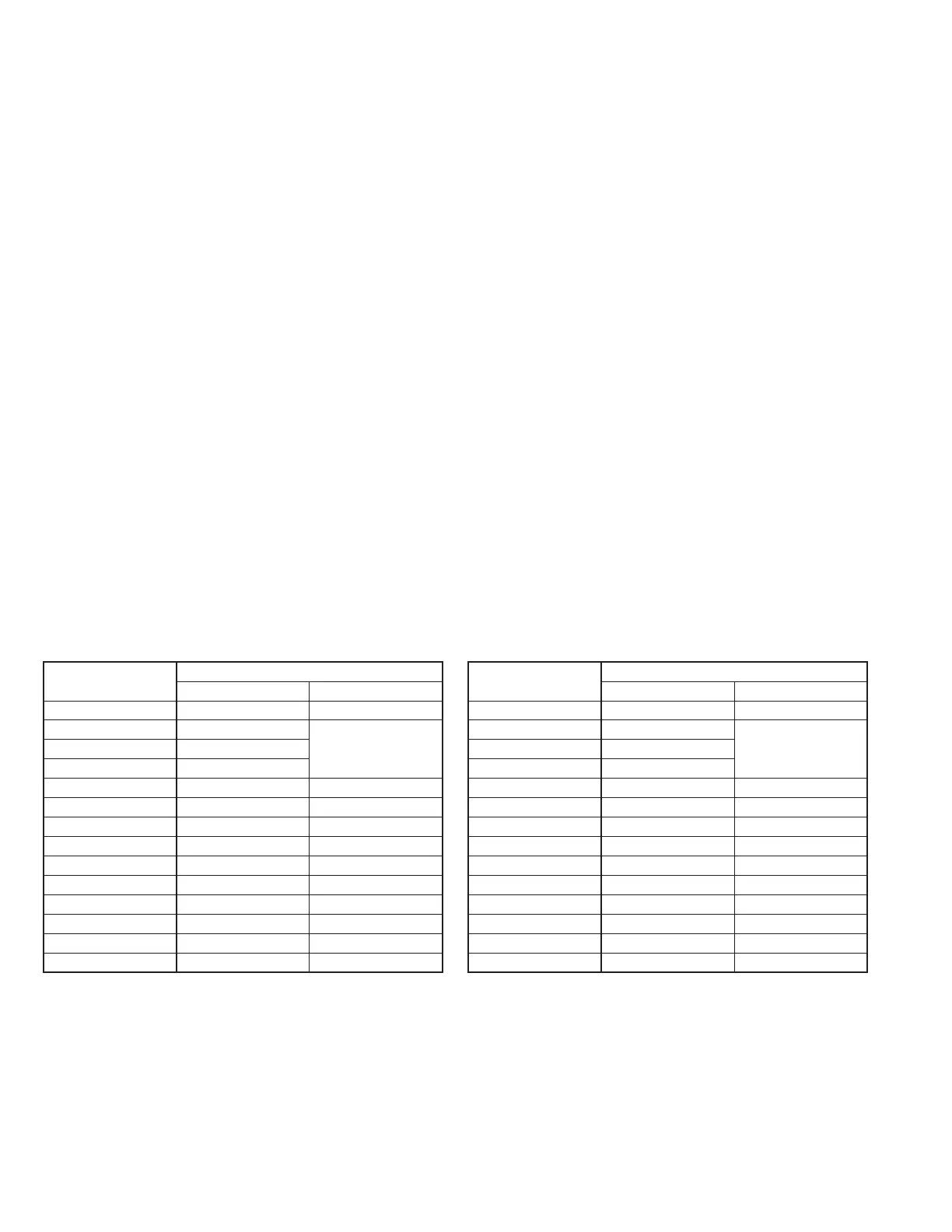
Table 16.1 - Natural Gas Heating Values at
Altitude ➀ ➂ ➃
Table 16.2 - Propane Gas Heating Values at Altitude ➁ ➂ ➃
Modine’s gas-fired equipment standard input ratings are
certified by ETL. For elevations above 2,000', ANSI Z223.1
requires ratings be reduced 4 percent for each 1000' above sea
level. For units in Canada, CSA requires that ratings be reduced
10 percent at elevations above 2,000'. The high altitude
adjustment instructions and pressure switch kits listed in this
manual are for use with units that will be installed over 2,000'.
These methods and kits comply with both ANSI Z223.1 and
CSA requirements.
If a unit is to be installed at higher elevations AND converted from
natural gas to propane gas operation, a propane conversion kit
must be used in conjunction with the pressure adjustment
methods and pressure switch kits listed herein. For the selection
and installation instructions for propane conversion kits, please
see the latest revision of Modine Manual 75-515.
Selection of the Proper Pressure and Kit
To determine the proper manifold pressure at altitude and if
required, the proper combustion air pressure switch kit, the full
model number of the heater, the fuel to be used, and the
altitude the unit will be installed at must be known. Refer to
the unit serial plate or carton label to obtain the necessary
information about the unit.
After obtaining this information, refer to the gas pressure and
selection charts shown in Tables 16.1 through 17.1. The
pressure charts are differentiated by elevation, fuel type, and
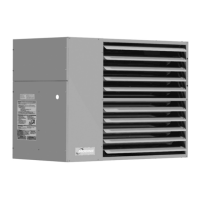
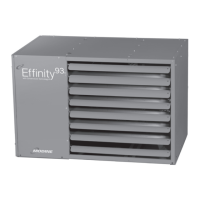
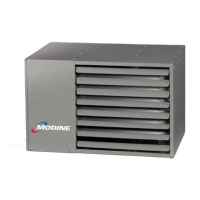
country the product is being installed in. The selection charts
are differentiated by product type, altitude and fuel type. If
converting from natural gas to propane gas and operation at high
altitude, both a propane conversion kit and a pressure switch kit must
be used (if applicable). Selection charts include the proper kit
suffix, when required.
Manifold Pressure Adjustment
The inlet pressure to the unit must be confirmed to be within
acceptable limits (6-7" W.C. for natural gas and 11-14" W.C.
for propane gas) before opening the shutoff valve or the
combination gas valve may be damaged.
Heaters for use with natural gas have gas valves that need to
be field set at 3.5” W.C. manifold pressure at 7.0” W.C. inlet
pressure.
Units for use with propane gas need to be field set for 10.0”
W.C. manifold pressure at 14.0” W.C. inlet pressure.
Installation above 2,000' elevation requires adjustment of the
manifold pressure as described.
Derated BTU Content Gas and Manifold Pressure Calculation
Some utility companies may derate the BTU content (heating
value) of the gas provided at altitude to a value other than
1,050 BTU/ft
3
for natural gas or 2,500 BTU/ft
3
for propane gas
to allow certain heating appliances to be used with no manifold
pressure adjustments. For this reason it is necessary that the
supplying utility be contacted for detailed information about the
gas type and BTU content (heating value) before operating any
heater. Tables 16.1 and 16.2 show the standard derated heating
values (4% per 1,000' of elevation in the USA and 10% between
2,001' and 4,500' elevation in Canada) of natural and propane
gases at various altitudes. If the utility is supplying gas with
heating values as shown in Tables 16.1 and 16.2, the manifold
pressure should be set to 3.5" W.C for natural gas and
10.0" W.C. for propane gas.
NOTE: Only the high fire gas pressure need be adjusted, low fire
gas pressure should remain the same.
➀ Values shown are for 3.5" W.C. manifold pressure, for other BTU content values (available from local utility) use Equation 17.1 to calculate manifold pressure.
➁ Values shown are for 10.0" W.C. manifold pressure, for other BTU content values (available from local utility) use Equation 17.1 to calculate manifold pressure.
➂ When installed at altitudes above 2,000', a pressure switch may need to be changed. Refer to Table 17.1 to determine if a switch change is required.
➃ Gas heating values are derated 4% per 1,000' of elevation in the USA and 10% between 2,000' and 4,500' elevation in Canada in accordance with ANSI Z223.1
and CSA-B149, respectively.
Altitude (ft)
Gas Heating Values at Altitude (BTU/ft
3
)
USA Canada
0-2,000 1,050 1,050
2,001-3,000 929
9453,001-4,000 892
4,001-4,500 874
4,501-5,000 856 856
5,001-6,000 822 822
6,001-7,000 789 789
7,001-8,000 757 757
8,001-9,000 727 727
9,001-10,000 698 698
10,001-11,000 670 670
11,001-12,000 643 643
12,001-13,000 618 618
13,001-14,000 593 593
Altitude (ft)
Gas Heating Values at Altitude (BTU/ft
3
)
USA Canada
0-2,000 2,500 2,500
2,001-3,000 2,212
2,2503,001-4,000 2,123
4,001-4,500 2,080
4,501-5,000 2,038 2,038
5,001-6,000 1,957 1,957
6,001-7,000 1,879 1,879
7,001-8,000 1,803 1,803
8,001-9,000 1,731 1,731
9,001-10,000 1,662 1,662
10,001-11,000 1,596 1,596
11,001-12,000 1,532 1,532
12,001-13,000 1,471 1,471
13,001-14,000 1,412 1,412


 To Next Page