1. Introduction
The MOGLabs FSC provides the critical elements of a high-bandwidth
low-latency servo controller, primarily intended for laser frequency
stabilisation and linewidth narrowing. The FSC can also be used for
amplitude control, for example to create a “noise-eater” that stabi-
lises the optical power of a laser, but in this manual we assume the
more common application of frequency stabilisation.
Feedback frequency stabilisation of lasers can be complicated. We
encourage readers to review control theory textbooks [1,2] and lite-
rature on laser frequency stabilisation [3].
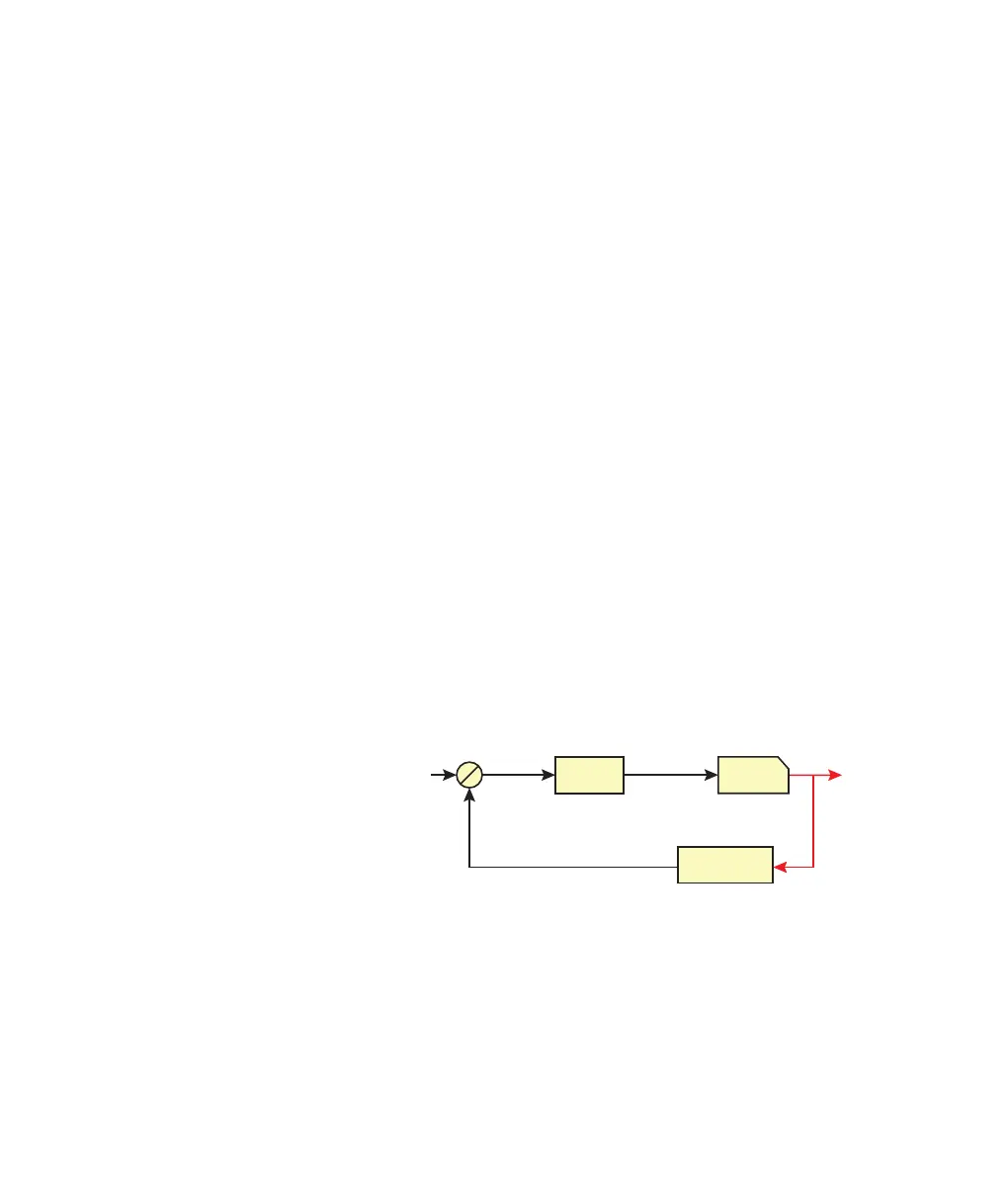
The concept of feedback control is shown schematically in figure 1.1.
The frequency of the laser is measured with a frequency discrimi-
nator which generates an error signal that is proportional to the
difference between the instantaneous laser frequency and the de-
sired or setpoint frequency. Common discriminators include optical
cavities and Pound-Drever-Hall (PDH) [4] or H¨ansch-Couillaud [5]
detection; offset locking [6]; or many variations of atomic absorption
spectroscopy [7–10].
+
–
0
Servo
Laser
Frequency
discriminator
Error
signal
Control
signal
dV/df
Figure 1.1: Simplified block diagram of the FSC.
The key common feature is that the error signal should reverse sign
as the laser frequency shifts above or below the setpoint, as in
figure 1.2. From the error signal, a feedback servo or compensator
generates a control signal for a transducer in the laser, such that
the laser frequency is driven towards the desired setpoint.
1



 To Next Page