EasyManua.ls Logo

Mooney Flowgrid - User Manual

Mooney Flowgrid
16 pages
Print Icon
To Next Page IconTo Next Page
Loading...
Flowgrid
®
Regulator
Installation/Operation/Maintenance Manual
MOONEY
®
FLOWGRID
®
REGULATOR
Table of Contents
Product Description ..............................................................1
Valve Markings .....................................................................3
Nameplate Information .........................................................3
Principles of Operation ..................................................... 4-5
Hydrostatic Testing ...............................................................5
Installation ........................................................................ 6-7
Piping Details .................................................................. 7-10
Start-up and Operation .......................................................11
Maintenance ................................................................ 13-14
Troubleshooting ..................................................................15
Warranty .............................................................................16
Product Description
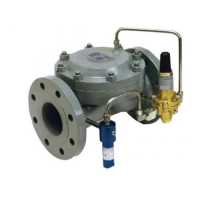
The Flowgrid
®
valve is an easy to maintain valve designed
to be used primarily with a self contained pilot system. The
Flowgrid
®
valve has several unique features that add to its
versatility such as:
In line maintenance.
Replaceable trim.
Reversible trim parts.
Dual flow elements for added capacity or redundancy.
Non stretching fabric reinforced diaphragm for stability and
fast response at all temperatures.
Positive spring shutoff.
Two-stage pressure drop to minimize noise and provide
cavitation protection.
Refer to Figure 1 (Page 2).
All Flowgrid
®
valves have six main parts (excluding bolting
and O-rings); the body, throttle plate, spacer, diaphragm,
main spring, and spring case. Although parts vary in size and
design, all valves share the same principle of operation.
The body (1) is available with single or dual ports. The
dual port design (figure 3) can provide redundant control if
equipped with dual pilots or be used with a single pilot for
maximum capacity.
Scope
This manual provides installation, operation, and maintenance instructions for the Flowgrid
®
valve and regulator. Instructions for
the Series 20 Pilot will be found in a separate manual.
Question and Answer IconNeed help?

Do you have a question about the Mooney Flowgrid and is the answer not in the manual?

Summary

Product Description

Key Features of Flowgrid Valve

Details unique features like in-line maintenance, replaceable and reversible trim, dual flow elements, and reinforced diaphragm.

Principles of Operation

Pressure Reducing Regulator (PRV) Operation

Describes how the Flowgrid valve functions in a pressure reducing application, showing closed and partially open states.

Back Pressure Regulator (BPV) Operation

Explains the valve's operation as a back pressure regulator, illustrating closed and partially open conditions.

Installation Guidelines

Installation Warnings

Critical safety warnings regarding overpressure, leaks, and proper installation location to prevent injury or damage.

Start Up and Operation

Pressure Reducing Regulator Start Up

Step-by-step instructions for starting up the Flowgrid valve in a pressure reducing application.

Back Pressure Regulator Start Up

Procedure for safely starting up the Flowgrid valve as a back pressure regulator or relief valve.

Standby Monitor Operation

Setting Up Standby Monitor

Procedure for configuring the operating and monitor regulators in a standby setup.

Working Monitor Operation

Setting Up Working Monitor

Instructions for configuring the 1st and 2nd stage regulators in a working monitor system.

Troubleshooting Guide

Initial Troubleshooting Steps

Key verification steps including checking specifications, piping, and regulator sizing.

Common Regulator Problems

Addresses issues like failure to shut off, erratic control, and instability with potential causes and solutions.

Overview

The Flowgrid® Regulator is a robust and versatile device designed for pressure regulation in various applications, primarily utilizing a self-contained pilot system. This installation, operation, and maintenance manual provides comprehensive guidance for its proper use and upkeep.

Function Description

The Flowgrid® valve acts as both an actuator and a throttling element, providing stable and responsive control over fluid flow. It is designed to operate in two primary configurations: Pressure Reducing Valve (PRV) and Back Pressure Regulator (BPV) or relief valve.

In a Pressure Reducing Application (PRV), the regulator maintains a desired downstream pressure. When the outlet pressure exceeds the pilot regulator's set point, the pilot closes, and full inlet pressure loads the spring case, causing the diaphragm to seal tightly against the throttle plate, effectively shutting off flow. As downstream demand increases and outlet pressure drops, the pilot opens, bleeding pressure from the spring case. This allows the inlet pressure to lift the diaphragm, opening the valve to meet demand. Conversely, when demand decreases, the pilot closes, and the spring force, combined with pressure differential across the diaphragm, closes the valve.

In a Back Pressure Configuration (BPV) or Relief Valve, the regulator controls upstream pressure. When the inlet pressure is below the pilot regulator's set point, the pilot closes, loading the spring case and closing the diaphragm against the throttle plate. As inlet pressure rises above the set point, the pilot opens, bleeding pressure from the spring case. This allows the diaphragm to lift, opening the valve to satisfy upstream flow demand. When upstream pressure decreases, the pilot closes, and the spring force, along with the pressure differential, closes the valve.

The main spring in the Flowgrid® valve provides high-frequency response, proportional action for stability, and a consistent minimum differential, regardless of temperature. It also contributes a positive closing force, which is crucial for monitor regulation applications. The spring case retains the main spring and provides a low-volume cavity where loading pressure from the pilot system is applied to the diaphragm to control flow.

Usage Features

The Flowgrid® valve offers several unique features that enhance its versatility and performance:

  • Bi-Directional Flow: The valve can accommodate flow in either direction by simply changing pilot connections and reversing the spring case. This flexibility allows for adaptability to different system requirements.
  • Dual Flow Elements: Some models feature a dual-port design, which can provide redundant control when equipped with dual pilots. Alternatively, it can be used with a single pilot to achieve maximum capacity, offering flexibility in system design and performance.
  • Two-Stage Pressure Drop: This design feature helps minimize noise during operation and provides cavitation protection, contributing to a smoother and more reliable performance, especially in demanding applications.
  • Fabric-Reinforced Diaphragm: The diaphragm is a critical component, functioning as both an actuator and the valve's throttling element. Its fabric-reinforced construction ensures stability, rangeability, and fast response without stretching. It is designed for durability and wear resistance, resisting "setting" over time.
  • Adjustable Restrictor: The restrictor in the pilot system allows for fine-tuning of the regulator's response rate, stability, and sensitivity. Smaller restrictor openings increase gain (sensitivity) but slow closing speeds, while larger openings reduce gain (increase proportional band) but improve stability and speed up closing. This adjustability enables optimization for specific application needs.
  • Capacity Options: The throttle plate, which supports the diaphragm and provides a sealing surface for bubble-tight shutoff, is available with restricted capacity plates (35%, 50%, and 75%). This allows for tailoring the valve's capacity to match specific flow requirements.
  • Pilot Gas Heaters (Optional): For applications where the formation of ice or hydrates in the pilot system is a concern, optional pilot gas heaters can be installed. These heaters warm the pilot supply gas to prevent freezing, ensuring reliable operation in cold environments.
  • Pilot Supply Filtration: The use of a Type 30 filter in the pilot supply line is recommended to clean dirt and other particulates that could affect the restrictor or variable orifice in the pilot. This helps maintain the integrity and performance of the pilot system.
  • Versatile Installation: The Flowgrid® valve can be installed in any position, with the best position being one that provides the easiest access for pilot adjustment and valve maintenance. This flexibility simplifies installation in various piping configurations.

Maintenance Features

The Flowgrid® Regulator is designed with ease of maintenance in mind, incorporating features that simplify inspection and part replacement:

  • In-Line Maintenance: A key feature of the Flowgrid® valve is its capability for in-line maintenance. This means that many maintenance tasks can be performed without removing the entire valve from the pipeline, reducing downtime and simplifying service procedures.
  • Replaceable Trim: The valve's trim parts are replaceable, allowing for easy restoration of performance without needing to replace the entire valve body. This contributes to a longer service life and cost-effective maintenance.
  • Reversible Trim Parts: Both the throttle plate and the diaphragm can be turned 180 degrees (not upside down) to renew the shutoff capability. If the inlet side shows less wear than the outlet, reversing these parts can extend their lifespan and maintain effective shutoff.
  • Easy Disassembly: The manual provides clear instructions for disassembling the valve, starting with disconnecting control lines and loosening main spring case nuts. This systematic approach ensures that components like the spring, diaphragm, throttling element, spacer, throttle plate, and O-rings can be removed in a logical order for inspection and replacement.
  • Inspection Guidance: The manual emphasizes the importance of inspecting all parts for wear and damage, particularly the periphery of the downstream (outlet) portion of the throttling plate, which is the primary shutoff surface. This guidance helps identify critical areas for attention during maintenance.
  • O-Ring Management: Specific instructions are provided for handling O-rings, including how to address swelling (which can occur due to gas permeation) and how to speed up the process of returning them to normal size (e.g., by placing them on ice). This ensures proper O-ring condition for effective sealing.
  • Cleaning Procedures: The manual advises against using sharp metal tools to clean O-ring grooves and emphasizes the need for smooth finishes on mating surfaces to prevent leakage. This attention to detail in cleaning helps maintain the integrity of the valve's seals.
  • Bolting Torque Values: A table of recommended bolt torque values is provided for various valve sizes, ensuring proper assembly and preventing damage to components like the diaphragm from overtightening.
  • Component Compatibility: The manual includes a warning about replacing studs or nuts only with combinations that meet SAE Grade 7 or ASTM Grade B7 ratings, ensuring that replacement parts meet the necessary strength and durability standards.
  • Hydrostatic Testing Procedures: Detailed procedures are outlined for hydrostatic testing, including options to protect the diaphragm from damage. This ensures that retesting can be performed safely and effectively, maintaining the valve's pressure integrity.
  • Troubleshooting Guide: A comprehensive troubleshooting section helps diagnose common problems such as the regulator not shutting off, erratic control, instability, or failure to regulate to the set point. This guide, along with a failure mode chart, assists in quickly identifying and resolving operational issues.

Mooney Flowgrid Specifications

General IconGeneral
ApplicationFlow measurement and control
CategoryControl Unit
Output Current4-20 mA
Temperature Range-40°F to 185°F (-40°C to +85°C)
Operating Temperature-40°F to 185°F (-40°C to 85°C)
Protection RatingIP65
Housing MaterialAluminum
End ConnectionsFlanged, threaded, or welded