10
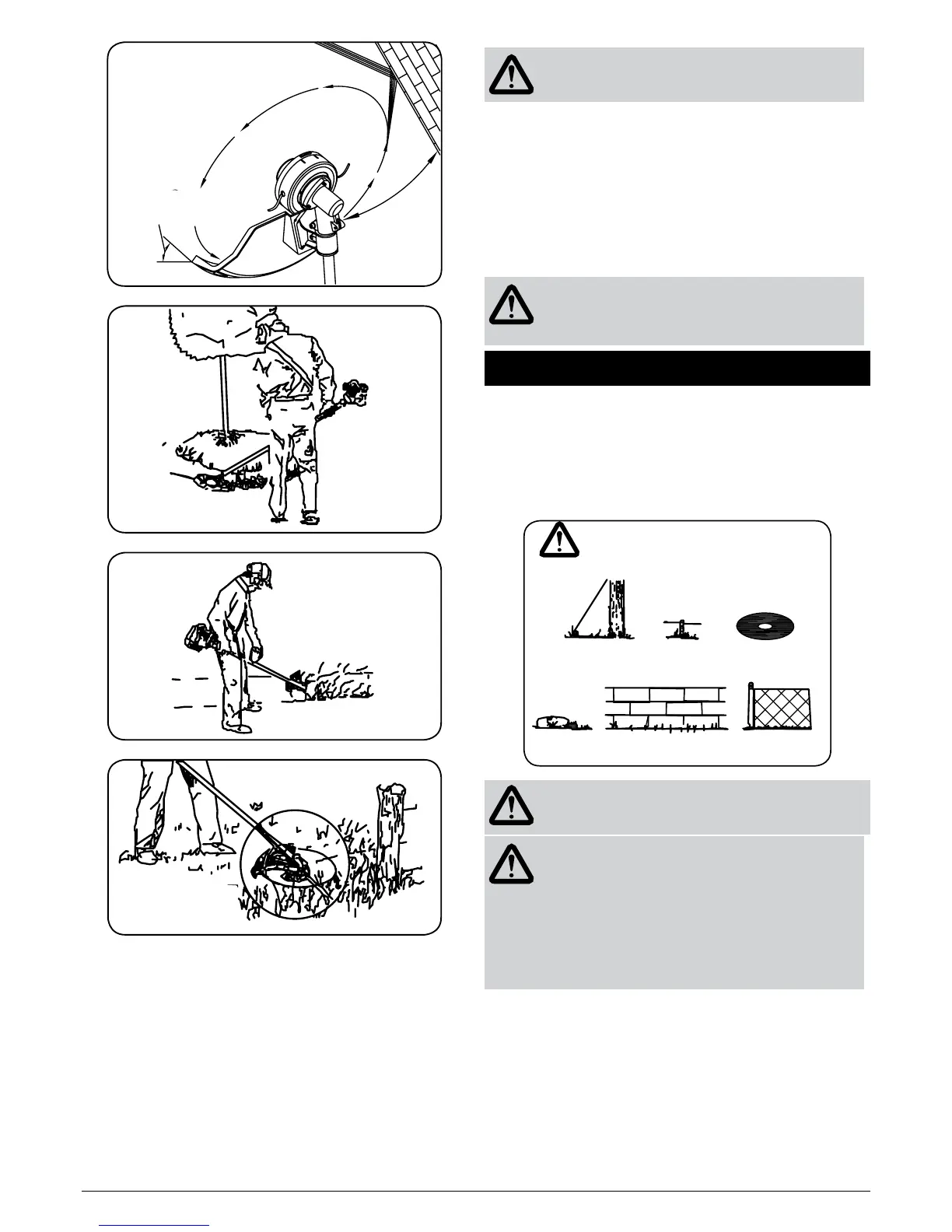
Angle to ground
Trimming
Knife side raised
Debris
Angle to
wall
Scalping
Edging
Avoid Wire
TRIMMING
This is feeding the trimmer carefully into the material you wish to
cut.Tilt the head slowly to direct debris away from you. If cutting
up to a barrier such as fence, wallor tree,approach from an angle
where any debris ricocheting off the barrier will fly away from you.
Move the line head slowly until the grass is cut right up the barrier,
but do not jam( overfeed )the line into the barrier. If trimming up to a
wire mesh or chain linked fence be careful to feed only up to wire. If
you go to far the line will snap off around the wire. Trimming can be
done to cut through weed stems one at a time. Place the trimmer
line head near the bottom of the weed-never high up which could
cause the weed to chatter and catch the line. Rather than cut the
weed right through, just use the very end of the line to wear through
the stem slowly.
WARNING!
Do not use a steel blade for edging or scalping.
SCALPING & EDGING
Both of these are done with the line head tilted at a steep angle
Scalping is removing top growth leaving the earth bear. Edging is
trimming the grass back where it has spread over a sidewalk or
drive way. During both edging and scalping, hold the unit a steep
angle and in a position where the debris, and any dislodging dirt
and stones, will not come back towards you even if it ricochets
off the hard surface. Although the picture shows how to edge and
scalp every oprator must find for himself the angles which suits his
body size and cutting situation.
WARNING!
Do not trim in any area where there are strands of fencing
wire. Wear protective safety protecting, Do not cut where you
cannot see what the cutting device is cutting.
CUTTING WITH A BLADE
CUTTING WITH A BLADE
There are many different types of blades, however the two most
commonly used are the following.
BRUSHBLADE is used for cutting brush and weeds up to 3/4” in
diameter. Only CG420-2 255mm 3-blade can be used in this type
of brush cutter.
WARNING!
Utility Wires
Metal Stakes Rubber
Rocks Masonary Fences
Do not touch these types of objects with blade
WARNING!
Do not use a brushcutter for cutting trees.
WARNING!
Do not cut with dull, cracked or damaged metal blade.
Before cutting growth, inspect for obstructions such as
boulders, metal stakes or strands of wire from broken
fences. If an obstruction cannot be removed, mark its
location so that you can avoid it with the blade. Rocks
and metal will dull or damage a blade. Wires can catch
on the blade head and flap around or be thrown into
the air.
Blade thrust is the reaction which may occur when the spinning
blade contacts anything it cannot cut. This contact may cause the
blade to stop for an instant, and suddenly “thrust” the unit away
from the object that was hit. This reaction can be violent enough
to cause the operator to lose control of the unit. Blade thrust may
occur without warning if the blade snags, stalls or binds. This is
more likely to occur in areas where it is difficult to see the material
being cut. For cutting ease and safely, approach the weeds being
cut from the right to the left,in the event that an unexpected object
or woody stock is encountered, this could minimise the blade thrust
reaction.


 To Next Page
 Loading...