EasyManua.ls Logo

mycom 220JL-V - User Manual

Default Icon
209 pages
Print Icon
To Next Page IconTo Next Page
Loading...
2205B0JE-DA-J-N_2014.05.
3–14–15 Botan Koto-ku, Tokyo 135-8482, Japan
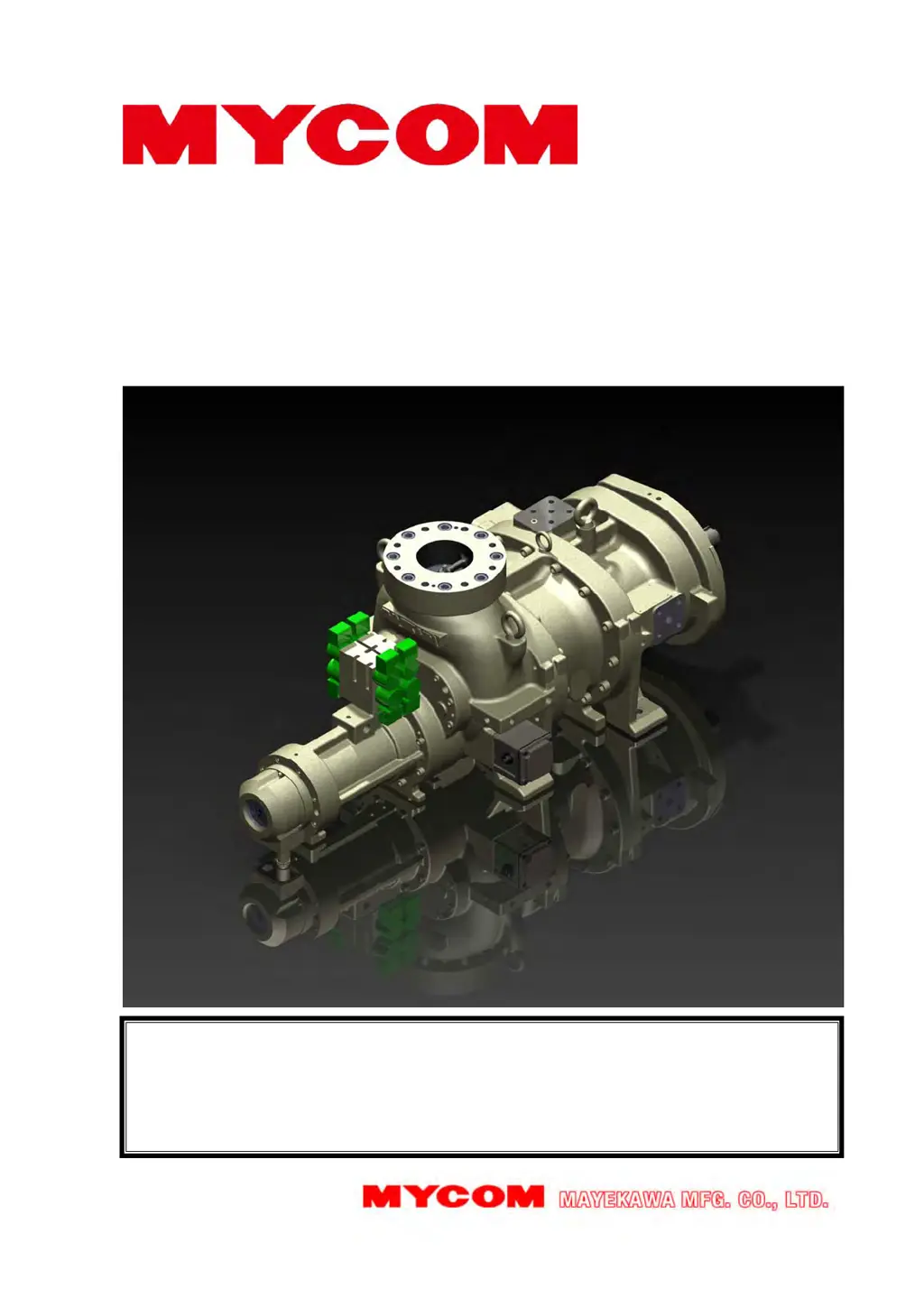
Screw Compressor
J-Series Instruction Manual
170JS-V/170JM-V/170JL-V
220JS-V/220JM-V/220JL-V
280JS-V/280JM-V/280JL-V
CAUTION
Before operating, maintaining, or inspecting this product, read the manual thoroughly and fully
understand the contents.
Keep the operation manual in a safe, designated place for future reference whenever the need
arises.
Specifications of this product are subject to change without prior notice.

Table of Contents

Other manuals for mycom 220JL-V

Questions and Answers

  • L
    lauren38Aug 17, 2025
    What causes abnormally high pressure in my mycom 220JL-V Air Compressor?
    • C
      Christina MoralesAug 17, 2025
      Abnormally high pressure in your mycom Air Compressor can be caused by a heat exchange failure at the condenser (heat exchanger). Clean and wash the heat exchangers, using solvent depending on the contamination. Other causes include malfunction of the fan motor, thermo-switch, water spray bars, cooling water pumps, etc. (identify malfunctioning devices, examine their causes, take measures, and replace malfunctioning devices), a flow volume adjustment fault for cooling water, brine, etc. (readjust manually or examine the cause and take measures if an automatic control valve is used), or poor performance in the heat exchanger (re-examine the conditions to improve if the trouble is caused by a change in operating conditions).
  • B
    Brent MaldonadoAug 21, 2025
    What to do if my mycom 220JL-V stops immediately after startup?
    • M
      michaelbeanAug 21, 2025
      If your mycom Air Compressor stops immediately after startup, it could be due to the low pressure protection circuit being activated. Check for and stop any refrigerant leaks, then replenish the refrigerant, being aware of potential moisture contamination in the system. Another cause might be insufficient refrigerant circulation volume; if there are any heat exchange failures, such as poor defrost performance, investigate the cause and take corrective actions. A malfunction of the low pressure protection device, pressure sensor, relays, etc., could also be the reason. In this case, identify the malfunctioning devices, examine their causes, take appropriate measures, and then replace the faulty devices.
  • C
    Charles NicholsonSep 2, 2025
    What causes faulty indication of capacity control position in my mycom 220JL-V Air Compressor?
    • T
      Travis MitchellSep 2, 2025
      Faulty indication of capacity control position in your mycom Air Compressor may arise from imprecision in the compressor indicator. Manually tighten screws to the 0% indication position of compressor capacity control. It could also be due to imprecision in the controller capacity control indicator, in which case, replace the indicator cam. Another potential cause is a malfunction in the potentiometer; if this is caused by aging degradation or prolonged partial load operation, replace the potentiometer.
  • O
    Oscar SwansonSep 5, 2025
    What causes capacity control malfunction in my mycom 220JL-V Air Compressor?
    • D
      David WhiteSep 5, 2025
      Capacity control malfunction in your mycom Air Compressor can occur if 100% or 0% is undetected by the indicator; replace the micro-switch in this case. Malfunction of solenoid (modular) valves or related relays for capacity control can also cause this issue; for aging degradation, replace the parts. Internal leakage of solenoid (modular) valves for capacity control is another possibility; if caused by prolonged low load operation, improve by re-examining the operation method.
  • J
    Joshua MillerSep 9, 2025
    How to address abnormal vibration and/or noise in my mycom 220JL-V?
    • J
      Jeffrey GuzmanSep 9, 2025
      Abnormal vibration or noise in your mycom Air Compressor might be due to insufficient axis adjustment with the motor side; readjust the shaft-center. Another cause could be a large runout in the Male rotor axis; if loose locknuts exist and no other fault is found in parts such as the thrust bearing, tighten the locknuts evenly. Damage to the thrust bearing can also result in abnormal vibration or noise. Note that the appropriate time for replacement will differ due to operating conditions.
  • J
    Joshua ByrdNov 13, 2025
    Why is my mycom 220JL-V Air Compressor not starting?
    • A
      allisonbrownNov 13, 2025
      Several factors can prevent your mycom Air Compressor from starting. The power source might be off, so it is recommended to check using a check sheet, and by pointing and calling. There may be a main motor malfunction (refer to the motor instruction manual for other causes and actions), a capacity control of 0% undetected by the unloader indicator (replace the micro-switch), a capacity control hydraulic circuit defect (readjust), leaks or clogging in pipes and solenoid valves (remove factors, check oil contamination level, and replace pipes and solenoid valves). Other potential causes include unconfirmed hydraulic pressure or cooling water circulation (identify malfunctioning devices, examine their causes, take measures, and replace malfunctioning devices), clogging in connecting pipes (re...
  • R
    ryanadamsNov 24, 2025
    What causes low oil-supply pressure in my mycom 220JL-V?
    • L
      Lisa RamosNov 24, 2025
      Low oil-supply pressure in your mycom Air Compressor can stem from several causes. There might be clogging in the oil filter element, indicated by a big difference in outlet/inlet pressures; remove the clogging, check the oil contamination level, and change the lubricant if necessary. A defect inside the compressor could also be responsible; check the oil contamination level and, after a vibration noise diagnosis, overhaul the compressor if necessary. Other potential causes include insufficient oil amount in the oil separator (inspect the oil heater and related circuit relays, replacing parts as needed), insufficient return due to insufficient refrigerant circulation (resolve the refrigerant circulation issue and return oil from the load side heat exchanger), or an extensive oil leak (insp...
  • E
    Edwin SmithNov 27, 2025
    How to troubleshoot a leak from the mechanical seal of my mycom Air Compressor?
    • T
      teresa04Nov 28, 2025
      If there's a leak from the mechanical seal of your mycom Air Compressor, it could be an initial leak after replacement until the sliding surfaces fit together. For an initial leak, the amount might increase temporarily but should gradually decrease; monitor to ensure it doesn't continuously increase. Another cause is damaged sliding surfaces due to excessive heat; if the heat load is below the device’s design conditions, re-examine operating conditions. Deteriorated parts, such as an aging O-ring, can also cause leaks, so replace the O-ring. Finally, incompatibility between operating conditions (working temperature ranges, refrigerant, etc.) and the lubricant could be the issue; re-examine operating conditions if possible, and if not, select a suitable lubricant and replace all the current...

Summary

1 Safety

1.1 Observation;Prevention

Key safety observations and preventive measures for safe operation.

1.1.1 Observance (Dos)

Lists essential actions and practices to follow for safe operation.

1.1.2 Prohibition (Donts)

Lists actions and practices to avoid for safe operation.

1.4 Safety Devices

Details the safety features and devices installed to protect the compressor.

2 Structure and Specifications of the Compressor

2.3 Compressor Specifications

Provides detailed technical specifications for different compressor models.

2.3.1 Specifications

Lists the technical data and parameters of the compressor models.

2.3.2 Operation Limits

Defines the acceptable operating ranges for the compressor.

2.4 Structure of the Compressor

Explains the internal components and assembly of the compressor.

2.8 Variable Vi Control

Details the mechanism and function of variable internal volume ratio control.

3 Installation

3.1 Precautions for Installation

Essential safety and procedural notes before starting installation.

3.2.5.3 Equipment and Devices for Protection of the Compressor

Details on auxiliary equipment for compressor protection.

4 Compressor and Package Operation

4.1 Adjustment before Test Operation

Procedures for initial adjustments before the compressor is run.

4.1.1 Adjustment of Unloader Slide Valve and Variable Vi Slide Valve

Specific steps for adjusting key operational valves.

4.2 Lubricant (Refrigerant Oil)

Information on selecting, managing, and using compressor lubricant.

4.3 Precautions for Operation

Essential safety guidelines to follow during compressor operation.

4.3.1 Prevention of Liquid Return (Liquid Backflow) Operation

Measures to avoid and consequences of liquid return.

5 Maintenance and Inspection

5.1 Precautions for Maintenance and Inspection

Essential safety guidelines before performing maintenance.

5.2 Maintenance List

A comprehensive list of maintenance tasks and their schedules.

5.2.2 Periodical inspection

Scheduled inspections at regular intervals.

5.4 Replacement Parts of the Compressor in Overhauling

List of parts recommended for replacement during overhaul.

5.3 Management of Lubricant

Procedures for managing and monitoring the compressor's lubricating oil.

5.4 Disassembly and Assembly of the Compressor

Detailed instructions for taking apart and reassembling compressor components.

5.4.4 Removing the Compressor

Steps for safely detaching the compressor from its package.

5.4.7 Vi Position Sensor

Steps for removing and installing the Vi position sensor assembly.

5.4.24 Adjustment of End Clearance

Steps for adjusting the end clearance of the rotors.

6 Troubleshooting

01 Compressor not starting

Steps to troubleshoot failure to start the compressor.

02 Compressor stops immediately after startup

Steps to address sudden shutdowns after startup.

05 Abnormally high pressure (abnormal discharge pressure)

Troubleshooting steps for high discharge pressure.

06 Abnormally high discharge temperature

Steps to address excessive discharge temperatures.

11 Abnormal vibration and;or noise of compressor

Troubleshooting for unusual vibrations or noises from the compressor.

Appendix 1 Tips for Design, Manufacturing, and Installation of the Compressor Package

mycom 220JL-V Specifications

General IconGeneral
Power SourceElectric
Horsepower2 HP
Tank Capacity20 gallons
Voltage120V
Noise Level78 dB

Related product manuals