CL40 Antenna Technical Instruction Manual Page 2-3
Section 2 Preparation for Use and Installation Issue 3.0
mast assembly (item 32) and the mast
insulator assembly (item 11) using two
gear clamps (item 61). Apply a bead of
silicone sealant where the upper mast
section inserts into the mast insulator.
See Figure 2-9.
NOTE
If you purchased the Top Loading Kit (Nautel
Part # 199-9085), refer to Figures 2-17 and 2-
18 to prepare your location and install the
foundation and guy wires. Use Table 2-3, not
Table 2-1, to configure the loading coils.
If you purchased the Guy Wire Kit (Nautel Part
# 199-9087), refer to Figures 2-17 and 2-19 to
prepare your location and install the foundation
and guy wires. Use Table 2-1 to configure the
loading coils.
If you purchased the Solar Light Mounting
Assembly (Nautel Part # 199-9086), refer to
Figure 2-19 for installation instructions. Install
this assembly before erecting the antenna.
(j) Lay out the six radials (item 7) in a
pattern approximating their final
configuration. Using the 2" stainless bolts
and stainless 'U' bolts (items 40, 41, 43 &
44) attach the radials to the mounting
ring (item 6) and mounting plate (item 5).
Replace any 1/4 SS nuts supplied with
the ‘U’ bolts with 1/4 SS locknuts (item
44). See Figure 2-10. Taking care not to
kink or twist the radial connector cable
assembly (item 3), insert each of the six
aluminium tips into the end of each
radial. Attach one vertical radiator (item
9) to the outer end of each radial using
the galvanized eyebolt supplied by
passing it through the pipe and
aluminium tip. Attach the loose end of
each radiator to the adjacent radial
connector assembly wire using the split
bolts (item 46). See Figure 2-11. Remove
the two 3/8 galvanized bolts from the end
of the upper mast section. If necessary,
raise the mast a further few feet. Slide
the radial assembly over the top of the
mast and align the two holes in the
mounting plate with the holes in the end
of the mast. Re-install the 3/8 galvanized
bolts and tighten firmly. Raise the mast a
further foot and place a wooden ‘A’ frame
(not supplied, see Figure 2-12) under the
upper mast. Lower the mast on to the
wooden frame until the mast is straight all
along its length. Attach three of the
vertical radiators to the 5/8 eye nut just
above the mast insulator and the
remaining three radiators to the eyebolt
on the opposite side. See Figure 2-9.
Use the stainless steel shackles
provided. Remove any slack by adjusting
the wire rope clip on each radiator.
Attach the loose end of each radiator to
the upper mast using one gear clamp
(item 47). Attach bonding lead (item 4)
between each radial and the upper mast
using six 9/16 to 1-1/4 gear clamps (item
45) and one 2-5/16 to 3-1/4 gear clamp
(item 47). See Figure 2-10.
(k) Mount two mounting bracket assy (item
29) on A1 using 4 - 3/8 x 1 stainless steel
bolt (item 59) with 4 galvanized flat
washers (item 51) and 4 galvanized lock
washers (item 50). Before securing the
mounting bracket assy install 8 - 3/8 x 6”
galvanized carriage bolts (item 58)
through the square holes of the mounting
bracket assy. Mount the loading coil
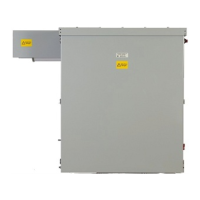
enclosure (A1, see Figure 2-13) 18”
below the weather protector using two
mounting bracket assy (item 29), two
mounting bracket back plates (item 35),
the 8 previously installed 3/8 x 6”
galvanized carriage bolts (item 58) with
flat washer, split washer and nut (items
51, 50, 49). Position it so the output
connector points up. The bottom of the
enclosure has a drain plug.
(l) Enter the carrier frequency in Table 2-1
(use Table 2-3 if you have the Top
Loading Kit) to determine the
configuration of loading coils L1A and
L1B. Connect the loading coils for series
or parallel configuration then connect
wires (provided in the ancillary kit) to the
appropriate input and output taps of the
loading coils. See Figures 2-14a & 2-14b
for connection examples.



 To Next Page