Need help?
Do you have a question about the NEFF D64 Series and is the answer not in the manual?
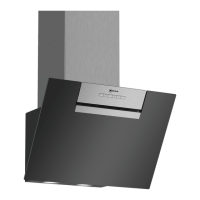
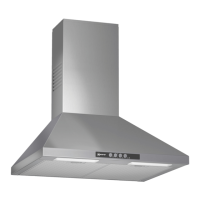
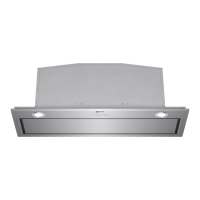
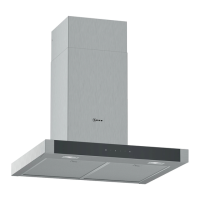
This document describes the NEFF D94..., D64..., D95..., D65... extractor hood, a kitchen appliance designed to extract cooking vapor and odors. It can operate in either air extraction mode or air recirculation mode, offering flexibility for different kitchen setups.
The primary function of the NEFF extractor hood is to remove cooking vapors and odors from the kitchen environment. In air extraction mode, the air drawn in is cleaned by grease filters and then conveyed to the exterior through a pipe system. This mode requires proper ventilation to the outside. In air recirculation mode, the drawn-in air is cleaned by both grease filters and an additional odor filter before being returned to the room. This mode is suitable for installations where external ventilation is not possible or desired, but requires the installation of an odor filter.
The appliance features multiple fan settings, including an intensive mode for particularly strong odors or vapors. The lighting can be switched on and off independently of the ventilation system.
While specific power consumption figures are not provided, the manual emphasizes energy-saving practices. The appliance is designed for use in private households and enclosed spaces, up to an altitude of 2000 m above sea level. Its maximum weight is 40 kg, which is important for installation considerations.
For air extraction, the exhaust air duct should be installed with a gradient of at least 1° from the appliance to prevent condensation. The recommended exhaust air pipe diameter is 150 mm, though a 120 mm diameter is also mentioned with a reducing connector. The connecting cable is approximately 1.30 m long. The appliance complies with EC interference suppression regulations and is protection class 1, requiring a protective earth connection.
Safety clearances are crucial for installation. For electrical cooktops, the minimum safety clearance above must be 600 mm (for Australia and New Zealand). For gas hobs, the specific clearance depends on the hob's installation instructions, with the larger of the two clearances (hob vs. hood) always applying if both are operated together. The appliance should be installed at least 50 mm from a high-sided unit or wall if placed directly next to it.
The extractor hood is controlled via a set of intuitive buttons:
The manual advises users to switch on the appliance during cooking to prevent condensation and to select a higher fan speed in good time if large amounts of steam are produced, as this helps distribute odors less. Putting a cooking lid on also helps reduce cooking vapors and condensation.
Regular cleaning and maintenance are essential for efficient and safe operation.
Cleaning the appliance:
Grease filters:
Odor filters (for recirculation mode):
Safety during maintenance:
The manual also includes a troubleshooting section for minor faults, advising users to check simple solutions before contacting customer service. For defective LED lights or power cord damage, professional assistance is required. Genuine spare parts should always be used for repairs.
 General
| Brand | NEFF |
|---|---|
| Model | D64 Series |
| Category | Ventilation Hood |
| Language | English |

 To Next Page