English Deutsch Français Español Italiano
日本語
27
THE WHEELS
Please review the wheel supplier instruction manual for specific procedures, instructions and warnings.
Due to the bumpy surfaces of the road, the weight of the cyclist and any additional baggage mounted onto your
NEIL PRYDE bike, the wheels are subjected to constant stress throughout their lifetime. Although great care and
attention is paid to the manufacture and delivery of the wheels they are still susceptible to minor wear during the
first few kilometers of use, even when used properly. Components such as the spokes and nipples can lose a slight
amount of tension early on. Because of this, you may be required to true the wheels properly after they have been
worn in over 100 to 200 kilometers of use.
You should check the wheels after they have been worn in in accordance with the wheel manufacturer’s instructions
and warnings. Particular areas that should be checked are the hub, rim and spokes of the wheels. You should not need
to tighten the spokes too often. The tire encases the inner tube by fitting onto the rim of the wheel. The inner tube is
very sensitive, and so it is protected by a rim tape that runs around the rims base. This offers some protection against
the sharp spoke nipples and rim edges.
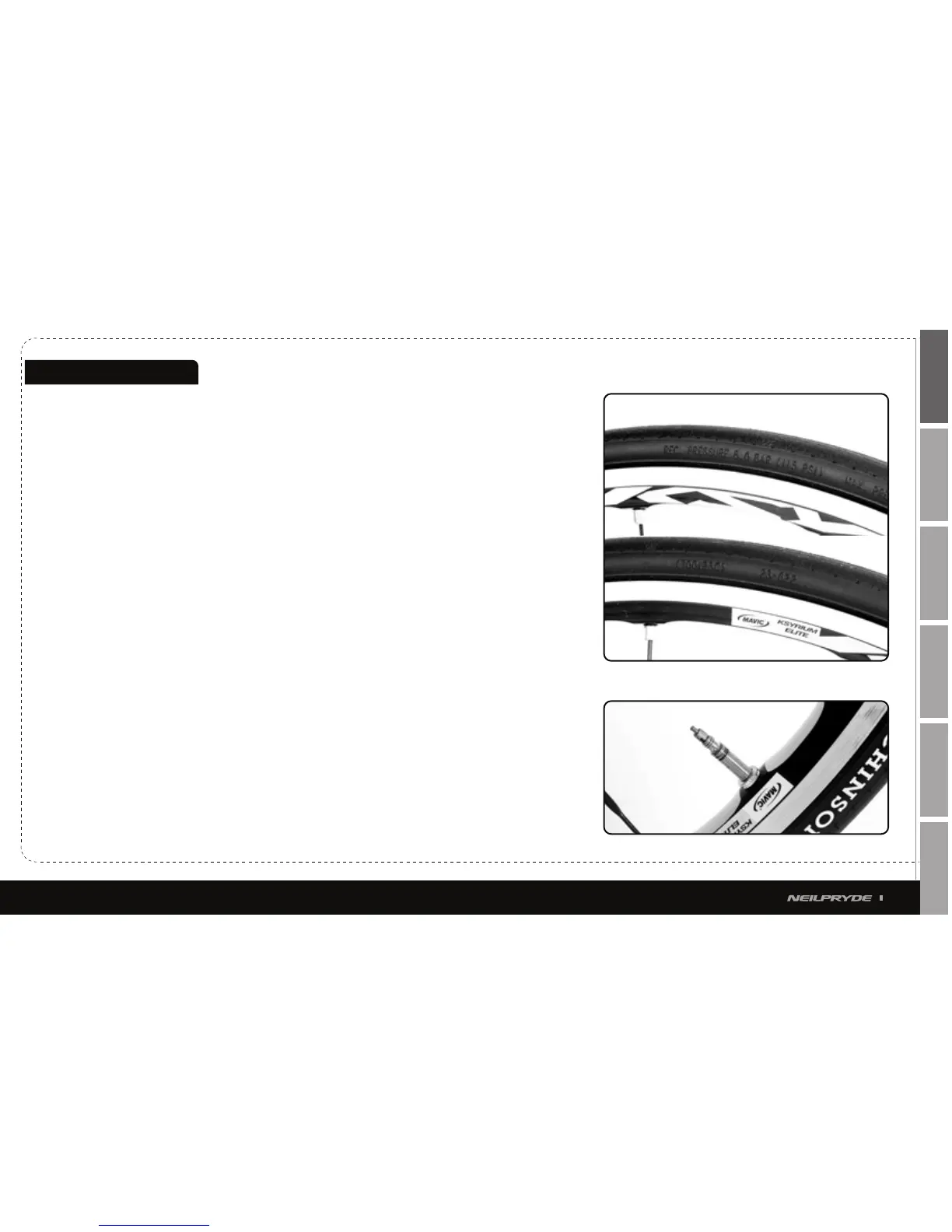
In order to replace and fit a new tire onto your NEILPRYDE bike, you must know what the dimensions of the old tire are.
These dimensions can be found marked on the edge of the tire. You must mount a new tire that has dimensions that
match the old one. If you fit a bigger tire, there is a risk that the new tire could drag along the rear frame or the fork,
and this can be damaging for your bike and tires.
In order for the tires to work properly and most efficiently, they must be correctly inflated to the recommended air
pressure. Doing so will also make the tires more resistant to deflation while you cycle. Under-inflated tires run the risk
of getting pinched, or snake-bitten, when traveling over sharp objects. You can locate the recommended air pressure
on the side of the tire, or on its label. You should see two different specifications. The highest specification is the one
that is most suitable for road use (smooth surfaces). The lower specification is more suited for off-road riding. This is
because it offers better cushioning against any lumps and bumps. With an increase in pressure, rolling resistance is
lowered, but so is the level of comfort afforded to the rider.
Many tires are designed to travel in one specific direction only. This will differ according to the tire model. Therefore,
in order to get the most out of your tires, always check and fit them correctly, so the tires will revolve in the correct
direction. You can find this information indicated on the side of the tire.
Race Valve
Dimension and Air pressure range of tire



 To Next Page