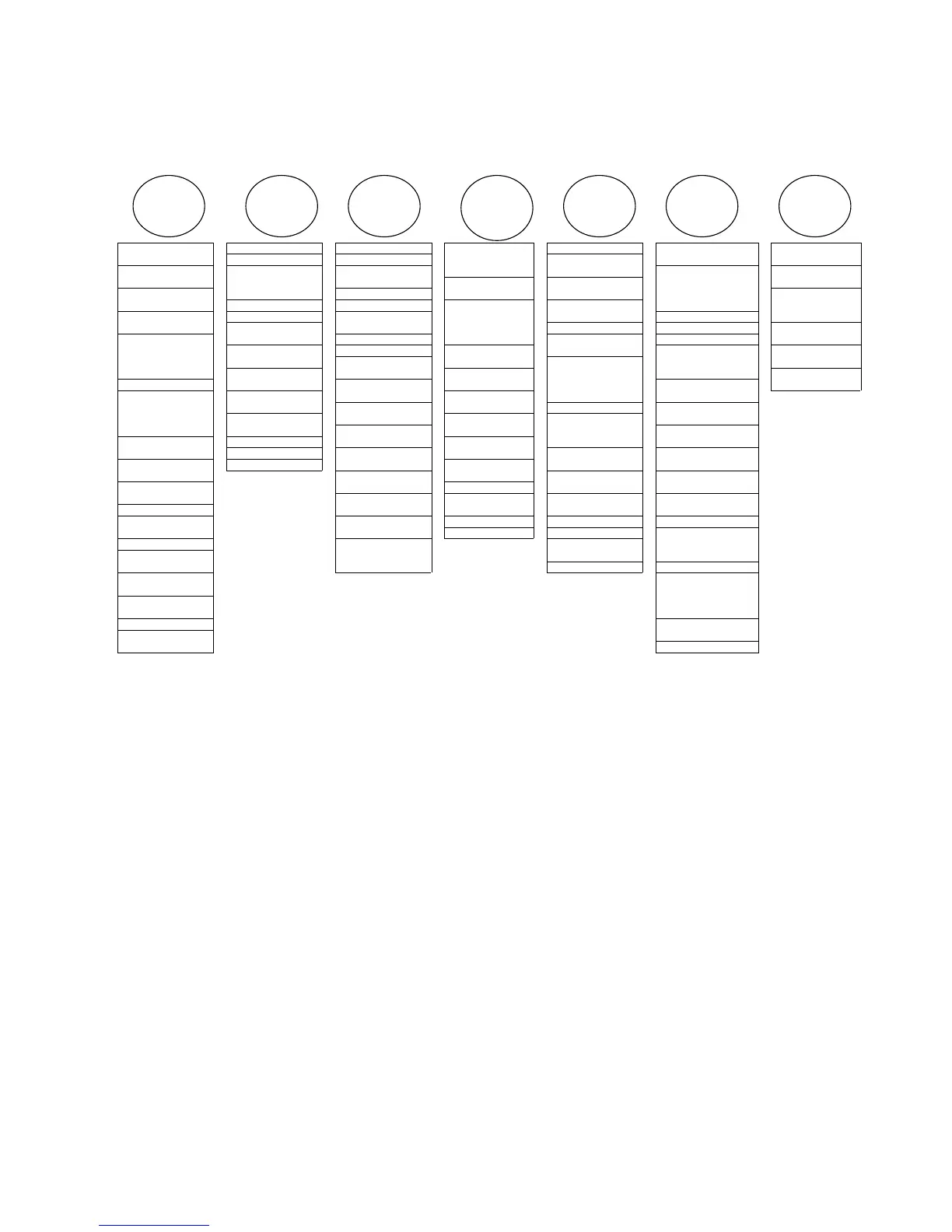
BURNER TROUBLE SHOOTING
Insufficient air for Oil leaks Fan noise Insufficient draft at Delayed ignition Too much excess Aquastat set too low
combustion Oil spilled Loose air shutter breeching or over Improper electrode air – low CO
2
or needs calibrating
Improper mixing Poor cutoff on Burner not mounted the fire setting Improper mixing of Aquastat contacts
of oil and air Pressure regulating Securely Chimney dirty, too Transformer oil and air by air dirty
Lack of air velocity Valve Pump gears worn small, or obstructed defective handling parts - Generator or instan-
and turbulence Poor grade of oil Dirty strainers Draft control Voltage drops when lack of turbelence taneous coil too
Grade of oil too Dirty chimney Obstructed suction improperly adjusted burner starts Air leaks through small
heavy Boiler sections not Line or locked in open Loose ignitors Boiler Storage tank too
Nozzle worn, clogged, Properly sealed Air in oil line positiom Porcelain insulators Boiler sooted up small
loose, insert loose, Draft control stuck Defective coupling Nozzle too large - carbonized Boiler priming and Coil not submerged
improper gallon rate In open position Burner resting on oil overfired High tension leads foaming due to in boiler water
or spray angle Openings between line for support Oil pressure too low loose, insulation dirty water Boiler water level
Oil pressure too low Smoke pipe joints Tank hum (anti-hum or excessively high defective, Building radiation or too low
After drip due to Lack of air for Valve) Insufficient mixing or grounded ducts too small
defective pressure Combustion Motor insecurely of air and oil Oil spray defective Building heat losses
regulating valve Improper oil and air Mounted Lack of primary Nozzle dirty, loose, high, needs insulation
cutoff mixture Motor bearings bind air, fan blades dirty or too far back in Poor or excessive
Nozzle too far back Over fired (lubricate) Static pressure in blast tube draft
in blast tube Dirty nozzle Pump and motor blast tube too low Pump pressure High stack
Burner set too far Defective nozzle shaft misaligned Operating periods too low temperature
forward Transformer too short After drip due to Overfired – nozzle
Flame striking Defective - hum Nozzle clogged poor cutoff too large
chamber walls Draft control Nozzle too far Oil leaking into Firing periods
Fan dirty, or loose Vibrating forward chamber too short
Operating period Relay hum – clapper Wrong spray angle Excess air Nozzle too small
too short not seating securely Flame impingement High draft Oil leak at buried tank
Insufficient draft Housing out of Primary air velocity or in buried suction
Chimney too small, Alignment. (New too great or return line
dirty, obstructed Housing needed) Water in oil Oil pressure too low
Breeching reduced Thermostat in wrong
in diameter location, setting too
Motor not up to high; wrong
speed differential
Over fired Defective radiator
Loose or defective vent valves
coupling Boiler or furnace too
OPERATING
Flue Draft
The flue draft must be -.03” W.C. to -.05”W.C. If the -.05”W.C. is exceeded a power failure situation could
cause a solid fuel fire to burn out of control.
BURNING WOOD
See pages 10 - 12 for the best types of wood to burn.
In order to increase the capacity of the boiler firebox for burning wood, the grates may be removed, the
base lined with firebrick as shown in diagram #1, and the fire built directly on the firebrick floor of the unit.
Grates are required when burning coal but wood burns more efficiently without grates.
Turn the control box toggle switch marked Oil to “Automatic” and the toggle switch marked “Wood Only”
this will start the combustion air draft fan. During the initial start turn the draft fan off by means of the
switch located on the fan itself. Place paper and wood kindling in the firebox and ignite it. Once the wood
begins to burn, start the draft fan by turning the switch located on the fan to the “On” position. Once a
good base fire is established fill the firebox with wood. After the water temperature reaches 170ºF turn
the control box toggle switch marked “Wood” to Automatic. Automatic position allows the oil burner to
come on if the wood fire (because of not being adequately charged) permits the water temperature to
drop below 170ºF.
*A small intense fire is preferable to a large smoldering fire, to reduce the buildup of creosote.
Smoke
and Soot
Odors
Noise
(mechanical)
Noise
(combustion.


 To Next Page