Need help?
Do you have a question about the Nextech QV3868 and is the answer not in the manual?
Use only the special car charger provided to avoid product damage or malfunction.
Avoid contact with water, vapor, and operating with wet hands to prevent short circuits.
Protect the device, battery, and charger from strong impacts to prevent faults.
Operate within -10°C to +60°C; extreme temperatures can cause faults.
Avoid dusty areas to prevent lens contamination affecting recording quality.
Do not disassemble the equipment or accessories without authorization to maintain warranty coverage.
Details about MINI USB, MicroSD card slot, and reset button for data transfer and recovery.
Explanation of the LED light's function during recording and charging.
Instructions for starting, turning off, and accessing the setting interface using the power button.
Connects to a Type-C cable for charging the device's battery.
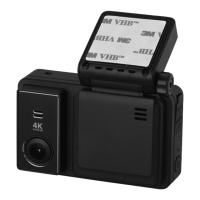
Describes the magnetic suction mount with an integrated GPS module.
Port for connecting an optional reverse camera.
Specifications for the 3-inch IPS display screen.
Used for securely attaching the mounting bracket to the car's windshield.
Component for audio output.
The primary lens for capturing video and photos.
Instructions on how to turn the device on, off, and access settings.
How to start/stop video recording and take photos.
Enables or disables audio recording for videos.
Protects the current recording from being overwritten in case of incidents.
Accessing the photo album to view recorded videos and photos.
Navigating and adjusting various device settings.
Configures video clip length and continuous recording without gaps.
Adjusting the date and time for accurate recording timestamps.
Option to embed the license plate number onto video recordings.
Setting the correct time zone for accurate GPS time synchronization.
Choosing the user interface language from available options.
Erases all data on the MicroSD card to restore it for use.
Adjusts the video orientation, including a mirror mode.
Restores the device to its original factory settings.
Enables recording only when movement is detected.
Displays the device's firmware version.
Dashcam automatically records when power is on and SD card is inserted.
Method for taking still photos while in video mode.
Accessing recorded files from the photo album.
Automatically locks video files during collisions or sudden impacts.
Records continuously, overwriting older footage without missing moments.
Setting accurate date/time for evidence preservation.
Connecting to a PC via USB for storage, camera mode, or charging.
Visual feedback on the device's charging status.
Automatically turns off the LCD display to save power.
Indicates successful GPS signal acquisition for location data.
Insert a high-speed SD card (Class10, min 8GB) and format it on the device.
Attach the bracket to the device and then to the windshield.
Plug the car charger into the cigarette lighter and connect to the device.
Ensure the camera lens is level with the ground for optimal recording.
Start the engine and verify working and recording indicators.
Details on MCU, Case Material, and Memory type.
Information on the 3.0" IPS screen and its resolution.
Video resolution (4K), sensor details, and lens viewing angle.
Battery capacity (Li-ion 3.7V, 230mAh) and video compression (H.264).
Max MicroSD storage (128GB) and input power requirements (DC12V-24V).
Details on GPS, G-Sensor, Parking Monitor, and Rear Camera support.
Check charger connection, battery level, or perform a reset.
Ensure high-speed SD card, check G-sensor, or format card.
Clean the lens surface for clear imaging.
Press the RESET button to restart the device.
Adjust the screen saver setting to 'off'.
Enable loop recording or delete unwanted files.
Normal operation, but avoid prolonged exposure to high temperatures.
 General
| Brand | Nextech |
|---|---|
| Model | QV3868 |
| Category | Dash Cameras |
| Language | English |

 To Next Page