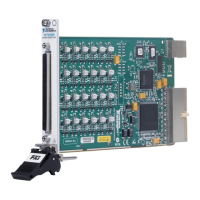
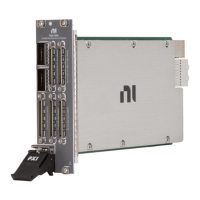
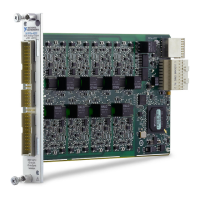
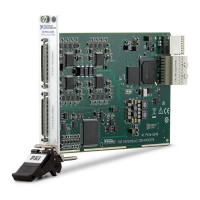
The SLSC-12202 is a 32-channel digital input/output module designed for use within the SLSC (Switch, Load, Signal Conditioning) platform. This device facilitates the connection and interaction between a measurement system, such as an FPGA-based PXIe-7821R, and a device under test (DUT) by providing configurable digital I/O channels. Its primary function is to offer flexible digital signal interfacing, allowing users to define the direction and characteristics of each channel's operation.
Function Description
The SLSC-12202 provides 32 digital input/output channels, each capable of being configured for direction (input or output). These channels are organized into two banks, with each bank containing 16 channels. Further organization divides each bank into two ports, each comprising eight channels. This hierarchical structure allows for granular control and flexible grouping of channels for various test and measurement applications.
Each bank of channels can be powered independently from either of the two available Vsup connections (Vsup_0 or Vsup_1), offering flexibility in power sourcing based on the requirements of the connected devices. The module's circuitry includes several key features to ensure robust and reliable operation.
For output channels, the SLSC-12202 supports various output modes, including sinking, sourcing, and push-pull. In sinking output mode, the channel pulls current from the connected load to ground. In sourcing output mode, the channel provides current to the connected load. Push-pull output combines both sinking and sourcing capabilities, allowing the channel to actively drive the output high and low. These configurable output types enable the module to interface with a wide range of digital devices and logic families.
For input channels, the module is designed to receive digital signals from the DUT. The input circuitry includes an input threshold, which can be configured to define the voltage level at which a signal is recognized as a digital high or low. Additionally, a RangeEnable5V feature suggests support for specific voltage ranges, enhancing compatibility with different digital signal levels.
A crucial component of the SLSC-12202's functionality is the Channel-Disconnect Switch. This switch allows for the software-controlled connection or disconnection of the digital input and output signals to the front I/O connector. This feature is vital for isolating the DUT from the measurement system, enabling safe power-on sequences, fault isolation, and dynamic reconfiguration during testing. The switching rate of this disconnect function is software-dependent, providing flexibility in how quickly channels can be enabled or disabled.
The module also incorporates pull-up enable functionality, which can be configured to pull up the signal lines to a supply voltage. This is particularly useful for open-collector or open-drain outputs from the DUT, ensuring defined logic states when the output is not actively driven.
The SLSC-12202 is designed to integrate seamlessly within the SLSC chassis, connecting to other SLSC modules or directly to PXIe modules via rear I/O connectors, such as the RTI-12308 for connection to a PXIe-7821R FPGA module. This integration allows for the creation of complex, high-channel-count test systems with synchronized digital I/O capabilities.
Usage Features
The SLSC-12202 offers several features that enhance its usability in various test and measurement scenarios:
- Configurable Channel Direction: Each of the 32 channels can be individually configured as either a digital input or a digital output. This flexibility allows the module to adapt to different DUT requirements without needing multiple specialized modules.
- Flexible Power Sourcing: The ability to power each bank of 16 channels from either Vsup_0 or Vsup_1 provides power isolation and allows for different voltage levels or power sources to be used for different groups of channels. This is beneficial when interfacing with mixed-voltage systems or when specific power requirements exist for different parts of the DUT.
- Software-Defined Power-On Configuration: The module's power-on state can be configured through software. The factory default sets front I/O channels to a disconnected state and rear I/O channels to input. This ensures a safe initial state, preventing unintended interactions with the DUT upon system power-up. Users can customize this behavior to suit their specific application needs, allowing for automated and repeatable test setups.
- Channel-Disconnect Switch: The software-controlled channel-disconnect switch is a powerful feature for managing connections to the DUT. It enables dynamic isolation of channels, which is crucial for hot-swapping DUTs, performing fault injection tests, or ensuring safe power-up and power-down sequences. The software-dependent switching rate provides control over the timing of these connections.
- Front Panel Pinout for Easy Wiring: The front panel features two connectors, J1 and J2, with clearly defined pinouts for each channel (Px.y, where x is the port number and y is the line number). This organized layout, along with dedicated COM (common reference to isolated ground) and K (keying) pins, simplifies wiring and reduces the chance of misconnections. The use of standard connector types (likely high-density D-sub or similar) ensures compatibility with common cabling solutions.
- Rear I/O Connectivity: The module's rear I/O (XJ2 and XJ4 connectors) provides connections for the digital I/O signals (DIO0-DIO31), ground (GND), and supply voltages (Vsup_0, Vsup_1). This allows for integration with other SLSC modules or PXIe devices, facilitating the creation of a comprehensive test system. The detailed pin assignments for the XJ2 connector, including NC (no connection) pins, help in understanding the signal flow and potential for custom wiring.
- Isolation: The circuitry diagram indicates isolation between the front I/O and the rear I/O/FPGA logic. This isolation protects the measurement system from potential faults or high voltages on the DUT side, enhancing system reliability and safety.
Maintenance Features
The SLSC-12202 incorporates several protection mechanisms that contribute to its robustness and reduce the need for frequent maintenance:
- Overvoltage & Short-Circuit Protection: The module includes overvoltage and short-circuit protection on its digital I/O channels. This is critical for protecting both the module itself and the connected DUT from electrical faults.
- Short-Circuit Protection: Digital output channels are protected against short-circuit faults. This protection operates in a "hiccup-mode." When a short-circuit fault is detected, the control logic disconnects the affected channel using the channel-disconnect switch. The channel remains disconnected for one second before the control logic attempts to re-enable it automatically. If the short-circuit fault persists, the channel will continue to operate in this hiccup protection mode, indicating an invalid input or output signal. This automatic retry mechanism helps in recovering from transient faults while preventing continuous damage.
- Overvoltage Protection: Digital input and output channels are protected against overvoltage conditions that fall outside the valid operating range, up to ±100 V at the front I/O connector. Similar to short-circuit protection, overvoltage protection is based on hiccup-mode operation, utilizing the channel-disconnect switch with a one-second auto-retry time. This protects the module from accidental application of excessive voltages from the DUT.
- Overcurrent Fault Handling: The module is designed to handle overcurrent faults, which occur when a digital output sources or sinks a continuous current greater than 150 mA before the short-circuit protection activates. While the module can withstand such conditions, it's important to note that the number of digital output channels experiencing an overcurrent fault should not exceed ten simultaneously to ensure optimal performance and longevity.
- Fault Indicator: A common fault indicator is provided for both short-circuit faults and front I/O overvoltage faults. This indicator is stored in a register, allowing software to monitor the health of the module. Users can refer to example LabVIEW VIs to access and interpret this register information, enabling proactive fault detection and diagnosis. This feature simplifies troubleshooting by providing a centralized status for critical protection events.
- Robust Design: The inclusion of dedicated COM connections for isolated ground helps in maintaining signal integrity and reducing noise, which contributes to the overall reliability and stability of the system, minimizing the chances of unexpected behavior that might require maintenance.
- Documentation and Support: The availability of comprehensive documentation, including safety, environmental, and regulatory information, as well as product certifications and declarations of conformity, aids in proper installation, operation, and compliance. Access to worldwide support and services from NI, including troubleshooting resources, application development assistance, and product registration, ensures that users can get help when needed, extending the operational life of the device and simplifying any necessary maintenance or repair processes.

 Need help?
 General

 To Next Page