Depth Of
Field
When
you
shoot at a certain aperture and focusing
distance,
you
will find that not only the main subject
but
al
so
objects within a certain range
in
front and
behind
it
will
be
sharp
in
the final photograph. This
"in-focus
zone"
is
known
as
depth of field. Objects
beyond this range become
increasingly out of focus.
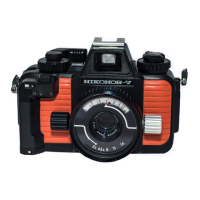
Because the Nikonos-V features aperture-priority
automatic exposure,
you
can control depth of field
by
varying the f/stop.
When
the zone of sharpness
is
la
r
ge,
depth of field is "deep"; when
it
is
small, depth
of
field
is
"shallow."
For
any individual lens:
-
The
smaller the aperture (the larger the f-number),
the deeper the depth of
field; the larger the aperture
(the
smaller the f-number), the shallower the depth
offield.
-
Depth of field becomes deeper t
he
farther the sub-
ject
is
from the lens; the depth of field becomes
shallower the closer the subject
is
to the lens.
-
Depth of field behind the main subject
is
deeper
than
in
front of
it.
Between lenses of different focal lengths: longer
focal length lenses
have shallower depth of field at
each f/stop; shorter
focal length lenses have deeper
depth of
field at each f/stop.
As
you
open and close the aperture, the pincer-type
depth-of-field indicators open
and
close to show the
distance range which
will
be
in
focus
in
the final
photograph.
(In
the case of the
LW
-Nikkor, depth of
field
is
indicated
by
pairs of colored depth-of-field
index lines
on
the aperture scal
e.)
For exampl
e,
with the star)dard W-Nikkor 35mm f/2.5
lens, when
the
lens focusing knob
is
set
at
3 m
and
the lens aperture knob
at
f/16,
the
indicators show
that
all
ob
jects between 1.5m
and
infinity
(00)
will
be
in
focus
in
the final photograph.
•
To
minimize any errors
you
may have made when measuring
or estimating the subject distance or focusing, use the
smallest aperture (the largest f-number) possible.
Alter-
nately, move farther from the subject or use a lens with
shorter focal length.
45


 To Next Page