EasyManua.ls Logo

Nikon S-kt - Page 13

Nikon S-kt
27 pages
Print Icon
To Next Page IconTo Next Page
To Previous Page IconTo Previous Page
Loading...
(3)
Coarse
Focusing
The
coarse adjustment
may be
eased or
tightened
by
means of the
coarse
focus
tension
adjusting
ring.
lf the
rotation of the coarse
focus
knob is
too
loose, turn the adjusting
ring counter-
clockwise.
Too
much
'tension
may be
adjusted
by
turning
clockwise.
Excessive
rotation
in the opposite direction
should
be avoided.
Never twist
the focus
knobs
for
this
adjustment
as
in traditional
microscopes
whose
focus
knobs, coarse and
fine, are
located separately
(not
coaxial).
Focusing
may
be
performed
as
follows: First,
raise
the
microscope
stage
until the distance
between
the specimen
and the
objective
becomes
less than the
working distance
of
the objective
to be used
(See
tableon
p.21
and
p.221
,
then
looking through
the
eyepiece, lower the stage
until
the
specimen
to be
examined
is clearlY
visible.
4X, 10X,40X
and 100X-objectives
are
parfocal,
and are
approximately
in
focus
when revolved into
position
one
after
another.
The use of the
fine
focus
knob
only is
required
for critical
focus-
Ing.
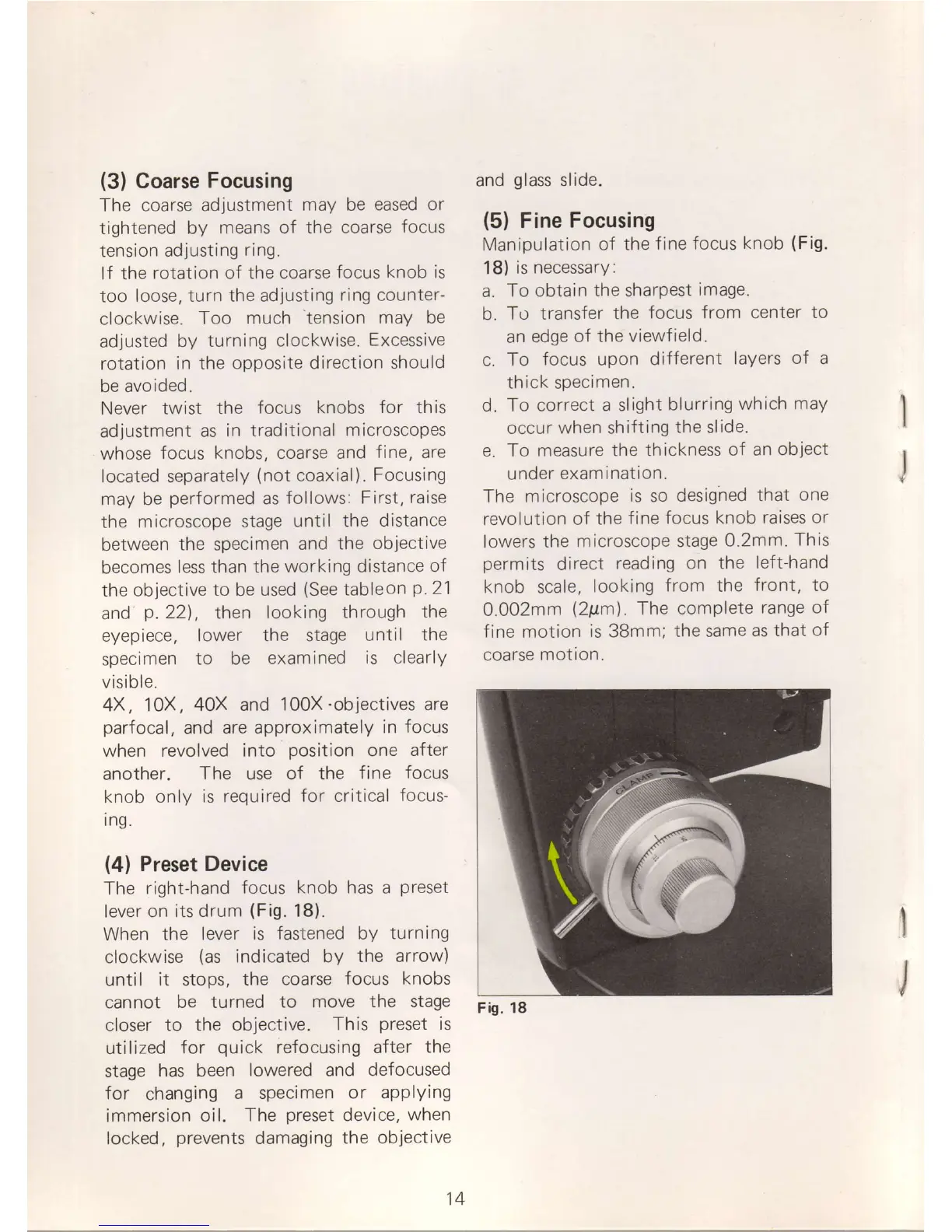
(4)
Preset Device
The
right-hand
focus knob has a
preset
lever on its
drum
(Fig.
18).
When
the
lever is
fastened by turning
clockwise
(as
indicated by
the arrow)
until
it
stops,
the
coarse
focus knobs
cannot
be turned to move
the stage
closer to
the objective.
This
preset
is
utilized
for
quick
refocusing
after
the
stage
has been
lowered
and
defocused
for
changing
a
specimen
or
applying
immersion
oil.
The
preset
device,
when
locked,
prevents
damaging the
objective
and
glass
slide.
(5)
Fine
Focusing
Manipulation of the
fine focus
knob
(Fig.
18)
is
necessary:
a.
To obtain
the
sharpest
image.
b.
To transfer the
focus from center
to
an
edge of the
viewfield.
c. To
focus upon different
layers
of
a
thick specimen.
d. To correct
a slight
blurring
which
may
occur when shifting
the
slide.
e. To measure
the thickness
of an
object
under examination.
The microscope
is
so
designed
that one
revolution of the
f ine
focus knob
raises or
lowers the
microscope stage
0.2mm.
This
permits
direct
reading
on the
left-hand
knob
scale,
looking
from
the
front, to
0.002mm
(2ttm\.
The
complete
range
of
f
ine
motion
is
38mm;
the same
as
that of
coarse
motion.
I
{
I
l
Fis. 18
14

Related product manuals