EasyManua.ls Logo

Nikon S-kt - 1 I L L U M I N a T I O N; Light Source; Condenser Focusing Knob

Nikon S-kt
27 pages
Print Icon
To Next Page IconTo Next Page
To Previous Page IconTo Previous Page
Loading...
may be effective
for
special
occasions
(e.9.
definition of the
general
structure of
unstained
specimens) .
(2)
Light Source
As already
discussed,
the
iris diaphragm
plays
an
important
role
in
illumination
for microscopy.
In
principle,
the dia-
phragm
should
be so adjusted
that
the
numerical aperture
of the
condenser
is
equal
to that of
the objective being
used,
in order
to obtain
maximum
resolution.
ln
practice,
however,
keeping
out stray
light
whlch
would
reduce image contrast
by
closing
the aperture
of the
condenser
down
to 60-700/o
of that
of the objective
will bring
about
good results in most
cases.
The coincidence
of condenser
dia-
phragm
aperture
with
the aperture
(exit
pupil)
of
the objective
can be ascertained
by
looking down
the
microscope tube
after
removing the
eyepiece and
closing
the
diaphragm
slowly.
An
experienced
user,
however,
may
dispense
with
this
procedure,
and obtain
the same
result by
adjusting
the
diaphragm
opening
until
satisfactory
distinctness
of
the image
is
obta
i ned
.
lf high
resolution and, at
the same
time,
high
contrast are
desirable,
oblique
illumi-
nation
may be
effective. This
is especially
suited
for lightly stained specimens,
trans-
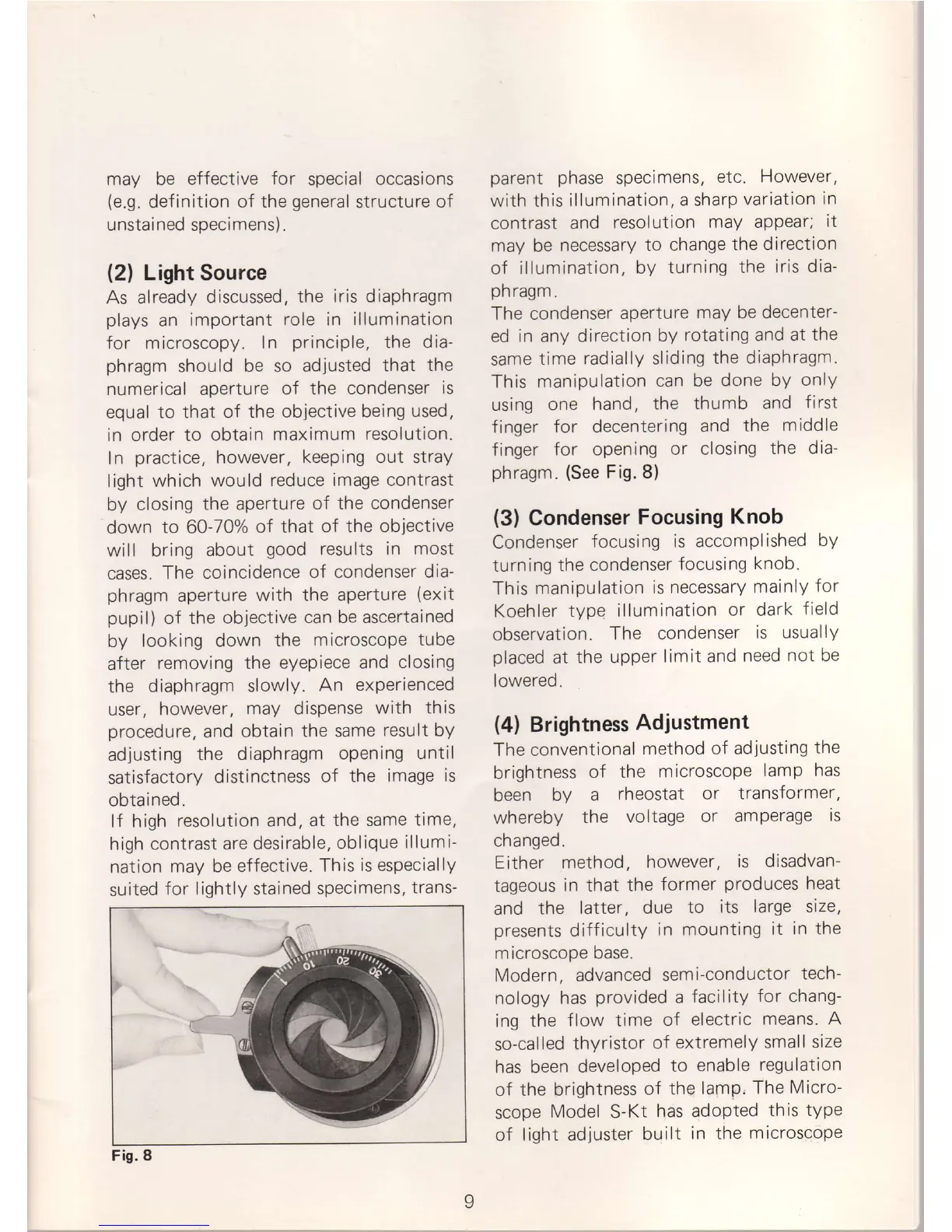
Fig. I
parent phase
specimens,
etc.
However,
with this
illumination,
a sharp
variation
in
contrast
and
resolution
may appear;
it
may
be
necessary to
change
the direction
of illumination,
by
turning
the
iris dia-
phragm.
The
condenser
aperture
may be decenter-
ed
in
any
direction
by
rotating
and
at the
same
time
radially sliding
the diaphragm.
This
manipulation
can be
done by
only
using
one
hand,
the thumb
and
first
finger
for decentering
and
the
middle
finger
for opening
or closing
the
dia-
phragm.
(See
Fig.8)
(3)
Condenser
Focusing
Knob
Condenser
focusing
is accomplished
by
turning
the condenser
focusing
knob.
This
manipulation
is necessary
mainly
for
Koehler
type
illumination
or dark
field
observation.
The
condenser
is usually
placed
at
the upper
limit and
need
not
be
lowered.
(4)
Brightness
Adjustment
The conventional
method
of adiusting
the
brightness
of the
microscope
lamp has
been
by a
rheostat or
transformer,
whereby
the
voltage
or amPerage
is
cnangeo.
Either method,
however,
is disadvan-
tageous
in
that
the
former
produces
heat
and
the
latter,
due
to its
large size,
presents
difficulty
in
mounting
it
in the
microscope
base.
Modern, advanced
semi-conductor
tech-
nology has
provided
a
facility
for chang-
ing
the
flow time
of electric
means. A
so-called
thyristor
of extremely
small
size
has been
developed
to
enable
regulation
of the
brightness
of
the
lamp, The
Micro-
scope
Model
S-Kt
has
adopted
this
type
of
light adjuster
built
in the
microscope

Related product manuals