6. P1|OTOillICROGRAP]|Y
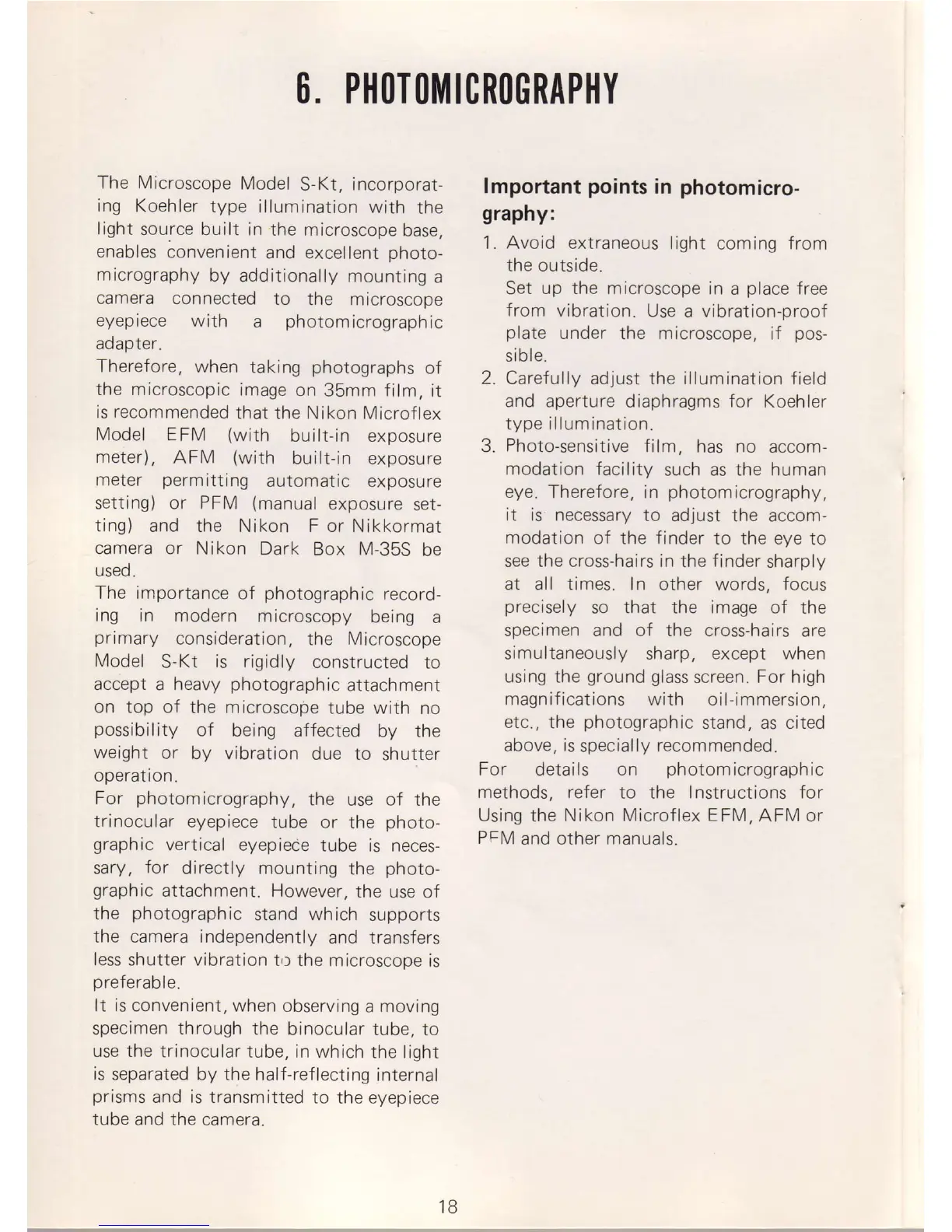
The Microscope
Model
S-Kt, incorporat-
ing
Koehler type
illumination
with
the
light
source built
in the
microscope
base,
enables
convenient
and excellent
photo-
micrography
by additionally
mounting
a
camera connected
to
the microscope
eyepiece
with
a
photom
icrograph
ic
adapter.
Therefore,
when
taking
photographs
of
the microscopic
image on
35mm film,
it
is recommended
that the Nikon Microflex
Model EFM
(with
built-in exposure
meter),
AFM
(with
built-in exposure
meter
permitting
automatic exposure
setting)
or PFM
(manual
exposure
set-
ting)
and
the
N
ikon
F or
N ikkormat
camera or
Nikon
Dark Box M-35S
be
useo.
The importance
of
photographic
record-
ing in
modern m
icroscopy
being
a
primary
consideration,
the
Microscope
Model
S-Kt
is rigidly
constructed
to
accept a heavy
photographic
attachment
on top of
the microscope
tube
with no
possibility
of
being
affected
by the
weight
or
by vibration
due to
shutter
operation.
For
photomicrography,
the use of the
trinocular eyepiece
tube
or the
photo-
graphic
vertical eyepiece
tube
is neces-
sary,
for
directly mounting
the
photo-
graphic
attachment. However,
the use
of
the
photographic
stand which
supports
the camera independently
and transfers
less shutter vibration
t,t the microscope
is
preferable.
It is convenient,
when observing
a moving
specimen
through
the
binocular tube,
to
use the
trinocular tube, in
which the light
is
separated by the half-reflecting
internal
prisms
and is transmitted
to
the eyepiece
tube and the
camera.
lmportant
points
in
photomicro-
graphy:
1. Avoid extraneous light
coming
from
the outside.
Set
up the microscope
in a
place
free
from
vibration.
Use a vibration-proof
plate
under
the microscope,
if
pos-
sible.
2. Carefully
adjust the
illumination
field
and aperture
diaphragms
for
Koehler
type
illumination.
3.
Photo-sensitive
film,
has no accom-
modation facility
such
as the human
eye.
Therefore, in
photomicrography,
it is necessary
to adjust
the accom-
modation
of the
finder
to the
eve
to
see the cross-hairs in the finder
sharply
at all times.
In other words,
focus
precisely
so
that
the
image
of the
specimen and of the
cross-hairs are
simultaneously sharp, except when
using the
ground
glass
screen.
For high
magnifications with oil-immersion,
etc.,
the
photographic
stand, as
cited
above, is
specially
recommended.
For
details
on
photomicrographic
methods, refer
to the Instructions for
Using the Nikon Microflex
EFM,
AFM or
PFM
and other
manuals.
18


 To Next Page