Need help?
Do you have a question about the Nokia TA-1032 and is the answer not in the manual?
Instructions for inserting nano-SIM cards and memory cards into the device.
Steps for charging the battery and powering on the new Nokia phone.
Information on finding printable user guides, online guides, and troubleshooting help.
Covers essential info on safe device use, network compatibility, and power management.
Details on supported networks and specific frequency band restrictions for certain countries.
Statement of product compliance with EU essential requirements and directives.
FCC compliance, interference guidelines, and radio frequency safety information.
Specific Absorption Rate (SAR) limits and testing information for European regions.
Specific Absorption Rate (SAR) limits and testing information for the US market.
This document describes the Nokia 3, a mobile device designed for communication and various other functions. It provides instructions on how to get started with the device, including inserting SIM and memory cards, charging the battery, and switching the phone on. It also offers information on product safety, regulatory compliance, and SAR certification.
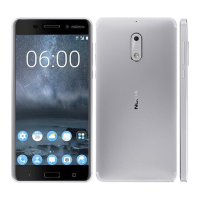
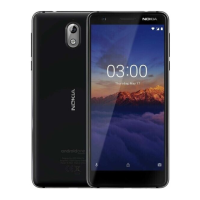
The Nokia 3 features a classic smartphone design with a front camera, earpiece, and various sensors on the front. The main camera is located on the rear. Physical controls include volume keys and a power/lock key on the side. Connectivity options include an audio connector, a charger connector (USB micro-B), and a loudspeaker. The device supports nano-SIM cards and microSD cards for expandable storage.
To begin using the Nokia 3, you need to insert your SIM card(s) and optionally a memory card. The device comes with a provided tray opener, which is essential for this process.
The Nokia 3 is equipped with an internal, non-removable rechargeable battery. It is crucial to charge the device before its first use or when the battery is depleted.
The Nokia 3 supports various network types, including GSM 850/900/1800/1900, WCDMA 1/2/5/8, and LTE 1/3/5/7/8/20/28/38/40. It requires a subscription with a service provider to function.
The device incorporates several wireless technologies for connectivity:
The Nokia 3 is equipped with both a main camera and a front camera, allowing for photography and video recording. When using the flash, it is advised to maintain a safe distance and avoid using it on people or animals at close range. Do not cover the flash when taking photos to ensure optimal lighting.
The device's battery is internal and non-removable. Attempting to remove it yourself may damage the device. For battery replacement, it is recommended to take the device to the nearest authorized service facility.
The device supports compatible memory cards to expand storage. Using incompatible cards may damage the card, the device, and corrupt stored data. It is important to use only approved memory cards.
Pre-installed system software and applications consume a significant portion of the device's memory space. This is a standard characteristic of modern smartphones.
The Nokia 3 complies with various international and regional safety guidelines.
For a printable user guide, online user guide, and troubleshooting help, users can visit the Nokia website at www.nokia.com/phones. The device's surface is nickel-free.
 General
| Network Technology | GSM / HSPA / LTE |
|---|---|
| Announced | 2017, February |
| Status | Available. Released 2017, June |
| SIM | Single SIM (Nano-SIM) or Dual SIM (Nano-SIM, dual stand-by) |
| Display Type | IPS LCD |
| Protection | Corning Gorilla Glass 3 |
| Operating System | Android 7.0 (Nougat), upgradable to Android 9.0 (Pie) |
| GPU | Mali-T720MP1 |
| Card slot | microSDXC (dedicated slot) |
| Main Camera Video | 720p@30fps |
| Loudspeaker | Yes |
| 3.5mm jack | Yes |
| WLAN | Wi-Fi 802.11 b/g/n, hotspot |
| GPS | Yes, with A-GPS |
| NFC | Yes |
| Radio | FM radio |
| USB | microUSB 2.0, USB On-The-Go |
| Model | TA-1032 |
| Build | Aluminum frame, plastic back |
| Resolution | 720 x 1280 pixels |
| Chipset | Mediatek MT6737 |
| Internal Storage | 16GB 2GB RAM |
| Main Camera | 8 MP, AF |
| Main Camera Features | LED flash |
| Selfie Camera | 8 MP, f/2.0 |
| Bluetooth | 4.0, A2DP |
| Sensors | Accelerometer, proximity, compass |
| Battery | Non-removable Li-Ion 2630 mAh battery |
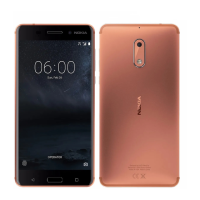
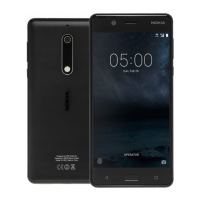
| Colors | Matte Black, Copper |
| Display Size | 5.0 inches |

 To Next Page