10.4.3 User Manual Contents April 17, 2020
Firmware: 5.2.1 Page 51 of 142
CAUTION: Data Quality Is a Function of TX Pulse Settings
High quality sonar data requires excellent Signal to Noise (SNR). Therefore,
the sonar Tx Pulse Settings directly impacts data quality. For most
conditions (temperature & salinity dependent) use FM Long Range mode
and 0.9cm resolution. If useable swath width becomes narrow (due to noisy
outer beams) then gradually decrease Resolution. If in doubt. use Auto
selection.
CAUTION: Bottom Classification Surveys Using Snippets
If backscatter data quality is the priority of the survey, deactivate Auto and
manually define Mode and Resolution. Changing these settings during a
survey, or operating in Auto mode, may cause data degradation as the
processing software is not able to compensate for variable pulse
characteristics. In general, FM Long Range mode should be used, however
this limits the ping rate to a maximum of 20Hz. If a faster ping rate is
required, select FM Short Range.
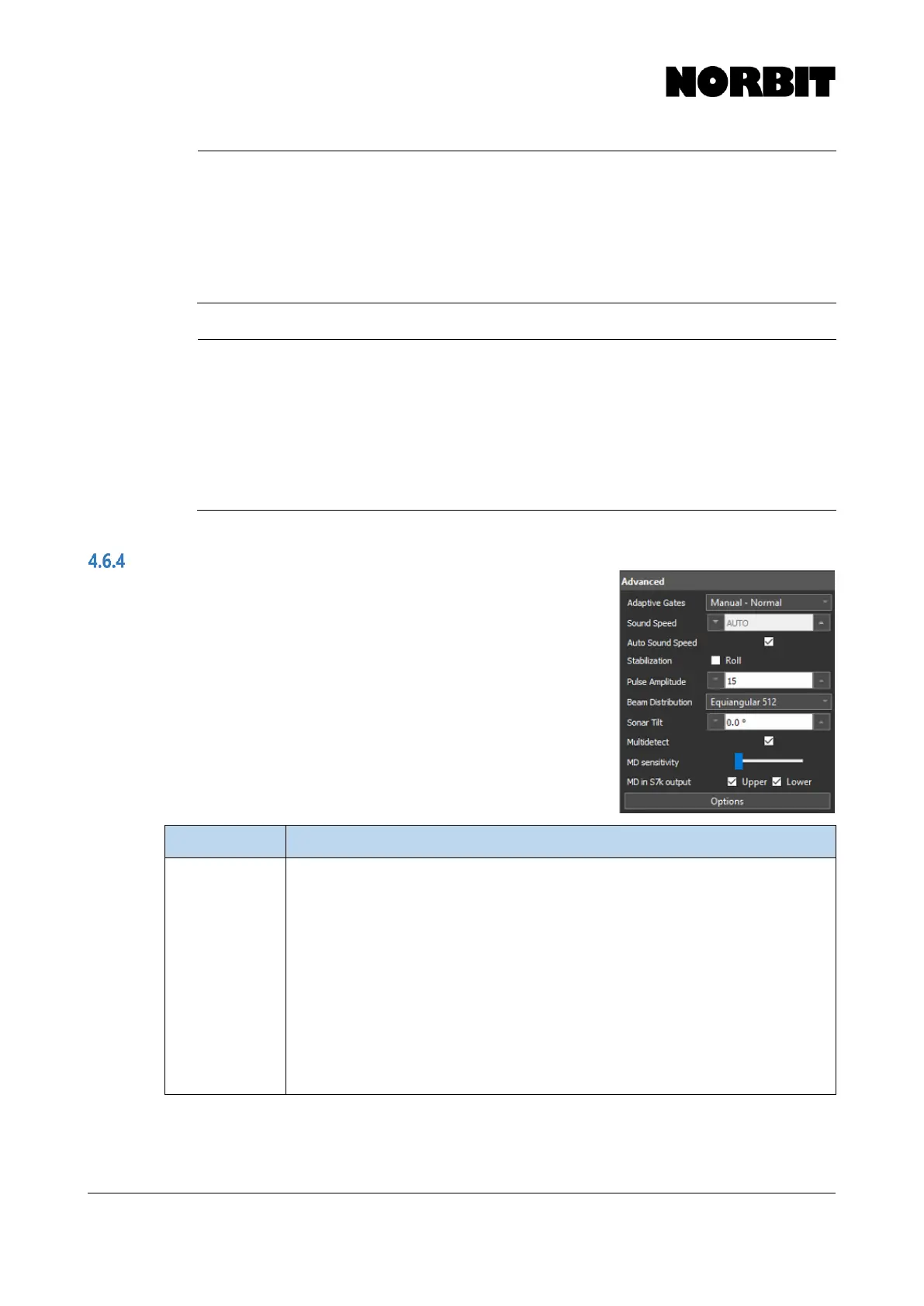
Advanced
It is prudent for the sonar operator to understand the Advanced
settings in the rare event that they need to be changed.
If a WBMS STX system is utilized, an additional checkbox appears
for activating pitch stabilization. Note that pitch stabilization should
not be used when Scanning is selected.
When Multidetect is selected, additional options become
available to control the detection sensitivity and customize the
output. All functions contained are explained in the table below.
Adaptive Gates work in a similar way to upper/lower gates, except they follow the
shape of the seafloor. Note that they are not visible on the sonar wedge. If the gates
are too narrow, bottom detections may be noisy for large depth changes. In areas with
steep gradients it is recommended that the gates be turned Off. If the gates are too
wide (or off), false bottom detections may occur due to noise, second returns or fish.
The following applications are well suited for the corresponding settings:
• Dredging Surveys: Normal Adaptive Gates
• Engineering Surveys: Normal or Wide Adaptive Gates
• General Bathy Surveys >40m: Narrow Adaptive Gates
• General Bathy Surveys <40m: Normal Adaptive Gates
• Wreck or Complex Structure Surveys: Wide Adaptive Gates or Off
In some sea states the gates may need to be set wider to avoid cutting out data during
large roll events. It is advisable to use adaptive gates in nearly all environments.


 To Next Page