Theory of Operation
To operate the sonar effectively, users should be aware of certain basic principles of sonar signal
processing. Possessing this knowledge gives users confidence to adjust the settings for optimal
bathymetry and backscatter data collection, as well as aiding troubleshooting.
5.1
Range vs. Bandwidth
For higher quality bottom detection, the bandwidth should be maximized. The NORBIT WBMS
implements a bandwidth of 80kHz throughout its operational range. Only the sweep time is adjusted
in shallow waters. If in manual mode and operating in shallow waters, select FM Short Range mode
to maximize ping rate.
The NORBIT WBMS has been tested to 175m using 80kHz bandwidth. It is recommended that for
most scenarios, users select the Auto option under Tx pulse settings.
5.2
Bottom Detection
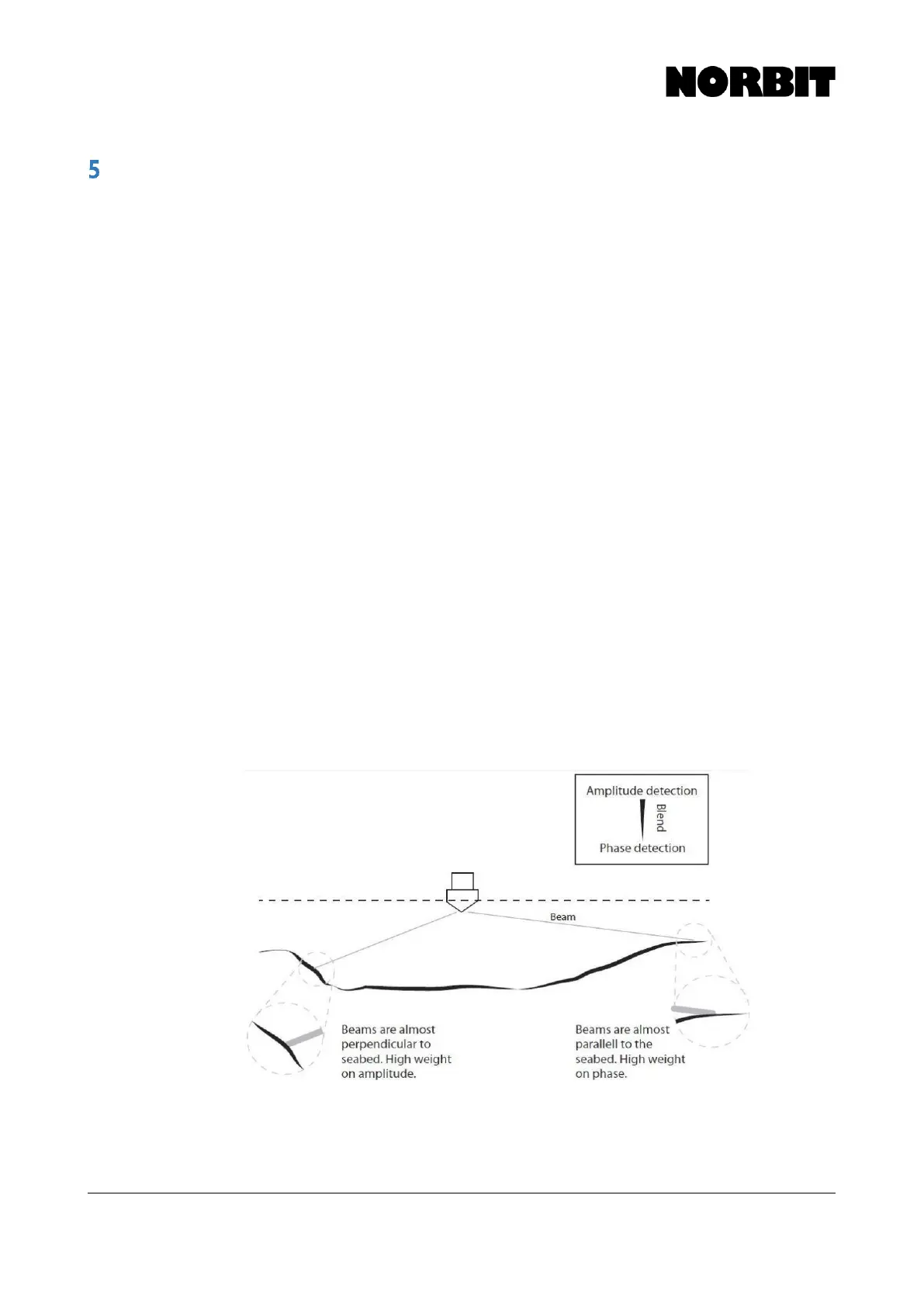
The WBMS seamlessly utilizes three methods for bottom detection:
▪ Amplitude
▪ Phase
▪ Weighted Blend
Amplitude based detection is most accurate when the reflecting area is close to perpendicular to the
beams. Phase based detection is most accurate when the reflecting area is at an angle to the beam.
Thick lines show high emphasis on amplitude detection. Thin lines show high emphasis on phase
detection.
The WBMS automatically weights the amplitude and phase detection to give a seamless transition
between the two at any area of the swath. This means that there are no predefined beams for
amplitude, phase or blend.


 To Next Page