MAINTENANCE OF YOUR REFRIGERATOR
Cleaning Cabinet and Door
Wipe with a soft, dr
cloth. To remove dirt, use a cloth mois-
tened b
a warm neutral deter
ent solution. Never use hot water.
After cleanin
, wipe with a dr
cloth.
CAUTION:
Never use a brush, powder soap, cleanser, acid, benzene,
asoline, or thinner. These tend to leave scratches on the coat-
in
.
Gasket (door cushion)
Wipe awa
dirt with a soft cloth moistened b
a neutral deter-
ent. Do not soak the cloth excessivel
. If water
ets inside, the
insulatin
effect ma
become temporaril
impaired.
Attachments
Wash all attachments in soap suds. Rinse and wipe clean with a
dr
cloth.
To Turn Off The Refrigerator
If
ou will not be usin
the refri
erator for a da
or two, turn the
thermostat knob to "1". For a lon
er period, set the On-Off switch
to "OFF" and disconnect power b
removin
the AC plu
from it’s
socket. Also, disconnect the DC power from it’s source.
When not in use, the refri
erator should be emptied, cleaned,
and dried, and the door left a
ar.
Defrosting
Set the On-Off switch to "OFF". When frost is melted, wipe the
compartment plates with a soft, dr
cloth. A better su
estion is to
set the dial to "1" before
ou retire for the ni
ht. The frost will be
one the next mornin
.
Do not use sharp ob
ects to chip ice from the coolin
plates.
Information on battery power
The batter
power re
uired for the operation of the refri
erator is
dependent upon the number of DC appliances bein
used, the
t
pe of operation desired and c
clin
pattern desired.
A batter
must also be sufficientl
char
ed to prevent overdraw.
A batter
is rated usuall
in ampere-hours; that is, it is capable
of sustainin
it’s rated ampere capacit
for a period of one hour.
If the total ampera
e load of the vehicle is hi
h
25 amperes
,
then the installation of a 72 ampere-hour batter
will not provide
the re
uired power for an
len
th of time unless it is aided b
a
rechar
in
source such as an alternator or
enerator.
Various load re
uirements of the vehicle’s DC s
stem dictate the
ampere-hour capacit
that should be installed.
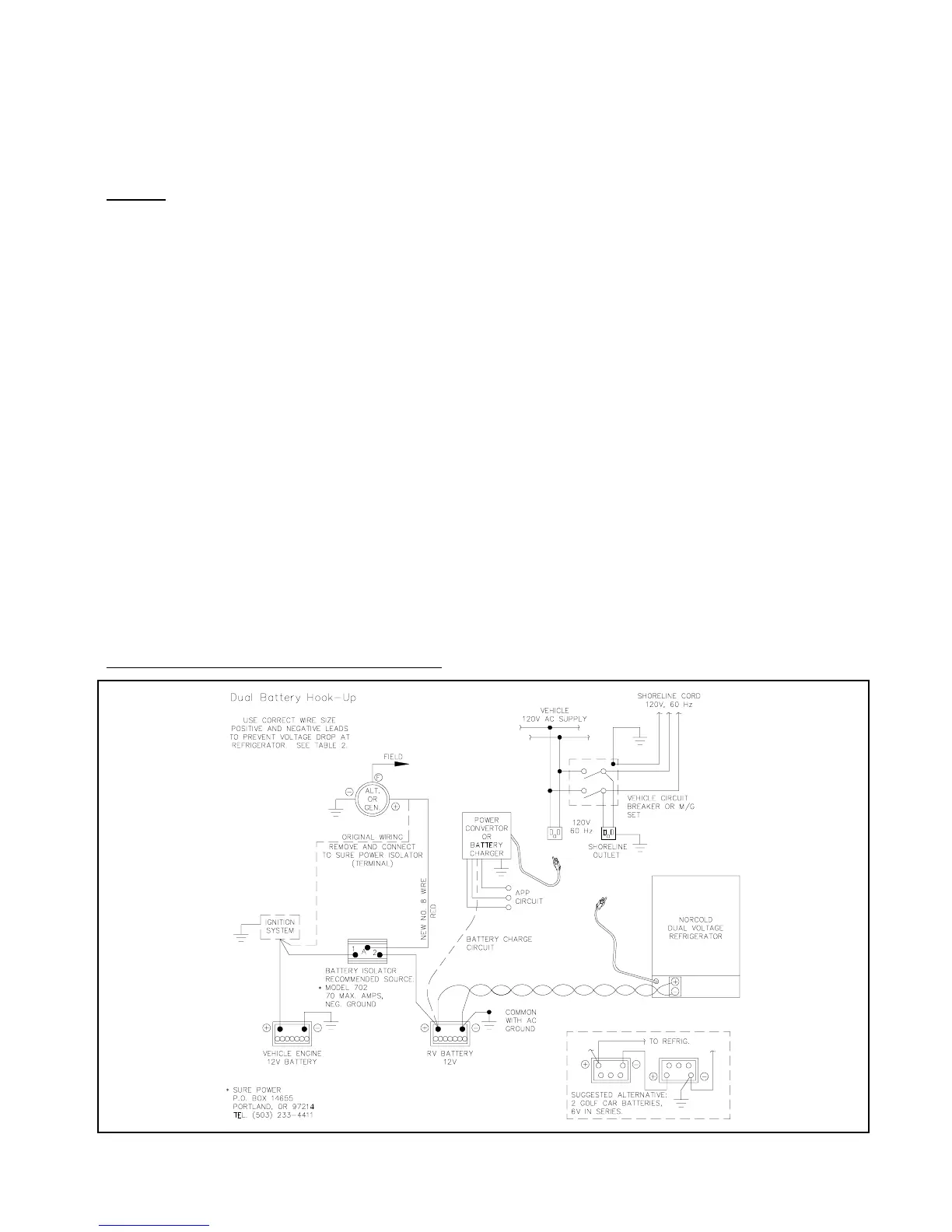
Refer to Fi
ure 3 for the su
ested dual-batter
wirin
dia
ram.
You will note that in this dia
ram there are 2 separate batter
sources. One source is the vehicle or car batter
used exclusivel
for the operation of the en
ine and accessor
e
uipment such as
head li
hts. The other source is for the operation of the DC appli-
ances within the recreational vehicle or boat. This batter
source
is referred to as the accessor
or house batter
and is used solel
for that purpose.
Both of these batter
sources are char
ed b
one alternator or
enerator which is powered b
the vehicle en
ine. This char
in
device should be of ade
uate ampera
e ratin
so that a short
en
ine run will brin
the batteries up to full char
e. The standard
alternator has a minimum ratin
of 60 amperes.
Check
our volta
e re
ulator or cut-out for correct char
in
level.
Volta
e should be 13.5 to 14.5. volts to the batter
.
Fi
ure 3
5



 To Next Page