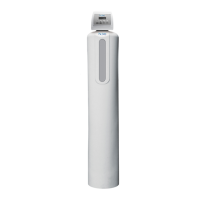
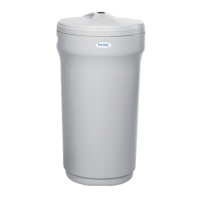
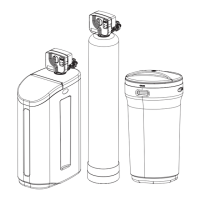
This document describes the Novo 485SIM Softener, Iron & Manganese Reduction System, a water conditioning product designed to improve water quality.
Function Description
The Novo 485SIM is a water softener and iron/manganese reduction system. Its primary function is to remove hardness minerals (calcium and magnesium), ferrous iron, and manganese from water through an ion exchange process. The system utilizes a demand-initiated regeneration (D.I.R.) feature, which helps minimize the amount of regenerant brine and water used during operation. When the system's capacity is nearly exhausted, it undergoes a regeneration cycle to restore its full softening and reduction capabilities. During regeneration, hard water is automatically bypassed for household use, and fresh water is introduced to backwash the resin, introduce brine solution, rinse the resin, and refill the salt tank for the next cycle.
Important Technical Specifications
The 485SIM series comes in several models (485SIM-100, 485SIM-150, 485SIM-200, 485SIM-300), each with varying capacities and specifications:
- Resin Quantity: Ranges from 1.0 ft³ (485SIM-100) to 3.0 ft³ (485SIM-300).
- Rated Service Flow: 11.0 gpm (485SIM-100) to 12.9 gpm (485SIM-300).
- Pressure Drop at Rated Service Flow: Consistently 15.0 psi across all models.
- Rated Softening Capacity: Varies from 13,269 grains @ 3lbs salt (485SIM-100) to 40,887 grains @ 9lbs salt (485SIM-300).
- Efficiency: 4,543 grains/lb salt across all models. The system's rated softener efficiency is not less than 3350 grains of total hardness exchange per pound of salt.
- Max. Flow Rate to Drain: 2.0 gpm (485SIM-100) to 5.0 gpm (485SIM-300).
- Working Pressure: Minimum 20 psi - Maximum 125 psi.
- Operating Temperature: Minimum 39°F - Maximum 100°F.
- Salt Used Per Regeneration: 12.0 lbs (485SIM-100) to 36.0 lbs (485SIM-300).
- Water Used Per Regeneration: 52.2 gal (485SIM-100) to 166 gal (485SIM-300).
- Hardness Removal: 30,000 grains (485SIM-100) to 90,000 grains (485SIM-300).
- Tank Size: Ranges from 9x48 (485SIM-100) to 14x65 (485SIM-300).
- Brine Tank / Cabinet Size: 18.1 x 34.5 inches (485SIM-100) to 23.0 x 40.5 inches (485SIM-300).
- Salt Storage Capacity: 240 lbs (485SIM-100) to 420 lbs (485SIM-300).
- Maximum Hardness: 75 Grains Per Gallon.
- Maximum Iron (Ferrous): 10 ppm.
- Maximum Manganese: 5 ppm.
- Plumbing Connections: 3/4" (Optional 1").
- Resin Type: Canature High Efficiency Cation Ion Exchange Resin.
- Electrical Requirements: Input 120V 60 Hz - Output 12V 650mA.
- Regeneration Type: Co-Current / Down Flow.
The system is IAPMO R & T Certified against CSA B483.1.
Usage Features
- Installation: The system should be installed in a location protected from freezing and direct sunlight, and where temperatures do not exceed 100°F. It requires a grounded 120-volt electrical outlet. Lead-free solder and flux are recommended for sweat-solder connections.
- Bypass Valve: An included bypass valve (or three shut-off valves) allows for isolating the softener for repairs while maintaining water supply to the house. The bypass valve can be set to "Service Position" for normal operation or "Bypass Position" to isolate the softener.
- Control Panel: The system features a key pad configuration with "SETTINGS," "MANUAL REGEN," "UP," and "DOWN" buttons for programming and manual regeneration.
- Programming: Users can set the time of day, year, month, day, water type (municipal/well/other), regeneration time, and the number of people in the home. The "SET HARDNESS" value (maximum compensated water hardness in grains per gallon) is crucial for calculating system capacity. For ferrous iron presence, 4 gpg should be added for every 1 ppm of ferrous iron. "REGEN DAYS" sets the number of days between regenerations or backwashes. "GALLONS" allows setting capacity based on water usage, causing regeneration when gallons remaining or regen days reach zero.
- Manual Regeneration: The system supports both delayed and immediate manual regeneration. Delayed regeneration schedules a cycle for the preset regeneration time, while immediate regeneration starts a cycle immediately.
- Automatic Hard Water Bypass: During the regeneration cycle (which can last 30 to 180 minutes), hard water is automatically bypassed for household use. This prevents hard water from filling the water heater during regeneration.
- Salt Type: Only clean water softening salts, at least 99.5% pure, such as NUGGET, PELLET, or coarse SOLAR salts, are recommended. Rock, block, granulated, or ice cream making salts are not recommended due to potential maintenance problems.
- New Sounds: The softener may produce new sounds during its operation, particularly during regeneration, which is normal.
Maintenance Features
- Salt Level Check: The salt level should be checked monthly. The salt lid should be kept in place unless servicing or refilling the unit.
- Adding Salt: When adding salt, lift the salt lid and add salt directly into the brine tank. Ensure the brine well cover is on and filled only to the height of the brine well.
- Bridging: Humidity or incorrect salt type can cause "bridging," where salt forms a crust that prevents brine solution from being made. If bridging occurs, carefully pound on the outside of the brine tank or pour warm water over the salt to break it up. The unit should then be allowed to sit for two hours to produce brine solution, followed by a manual regeneration.
- Cleaning/Replacing Injectors: Sediment, salt, and silt can restrict or clog the injector. The injector assembly is located on the right side of the control valve and can be cleaned by shutting off the water supply, removing the injector cover, carefully removing the injector orifice, flushing all parts, and cleaning small holes.
- Replacing Brine Line Flow Control (BLFC): This involves removing a red clip, the BLFC holder, splitting the holder, and removing the flow washer. Reassembly is the reverse procedure, ensuring markings on the BLFC washer face the correct direction.
- Replacing Drain Line Flow Control (DLFC): Similar to BLFC replacement, this involves removing a red clip and the BLFC washer from the elbow fitting, then reassembling.
- Sanitizing: The system is factory-cleaned and sanitary. However, during shipping, storage, installation, and operation, bacteria can form or grow. Sanitizing is recommended. The Sani-System Liquid Sanitizer Concentrate (Item# 80030021) is used for this. The process involves adding the concentrate to the brine well, starting an immediate regeneration, and allowing the softener to sanitize for about two hours. Soft water is available for use after sanitizing.
- Resin Cleaner: An approved resin cleaner (like Pro Res Care®) can be used regularly to maintain the resin's performance, especially if the water supply contains iron. The frequency of use depends on the quantity of iron in the water.

 Need help?
 General

 To Next Page