Vmax I&O Manual │Cascade Instructions
Communication Wiring – for each boiler in the cascade, wire in parallel electrical connections Argus Link (-)
and Argus Link (+), terminals 1 and 2 (see Figure 12-2).
Establish Managing Boiler – choose one boiler to be the Managing Boiler, this boiler will receive all control
wiring and will be used for setting control parameters (see steps below). All non-Managing Boilers
(Dependents) must have the “S4” switch (located on the top right side of the control) switched OFF. *
*Note: the “S4” switch is factory set to ON. The switch is in the off position when it is closest to the “S4”
marking. The “S4” switch must remain in the ON position on the Managing Boiler.
Plumbing – install the boilers in parallel in a primary/secondary plumbing configuration as illustrated in Figure
13-1.
System Sensor – install a system sensor (NTI p/n: 84010) on the outlet (supply) pipe feeding the heating system,
see Figure 13-1. Wire the system sensor to terminals 3 and 4 of the Managing Boiler (left boiler in
illustration).
IMPORTANT: the use of the system sensor is mandatory for proper operation of the boiler cascade system.
Outdoor Sensor – when using an outdoor sensor it must be connected to terminals 3 and 5 of the Managing
boiler (left boiler in illustration); outdoor sensors connected to non-Managing boilers will be ignored.
Boiler Pump – each boiler in the cascade must have its own circulator, powered by the respective boiler (see
Figure 13-1). The boiler model, and function in the cascade (i.e. Manager or Dependent), will determine
which pump output (CH or BOILER) needs to power the boiler pump.
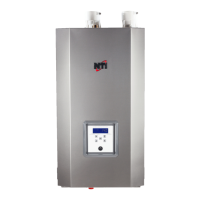
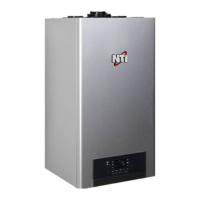
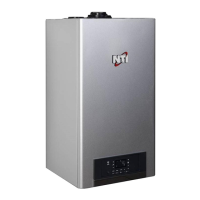
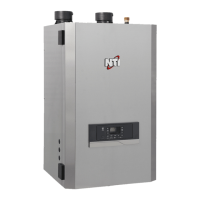
VM110 & VM153 (Manager) – when configured as the Manager, non-Plus models VM110 and VM153,
must have the local boiler pump powered by the respective boiler’s BOILER PUMP output. Furthermore,
model VM110 must also have the internal pump rewired to the BOILER PUMP output (factory wiring is
to the CH PUMP output).
VM110 & VM153 (Dependent) – when configured as Dependents, the local boiler pump must be
powered by the respective boiler’s CH PUMP output.
VM110P (Manager/Dependent) – does not require the installation of a separate boiler pump, instead, the
internal circulator is utilized by NOT installing the external Primary Loop Manifold at the bottom of the
boiler.
VM153P (Manager/Dependent) – the local boiler pump must be powered by the boiler’s CH PUMP
output.
CH Pump (System) – the Managing Boiler can control the System’s Central Heating Pump via its CH PUMP
output (terminal 12). IMPORTANT: due to the limited switching capacity of the CH PUMP output, it may be
necessary to use an isolation relay to activate the CH Pump, see Table 12-1.
DHW Pump (System) – the Managing Boiler can control the System’s DHW Pump via its DHW PUMP output
(terminal 11). IMPORTANT: due to the limited switching capacity of the DHW PUMP output, it may be
necessary to use an isolation relay to activate the DHW Pump, see Table 12-1.
Central Heat Demand Switch (Room Thermostat) – connect to terminals 7 and 8 (T, T) of the Managing
Boiler. Switch must be an isolated end switch (dry contact). Central Heat settings are programed from the
Managing Boiler only, i.e. Installer menu settings 2-01, 2-02, 2-03, 2-04, 2-05 and 2-06.
Tank Thermostat / Sensor – connect to terminals 3 and 6 of the Managing Boiler. DHW settings are programed
from the Managing Boiler only, i.e. Installer menu settings 2-07, 2-08 and 2-09. Set DHW Mode (Installer
menu setting 2-08) according to device used; Thermostat = 2, Sensor = 1.
Boiler Address – assign a unique boiler address for each boiler in the cascade via Installer menu setting 2-20.
Managing boiler must be set = 1; other boilers must be set from 2 to 16.
Rotation Interval – establishes the time, in days, between advancements of the staging sequence of boilers in the
cascade; set via Installer menu setting 2-22 of the Managing Boiler.


 To Next Page