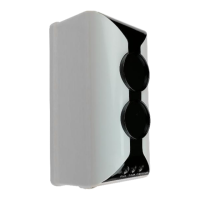
407 reflective beam line-type smoke detector
Installation and Service Manual
3
32-0061-r04_2020-10
© 2019, 2020 Ambest Electronics (Ningbo) Co Ltd. All rights reserved.
All specifications and other information shown were current at the date of publication and subject to change without notice.
2.1. Safety
ELECTRICAL HAZARD: Disconnect power from equipment prior to making any internal adjustments.
FRAGILE: Inspect the equipment prior to installation. Do not install the equipment if damage is apparent. If
damaged, return to the supplier.
ELECTROSTATIC HAZARD: This is sensitive electronic equipment. Apply safe ant-static practices when
handling this equipment.
GENERAL CAUTIONS: This equipment must be installed by a suitably qualified and technically competent
person. A basic knowledge and training in the installation of fire detection and alarm systems is assumed.
The system should be designed by a suitably qualified person with reference to local regulations and
guidance from the fire officer where applicable. Service should only be performed by qualified personnel.
2.2. Tools and Equipment
Before commencing installation, ensure all equipment and tools to mount and connect the equipment are
available, such as drills, mounting screws, cables and ladders.
Check that the following components are available.
Transceiver.
Four 2 x 1 reflectors.
Mounting bracket.
Six 6 mm wall plugs. (Six additional wall plugs are required if three additional reflectors are used).
Six ST4 x 30 screws. (Six additional screws are required if three additional reflectors are used).
Two M4 x 10 screws.
Magnet test tool.
Obscuration filter.
621-007 single input module with switched external DC 24 V supply (for indirect connection method).
2.3. Components
The 407 consists of a transceiver (incorporating the beam transmitter, receiver and laser light alignment tool),
the transceiver mounting bracket, and four 2 x 1 reflectors.
2.4. Location Selection
2.4.1. General Criteria
Select an installation location that satisfies the following criteria.
Clean and dry.
Not subject to direct sunlight.
Away from a glass external wall.
Where the beam path is not obscured by moving items.
On a surface such that the direction of transmitted beam does not vary due to vibration or changes in
temperature.


 To Next Page
 Loading...