Need help?
Do you have a question about the Ocean Optics USB4000 and is the answer not in the manual?
Defines the manual's purpose and the target audience for the USB4000 Spectrometer.
Highlights the new features or changes in this version of the manual.
Provides a brief overview of the manual's content and structure.
Information on accessing additional documentation and resources for Ocean Optics products.
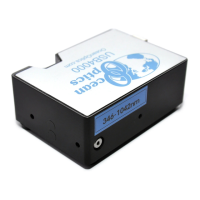
Introduces the USB4000 Fiber Optic Spectrometer, detailing its next-generation features.
Lists the key technical features of the USB4000, including detector, electronics, and optics.
Outlines the necessary hardware and software requirements for operating the USB4000.
Explains how EEPROM stores calibration coefficients and serial numbers for hot-swapping.
Describes SpectraSuite, the modular Java-based spectroscopy software platform.
Explains the function of Ocean Optics components within a sampling system.
Lists available accessories for the USB4000, focusing on sampling system components.
Details the USB and serial port interface options for connecting the USB4000.
Describes the HR4-BREAKOUT Breakout Box for controlling devices and prototyping.
Lists the standard items included with the USB4000 Spectrometer shipment.
Identifies essential additional equipment, such as the SpectraSuite Operating Software.
Lists various other accessories available for spectroscopy applications.
Provides an overview of the installation process, emphasizing software installation first.
Contains instructions for connecting the USB4000 via both USB and serial modes.
Details the procedure for connecting the USB4000 to a computer using a USB port.
Explains how to connect the USB4000 to a computer using the serial port.
Guides on connecting compatible spectroscopic accessories to the USB4000.
Introduces options for triggering the USB4000 using external signals.
Introduces troubleshooting common issues encountered with the USB4000.
Addresses installation problems when the USB4000 is connected before software installation.
Provides troubleshooting steps specifically for Windows operating systems.
Step-by-step guide to remove an unknown device from Windows Device Manager.
Instructions for removing corrupted or improperly installed driver files.
Discusses troubleshooting considerations for Mac operating systems.
Covers troubleshooting procedures for Linux operating systems.
Describes the process for calibrating the wavelength of the USB4000 spectrometer.
Explains the polynomial relationship between pixel number and wavelength for calibration.
Details the procedure for calibrating the spectrometer's wavelength using spectral lines.
Lists the necessary components and software for performing wavelength calibration.
Provides step-by-step instructions on how to calibrate the spectrometer's wavelength.
Instructions for saving newly calibrated wavelength coefficients via USB mode.
Introduces the five triggering modes supported by the USB4000 spectrometer.
Describes the Normal (Free Running) mode where the spectrometer continuously scans.
Explains the External Software Trigger mode, controlled by the ExtTrigIn signal.
Details the External Hardware Trigger mode, initiated by an external signal.
Explains how to adjust the delay for the External Hardware Trigger.
Describes the External Synchronization Trigger mode for synchronized measurements.
Provides information on spectrometer operation, specifications, and system compatibility.
Explains the light path through the USB4000 Spectrometer's optical bench.
Details the components of the USB4000 Spectrometer and their specific functions.
Lists the key technical specifications for the USB4000 Spectrometer.
Provides detailed specifications for the CCD detector used in the USB4000.
Shows the pinout diagram for the USB4000's 22-pin accessory connector.
Explains the function and I/O type of each pin on the 22-pin accessory connector.
Lists the part numbers for the 22-pin accessory connector and mating components.
 General
| Spectral Range | 200 - 1100 nm |
|---|---|
| Resolution | 0.3 - 10.0 nm FWHM |
| Pixels | 3648 |
| Pixel Size | 8 μm x 200 μm |
| USB Interface | USB 2.0 |
| A/D Resolution | 16-bit |
| Signal-to-Noise Ratio | 300:1 |
| Dimensions | 89.1 mm x 63.3 mm x 34.4 mm |
| Detector Elements | 3648 |
| Detector Type | CCD |
| Detector | Sony ILX511 |
| Power | USB powered (500 mA max) |
| Stray Light | <0.05% at 600 nm |

 To Next Page