C: Specifications
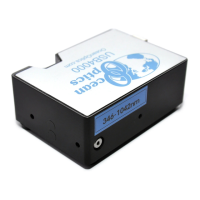
USB4000 Components Table
Ocean Optics permanently secures all components in the USB4000 at the time of manufacture. Only
Ocean Optics technicians can replace interchangeable components, where noted.
Item Name Description
1
SMA 905
Connector
Secures the input fiber to the spectrometer. Light from the input fiber enters the
optical bench through this connector.
2 Slit
A dark piece of material containing a rectangular aperture, which is mounted directly
behind the SMA Connector. The size of the aperture (from 5 µm to 200 µm)
regulates the amount of light that enters the optical bench and controls spectral
resolution.
You can also use the USB4000 without a Slit. In this configuration, the diameter of
the fiber connected to the USB4000 determines the size of the entrance aperture.
Only Ocean Optics technicians can change the Slit.
3 Filter
Restricts optical radiation to pre-determined wavelength regions. Light passes
through the Filter before entering the optical bench. Both bandpass and longpass
filters are available to restrict radiation to certain wavelength regions.
Only Ocean Optics technicians can change the Filter.
4
Collimating
Mirror
Focuses light entering the optical bench towards the Grating of the spectrometer.
Specify standard or SAG+.
Light enters the spectrometer, passes through the SMA Connector, Slit, and Filter,
and then reflects off the Collimating Mirror onto the Grating.
5 Grating
Diffracts light from the Collimating Mirror and directs the diffracted light onto the
Focusing Mirror. Gratings are available in different groove densities, allowing you to
specify wavelength coverage and resolution in the spectrometer.
Only Ocean Optics technicians can change the Grating.
6
Focusing
Mirror
Receives light reflected from the Grating and focuses first-order spectra onto the
detector plane.
7
L4 Detector
Collection
Lens
An optional component that attaches to the Detector to increase light-collection
efficiency. It focuses light from a tall slit onto the shorter Detector elements.
The L4 Detector Collection Lens should be used with large diameter slits or in
applications with low light levels. It also improves efficiency by reducing the effects
of stray light.
Only Ocean Optics technicians can add or remove the L4 Detection Collection Lens.
8
Detector
(UV or VIS)
Collects the light received from the Focusing Mirror or L4 Detector Collection Lens
and converts the optical signal to a digital signal. Each pixel on the Detector
responds to the wavelength of light that strikes it, creating a digital response. The
spectrometer then transmits the digital signal to the SpectraSuite application.
22 211-00000-000-02-0908


 To Next Page