Need help?
Do you have a question about the Oceanic VEO 100 and is the answer not in the manual?
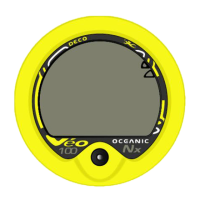
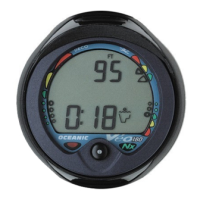
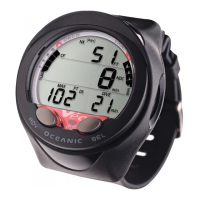
Welcome to the Veo 100 dive computer and guidance on using this operating manual.
Explains how the control button selects display options and accesses specific information on the Veo 100.
Details the Tissue Loading Bar Graph (TLBG) for nitrogen absorption and decompression status.
Covers various alpha-numeric displays: Depth, Time, Date, and Temperature, providing essential dive data.
Covers battery type, life expectancy, and low battery condition indicators for the Veo 100.
Explains automatic unit activation via water contact, and the importance of maintaining clean contacts.
Details the manual activation process, diagnostic mode checks, and serial number identification.
Covers backup automatic activation and the displays shown during the surface sequence.
Explains the Pre Dive Planning Sequence (PDPS) and accessing Set Mode for configuration.
Guides through setting Units, Hour Format, Time, Date, Gauge Mode, and Wet Activation preferences.
Explains how the Veo 100 functions as a digital depth gauge/timer without nitrogen calculations.
Describes dive mode bar graphs, ascent rate indicators, and how to control displayed information.
Details the No Decompression Dive Mode, its entry conditions, and main display variations.
Explains the safety stop procedure and display during No Decompression dives.
Explains when Decompression Dive Mode activates and its purpose in managing decompression obligations.
Details the main display for Decompression Dive Mode, including ceiling stops and total ascent time.
Describes the alternate display screens available for viewing additional information during Decompression Dive Mode.
Introduces Conditional, Delayed, and Immediate Violation Modes and their continuations.
Explains Delayed Violation Modes #1 and #2, their conditions, and associated display indicators.
Details Delayed Violation Mode #3 and entry into Immediate Violation and Violation Gauge Modes.
Describes Violation Gauge Mode, its display, and conditions for Permanent Violation.
Explains Surface Mode activation, the transition period, and accessing dive logs.
Details the Time to Fly and Time to Desaturate countdowns after the initial transition period.
Explains the PDPS after a dive and how the Veo 100 stores up to 12 dives in Log Mode.
Guides on accessing the Dive Identifier and Dive Data screens within Log Mode.
Describes display behavior after the first 2 hours post-dive, including Fly/Desaturate countdowns.
Explains the reset feature to clear data, including nitrogen calculations and log entries.
Provides guidelines for cleaning and protecting the Veo 100 module from damage and wear.
Advises on annual inspections by an Authorized Dealer for warranty and ongoing performance.
Details how to obtain service, return procedures, and warranty registration information.
Guides on removing the module from its boot and the critical procedure for battery replacement.
Details the correct installation of a new battery and inspection of components for sealing and damage.
Provides instructions on correctly reinserting the module into its protective boot after service or inspection.
Discusses unexpected display information loss, its importance, and the need for backup systems.
Lists the range and resolution for numeric displays, and special display occurrences.
Details bar graph segments, and speed ranges for the Variable Ascent Rate Indicator.
Covers accuracy, dive counting, and dive log storage capabilities of the Veo 100.
Details altitude limits, battery specifications, activation methods, and operating temperature.
Lists optional accessories available for purchase, such as lens guards and battery kits.
 General
| Display Type | LCD |
|---|---|
| Operating Modes | Air, Nitrox, Gauge |
| Audible Alarms | Yes |
| User Replaceable Battery | Yes |
| Nitrogen Tracking | Yes |
| Oxygen Tracking | Yes |
| Backlight | Yes |
| Logbook Capacity | 24 dives |
| Maximum Operating Depth | 100 meters |
| Ascent Rate Indicator | Yes |


 To Next Page