Need help?
Do you have a question about the Oceanic VEO 100 Nx and is the answer not in the manual?
Sensors transmit data to an Analog to Digital converter for processing.
Dive computers use algorithms for accurate profiles, recalculating frequently for better bottom time.
Oceanic PDCs simulate nitrogen absorption using mathematical models based on research.
The graph shows the controlling compartment, visible as stacked transparent displays.
Maximum time at current depth before entering a decompression situation.
At 75% power consumed, the indicator bar displays and flashes as a replacement warning.
Checks pressure and calibrates depth to zero; recalibrates at 2,000 ft+ for altitude.
Provides theoretical dive times for depths from 30-190 FT in 10 FT increments.
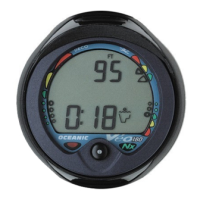
Shows Current Depth, Dive Time Remaining, Mode icon, and bar graphs.
'Backing off' the bar graph establishes personal conservatism and margin of protection.
A backup instrument system is highly recommended for critical dives.
May fly after 12 hr SI if no decompression was entered.
Stores up to 12 dives; oldest logs are overwritten. Transferring data is suggested.
Operates as AIR computer unless FO2 is set to a value between 21-50%.
Make a safe ascent to a depth slightly deeper than or equal to the required stop depth.
Open compartment in dry/clean environment; retain data if new battery inserted within 8 seconds.
No flying rule guarantees prevention of sickness; guidelines are best estimates for most divers.
Features include audible alarm, SmartGlo, OceanLog interface, Digital Gauge Mode, Date Stamp, 24 Dive Log.
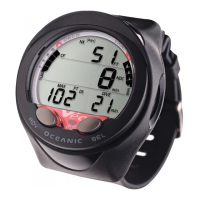
Packs VT3 features into a wristwatch; includes advanced digital watch functions.
 General
| Display Type | LCD |
|---|---|
| Operating Modes | Air, Nitrox |
| User Changeable Battery | Yes |
| Ascent Rate Indicator | Yes |
| Audible Alarms | Yes |
| Battery Type | CR2450 |
| Nitrox Compatibility | Yes |
| Battery Life | 300 dives |
| Water Resistance | 150 ft / 50 m |

 To Next Page