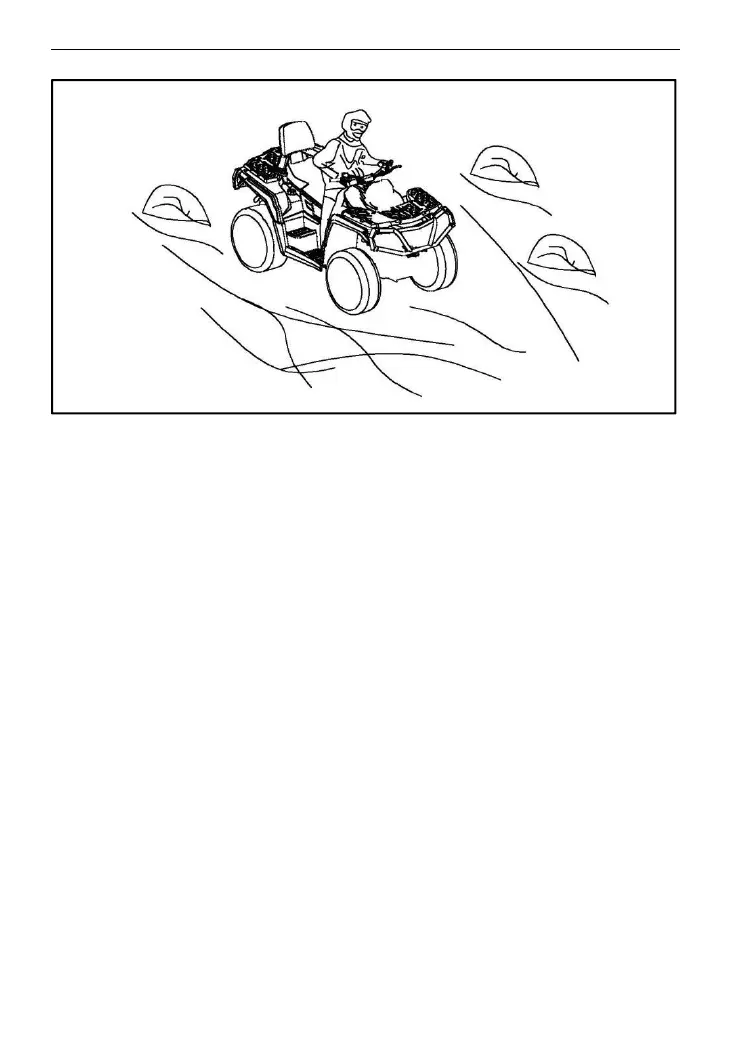
Mud or marsh lands may be encountered near water. Be prepared for sudden
'holes" or changes in depth. Similarly so, be watchful of hazards such as rocks,
logs, etc. partially covered by vegetation.
If your route crosses frozen waterways, make sure the ice is thick enough and
sound enough to support the total weight of yourself, the vehicle and its load.
Be ever watchful of open water, it is a sure indication that the ice thickness will
vary .If in doubt, do not attempt to cross.
Ice will also affect the control of the vehicle. Slow down and do not "qun" the
throttle. This will only result in spinning of the tires and possible tip over of the
vehicle. Avoid rapid braking. This again will possibly result in an uncontrolled
slide and tip over of the vehicle. Slush should be avoided at all times since it
could block the operation or controls of the vehicle.
Riding in snow may reduce the brakes stopping capability. Safely reduce speed
and allow greater distance for braking. Snow projection may cause ice build up
snow accumulation on brake components and controls. Apply brakes frequently
to prevent ice or snow accumulation. Refer to GENERAL OPERATING AND
SAFETY PRECAUTIONS in this subsection for more detailed information
regarding riding on snow covered surfaces.
Riding on sand, sand dunes or on snow is another unique experience, but there
are some basic precautions that should be observed. Wet, deep or fine
sand/snow may create a loss of traction and cause the vehicle to slide, drop off
or become bogged" down. If this occurs look for a firmer base. Again, the best
advice is to slow down and be watchful of the conditions.



 To Next Page