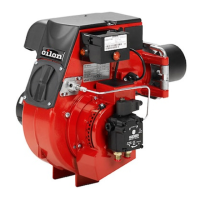
Need help?
Do you have a question about the Oilon Junior Pro 1 J10 and is the answer not in the manual?
Detailed visual representation of burner components and their assembly for identification.
Comprehensive listing of all burner parts with corresponding quantities required for maintenance.
Overview of burner types, installation requirements, electrical specifications, and nozzle types.
Reference table detailing burner capacity ranges in kg/h and kW for different models.
Guidance on interpreting the burner's name plate for model and serial number information.
Steps for securely attaching the burner to the boiler or furnace assembly.
Information on the burner's hinged housing for improved access and maintenance.
Instructions for correctly connecting the burner's electrical components.
Procedure for connecting the burner to the electrical mains supply via its plug connector.
Details on connecting the burner to the fuel oil delivery system.
Guidelines for installing oil pipes, considering viscosity, length, and material.
Description of oil pump functions, venting procedures, and maintenance.
Schematic illustrating the operational sequence with the BFP 21 L3 oil pump.
Schematic illustrating the operational sequence with the AS 47C oil pump.
Explanation of the burner's functional sequence from startup to normal running.
Procedures for adjusting the burner's thermal output by modifying nozzle or pump pressure.
Criteria and tables for selecting the appropriate nozzle for optimal performance.
Step-by-step guide to setting the oil pump pressure accurately.
Formulas and examples for calculating the burner's heating capacity based on settings.
A table listing nozzle capacities at different atomizing pressures and standards.
Correct positioning specifications for the nozzle and ignition electrodes.
Instructions for fine-tuning air velocity in the combustion head for specific models.
Procedures for setting the correct distance and alignment of the nozzle.
Method for adjusting combustion air for efficient combustion, including flue gas analysis.
Guide on how to observe and verify the burner's flame quality.
Visual representation of the control program's timing sequences for burner operation.
Explains how the control unit manages and responds to various fault conditions.
Key technical specifications like supply voltage, frequency, and fuse rating.
Details on measuring the current signal from the flame detector.
Method for measuring the flame signal using a multimeter.
Routine procedures for cleaning and inspecting burner components to ensure reliability.
Essential checks of the boiler and its environment for safe operation.
Troubleshooting steps for when the burner motor fails to initiate operation.
Diagnosing and resolving issues with the burner's ignition system.
Steps to address situations where the burner starts but fails to produce a flame.
Troubleshooting for problems related to the oil pump, including pressure and supply.
Addressing operational faults where the flame appears earlier than expected.
Resolving errors in the flame detection system that cause burner lock-out.
Troubleshooting steps for issues within the combustion head, like deposits or incorrect settings.
Covers miscellaneous causes for burner lock-out or poor combustion performance.
 General
| Fuel Type | Light oil |
|---|---|
| Pump Pressure | 10 bar |
| Motor Power | 0.18 kW |
| Voltage | 230V |
| Frequency | 50 Hz |
| Nozzle Angle | 60° or 80° (depending on model) |

 To Next Page