Need help?
Do you have a question about the Olympus DO and is the answer not in the manual?
Details of the main body component, including filter lever, clamp knob, and pointer knob.
Details of the binocular head component, including eyepiece sleeve and dioptric adjustment ring.
Details of the transformer unit, including power cord, voltage knob, pilot lamp, and main switch.
Instructions for attaching the main body of the observation attachment to the microscope.
Instructions for attaching the binocular heads to the main body.
Procedure for inserting the eyepieces into the binocular heads.
Connecting the primary and secondary cords to the transformer and projector.
Procedures for adjusting mechanical tube length for principal and sub-observers.
Instructions on how to operate and use the pointer feature.
Formula for calculating the observation magnification.
The Olympus Duo Observation Attachment, Model DO, is a specialized accessory designed to enhance the functionality of Olympus microscopes, specifically models FHA, EHA, and E, by enabling dual observation. This attachment allows two observers to view a specimen simultaneously, making it an invaluable tool for teaching, collaborative research, and consultation in various scientific and educational settings.
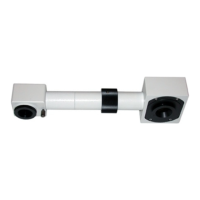
The primary function of the Olympus Duo Observation Attachment is to split the optical path from a single microscope, allowing two individuals to observe the same specimen at the same time. This is achieved through a main body unit that mounts onto the microscope in place of the standard viewing head, and two binocular heads that attach to the main body. The attachment also incorporates a pointer system, which allows one observer to highlight specific areas of interest within the field of view for the other observer, facilitating guided observation and discussion. A transformer is included to power the pointer's illumination. The system is designed to maintain a mechanical tube length of 160mm, ensuring compatibility with standard microscope optics.
The assembly process for the Duo Observation Attachment is straightforward. First, the existing viewing head of the Olympus microscope is removed. The main body of the Model DO attachment is then placed onto the microscope, secured with a mounting ring. Care must be taken during this step to avoid damaging the long, slim tube underneath the main body. The main body can be rotated 360 degrees and fastened in a preferred direction using a clamp knob. Next, the two binocular heads are attached to the sides of the main body, ensuring they are fastened tightly with their respective clamp knobs when the eyepiece tubes are in the uppermost position. It is crucial to ensure that the correct binocular heads are attached to avoid cutting off the marginal part of the view field. Eyepieces are then inserted into the sleeves of the binocular heads. Finally, the primary power cord of the transformer is connected to an AC outlet (compatible with 100V, 110V, 220V, or 240V), and the secondary cord from the projector tube on the main body is connected to the transformer.
Once assembled, the attachment requires adjustment for optimal viewing by both the principal observer and the sub-observer.
Principal Observer Adjustments:
Sub-Observer Adjustments:
The integrated pointer system is a key feature for collaborative observation.
The total observation magnification is calculated as: Objective magnification × Eyepiece magnification × 1.25. The 1.25 factor is inherent to the optical design of the Duo Observation Attachment.
While the manual primarily focuses on assembly and usage, some aspects imply maintenance considerations:
The Olympus Duo Observation Attachment, Model DO, is a robust and thoughtfully designed accessory that significantly enhances the utility of compatible Olympus microscopes by facilitating shared viewing and guided instruction, making it an indispensable tool for collaborative microscopy.
 General
| Type | Biological Microscope |
|---|---|
| Magnification | 40x - 1000x |
| Objective Lens | Achromatic |
| Objectives | 4x, 10x, 40x |
| Illumination | LED |
| Observation Methods | Brightfield |
| Eyepiece | 10x Widefield |
| Stage | Mechanical stage |
| Condenser | Abbe condenser NA 1.25 |
| Power Supply | 100-240V, 50/60Hz |


 To Next Page