FM Transmitter
Sistemas Electrónicos S.A EM 100 DIG
Technical Manual - v1.2 - November 2005 34
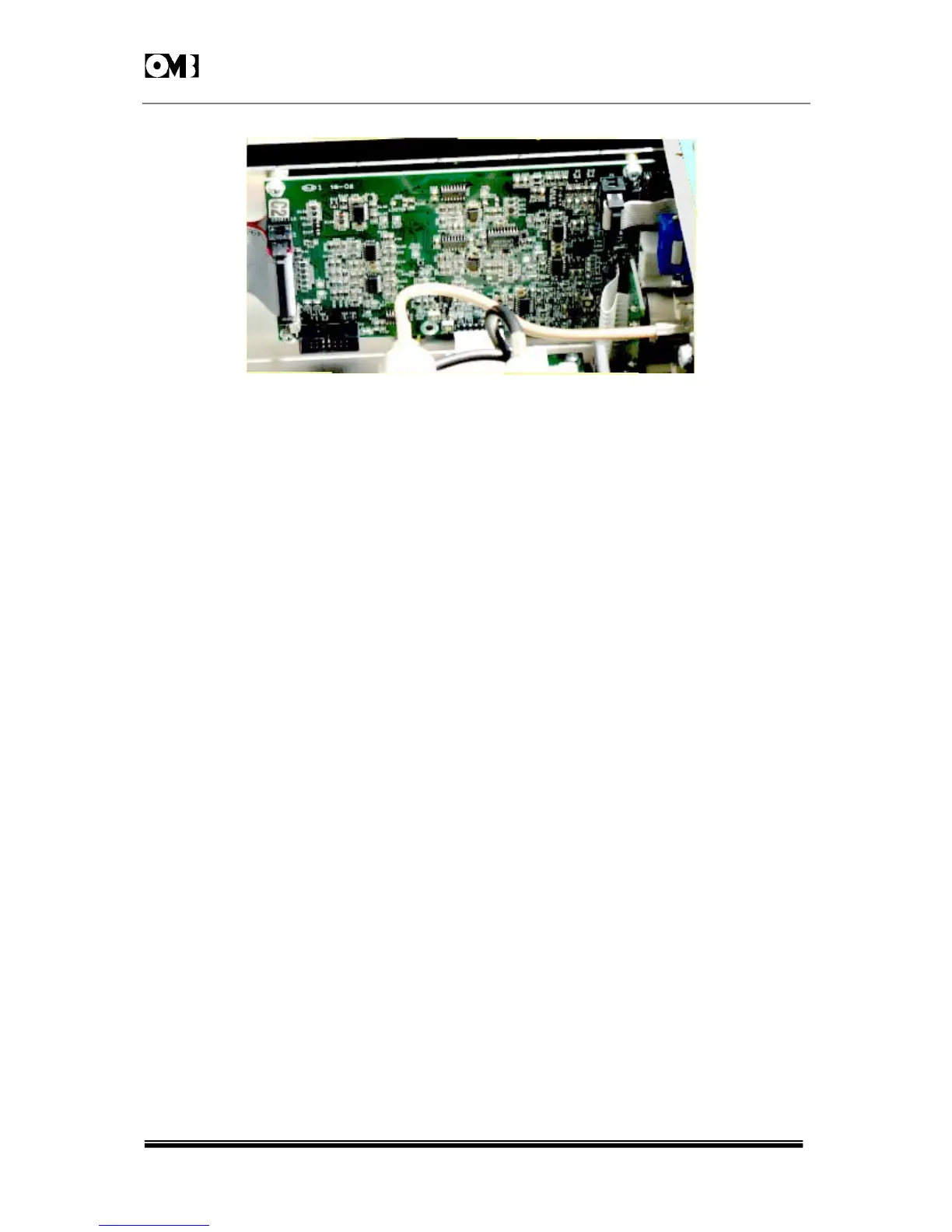
Figure 3-1: Main board.
On the lower right section of the diagram it is located the RF power controller.The RF forward and
reflected power signals coming from the output directional coupler (this located at RF Power
Module) are amplified by IC3 in a symmetrical circuit. The forward-power control circuit, built
around IC4a continuously drives the RF output stage gain, varying the bias supply voltage to the RF
output MOSFET transistor package. The reflected-power limiting circuit IC4b only acts on the same
loop when the IC3b output voltage is greater than the threshold set by the voltage on the R49/R50
network. A third and fourth section of IC4 filters and buffers the signal coming from the Microcontroller
and set the reference level for the output power loop. TR4 disables the RF output when the synthesizer
is not locked on the correct frequency.
In the upper right section of the sheet it is shown the control bus connector to the Microcontroller Unit,
which carries the digital control lines on the lower pins and the analog lines on the upper ones. From
this connector comes the power supply too: only +12.5V and -12.5V are used in the board.
Let's now go to the second sheet of this diagram. Beginning from the lower left side ,we find IC8,
which makes a 3-channel digitally controlled attenuator. It separately manages left, right and
auxiliary channel, while the external multiplex signal is processed in the same channel as the right
one. Three buffer/amplifiers follows each channel:IC7a, IC8a and IC12a. The output of the first two
amplifiers drive the pre-emphasis stages, whose time constants can be digitally set at 0, 50 and
75µs, through the analog gates of IC9. A limiter stage follows this arrangement, built around D8 and
D9 diodes acting as clippers. By acting on the limiter’s reference voltage driven by the
Microcontroller through IC13a, the limiter threshold level +Vl &-Vl can be adjusted. RT4,if present,
impose a top limit to the limiter.
The signal is then sent to the stereo-encoder circuit ’s input sections if present. At the same time, the
signal on the monaural right channel path is sent to a low-pass filter, consisting of the section built
around IC10 and IC11, which attenuates the frequencies above 15kHz.
The switch IC14 selects the signal issuing from the non-pre-emphasized input section through R124 or
from the pre-emphasis-and-filter section through R128 or from the stereo-encoder through R131.
IC12b buffers the chosen signal and mixes it with that issuing from the auxiliary channel. When
required, the diode D17 further limits the resulting total signal. The latter is then sent to the FM
modulating/exciting circuit via IC12c buffer circuit and adjusted in level by RT6 as required. A
separate section of IC12 separately buffers the modulation signal for monitoring purpose,and sends
it to the modulation output connector.
IC15 deserialize the digital signal sent by the Microcontroller, to control the transmission channels with
IC14 and preemphasis action with IC9. Two output lines from IC15 are used to latch the remote
output lines "FAIL"and "ON THE AIR".


 To Next Page