Need help?
Do you have a question about the Omron D2F and is the answer not in the manual?
Explains how to interpret model number codes for switch selection.
Details electrical ratings for different switch models under various conditions.
Expected number of operations before failure.
Details the material used for switch contacts.
Reference values for mechanical lifespan based on operation count.
Reference values for electrical lifespan based on operation count.
Overviews of dimensions for different model types.
Guidance on soldering lead wires to terminals.
Advice on proper mounting and operation.
Guidelines for proper mounting procedures.
Explains the use and types of contact protective circuits.
Common electrical failure modes and their causes.
Common mechanical failure modes and their causes.
The Omron D2F Ultra Subminiature Basic Switch is a compact and versatile component designed for a wide range of applications, particularly those requiring precise and reliable switching in a small form factor. Its subminiature size makes it ideal for mounting on printed circuit boards (PCBs), facilitating integration into densely packed electronic assemblies.
At its core, the D2F switch operates on a snapping mechanism, meticulously crafted with two highly precise split springs. This design ensures a long service life and consistent performance, critical for applications where reliability is paramount. The switch is capable of handling both general and micro loads, offering different models tailored to specific current requirements (3A, 1A, and 0.1A). This flexibility allows it to be used in diverse circuits, from those controlling larger power components to sensitive electronic signals.
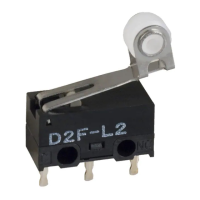
The D2F series offers various actuator types to suit different operational needs. These include the standard pin plunger, hinge lever, hinge roller lever, and simulated roller lever. Each actuator type provides a distinct mechanical interface for activation, allowing designers to select the most appropriate option based on the physical interaction required by their application. For instance, pin plunger models are suitable for direct, linear actuation, while lever types are ideal for applications involving cams or other rotating mechanisms.
Terminal configurations are also diverse, ensuring compatibility with various PCB assembly methods. Options include standard PCB terminals (straight), self-clinching PCB terminals for secure mounting, right-angled and left-angled PCB terminals for space-constrained layouts, and solder terminals (both standard and compact) for traditional wiring. This broad selection simplifies integration into different manufacturing processes and design constraints.
The D2F switch is engineered for ease of use and robust performance in various environments. Its insertion-molded terminals and a two-stage bottom design with different levels are specifically incorporated to prevent flux penetration during soldering, a common issue that can compromise switch reliability. This feature contributes to cleaner assembly and reduced potential for contact failure.
The availability of self-clinching, right-angled, left-angled, and solder terminals provides significant flexibility in PCB layout and wiring. Designers can choose the terminal type that best fits their space requirements and assembly preferences, optimizing both the physical design and manufacturing efficiency.
The switch is designed to meet a broad spectrum of application needs. It is commonly found in home appliances, where its reliability and compact size are beneficial for internal controls. In audio equipment, its consistent switching performance contributes to signal integrity. For office machines and communications equipment, the D2F's durability and precise operation support the demanding requirements of continuous use and data handling.
The operating characteristics, such as operating force (OF), release force (RF), pretravel (PT), overtravel (OT), and total travel position (TTP), are carefully defined for each actuator type and model. These parameters allow designers to precisely integrate the switch into their mechanical systems, ensuring optimal actuation and release. For example, models with lower operating forces are suitable for applications requiring lighter touch or reduced mechanical stress.
The switch's durability is a key feature, with mechanical durability rated for millions of operations, ensuring a long operational lifespan. Electrical durability is also specified for various loads, providing confidence in its performance over time. The degree of protection, rated at IEC IP40, indicates resistance to solid objects, making it suitable for environments where dust ingress needs to be managed.
While the D2F switch is designed for long-term reliability, the manual provides crucial guidelines for proper installation and usage to maximize its lifespan and prevent common issues.
For terminal connection, specific instructions are given for soldering, including recommended soldering iron wattage, tip temperature, and soldering duration. These precautions are vital to prevent abnormal heating, deterioration of switch characteristics, and potential damage to the switch or its housing. The manual emphasizes preventing flux and solder liquid from exceeding the PCB level, as this can lead to contact failure.
Mounting guidelines are detailed, recommending M2 mounting screws with plane or spring washers and specifying a tightening torque range. This ensures secure mounting without deforming the switch housing, which could lead to faulty operation. The importance of mounting the switch on a flat surface is highlighted to prevent deformation and ensure proper functionality.
Operating stroke setting is a critical aspect of maintenance and installation. For pin plunger models, it is advised to set the operating stroke between 70% and 100% of the rated OT distance. Exceeding the OT distance can deteriorate the switch's durability. For lever models, proper cam or dog design is recommended to ensure smooth actuation and prevent shock, which can damage the actuator and reduce durability.
The manual also addresses environmental considerations, advising against applying oil, grease, or other lubricants to sliding parts, as these can cause operating or contact failure. It also warns against using the switch in environments with continuous vibration, shock, corrosive gases, or high temperature and humidity, which can lead to contact failure, malfunction, or corrosion.
For applications involving micro loads, specific models (D2F-01) are recommended, and the use of contact protective circuits is advised to mitigate the effects of inrush current and extend durability. The manual provides detailed examples of contact protective circuits (surge killers) for both AC and DC loads, including CR circuits, diode methods, and varistor methods, along with guidance on element selection. These circuits help suppress arcs, prevent noise, and reduce contact abrasion, thereby enhancing the switch's reliability and lifespan in demanding electrical conditions.
Finally, a comprehensive troubleshooting guide is provided, outlining possible causes and corrective actions for common issues such as contact failure, malfunction, contact welding, insulation degradation, operating failure, low durability, and damage during mounting or wiring. This resource helps users diagnose and resolve problems efficiently, ensuring the continued optimal performance of the D2F switch.
 General
| Contact Form | SPDT |
|---|---|
| Contact Rating | 0.1 A at 30 VDC |
| Mechanical Life | 10, 000, 000 operations min. |
| Electrical Life | 100, 000 operations min. |
| Type | Micro Switch |
| Contact Resistance | 100 mΩ max. |
| Insulation Resistance | 100 MΩ min. (at 500 VDC) |
| Operating Force | 0.74 N {75 gf} |
| Operating Temperature | -25°C to 85°C |
| Release Force | 0.15 N (15 gf) min. |

 To Next Page