10
I/O Configuration and Main Functions Section 1-2
1-2-2 Main Functions
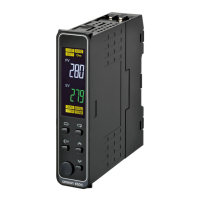
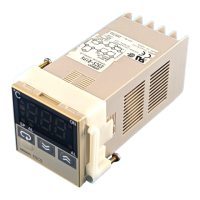
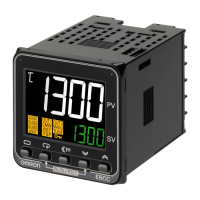
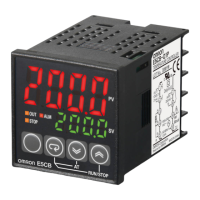
This section introduces the main E5CN/CN-U/AN/EN/GN functions. For
details on particular functions and how to use them, refer to SECTION 3 Basic
Operation and following sections.
Input Sensor Types • The following input sensors can be connected for temperature input
(i.e., E5_N-@@@@T):
Thermocouple: K, J, T, E, L, U, N, R, S, B, W, PLII
Infrared temperature sensor: ES1B
10 to 70°C, 60 to 120°C, 115 to 165°C,
140 to 260°C
Platinum resistance thermometer: Pt100, JPt100
Analog input: 0 to 50 mV
• Inputs with the following specifications can be connected for analog input
(i.e., E5_N-@@@@L):
Current input: 4 to 20 mA DC, 0 to 20 mA DC
Voltage input: 1 to 5 VDC, 0 to 5 V DC, 0 to 10 V DC
Control Outputs • A control output can be a relay, voltage (for driving SSR), or current out-
put, depending on the model.
• Long-life relay outputs (see note) use semiconductors for switching when
closing and opening the circuit, thereby reducing chattering and arcing
and improving durability. However, if high levels of noise or surge are
imposed between the output terminals, short-circuit faults may occasion-
ally occur. If the output becomes permanently shorted, there is the danger
of fire due to overheating of the heater. Design safety into the system,
including measures to prevent excessive temperature rise and spreading
of fire. Take countermeasures such as installing a surge absorber. As an
additional safety measure, provide error detection in the control loop.
(Use the Loop Burnout Alarm (LBA) and HS alarm that are provided for
the E5@N.)
Select a surge absorber that satisfies the following conditions.
• Always connect an AC load to a long-life relay output (see note). The out-
put will not turn OFF if a DC load is connected.
Note Long-life relay outputs are not supported for the E5GN.
Alarms • Set the alarm type and alarm value or the alarm value upper and lower
limits.
• If necessary, a more comprehensive alarm function can be achieved by
setting a standby sequence, alarm hysteresis, auxiliary output close in
alarm/open in alarm, alarm latch, alarm ON delay, and alarm OFF delay.
• If the Input Error Output parameter is set to ON, the output assigned to
alarm 1 function will turn ON when an input error occurs.
Voltage used Varistor voltage Surge resistance
100 to 120 VAC 240 to 270 V 1,000 A min.
200 to 240 VAC 440 to 470 V
1
2
Long-life
relay output
Varistor
Varistor
Inductive
load



 To Next Page